|
Home>News Center>Life | |
|
|
|
|
|
|
|
|
|
|
|||||||||||||||||||||||||||||||||||||||||||||||||||||||||||||||||||||||||||||
|
|
Too tall and too close for comfort
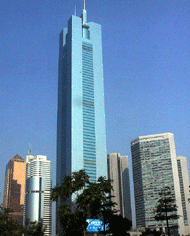
High-rise buildings continue to sprout unabated in the major urban centres of China, bringing to the fore public concerns about their height and density.
But critics say an unchecked building blitz destroys the landscape of historic cities and bring along attendant problems such as traffic congestion, high energy usage and pollution as well as potential damage from earthquakes and fires. In Beijing, a city with a history of more than 3,000 years, a slew of skyscrapers - including the controversial 230-metre-tall China Central Television building and the third phase of the World Trade Centre that is expected to reach 330 metres - will in a few years dwarf the 209-metre Jingguang Centre, built in the early 1980s and the tallest building in the city for more than a decade. Beijing faces a dilemma common to many cities worldwide - the need to safeguard the past while continuing to build the future. "It is not wise for Beijing to build more high-rises blindly, and the city needs to draw up regulations to limit the competitive construction of skyscrapers," Zhao Zhijing, a renowned urban planning expert, was quoted by local media as saying. Mao Qizhi, a construction professor at Tsinghua University, said Beijing had announced several regulations in the 1990s to limit the height of buildings. For instance, buildings over 60 metres tall are not allowed in the old city area. "However, these rules were not observed strictly at that time and many buildings more than 100 metres high have already risen in the downtown area," said Mao. "We do not just simply say 'No' to the construction of high-rises; after all, skyscrapers are widely regarded as important marks of a city's development," Mao said. "But the city should have a scientific design and layout. In Shanghai and Guangzhou, high-rises pose an additional risk: subsidence. In the former, for example, skyscrapers are blamed for the city sinking about 1.5 centimetres annually." Municipal authorities in Shanghai, however, rose to the challenge of providing more public space in the downtown area. They managed to reduce 3,700,000 square metres of floor space, about a sixth of the total, from 376 approved projects and added more than 210,000 square metres of green land by the end of last year. "We talked to the real estate developers, asking them to either adjust the height and density of their projects or move them to other less populated areas," said Mao Jialiang, director of the Shanghai Urban Planning Administration Bureau. "New projects are approved only when their height and density strictly conform to our requirements." High rises are also to blame for air pollution and energy wastage, worsening environment, and are bad to health, said Cai Zhenyu, chief architect of the East China Architectural Design and Research Institute. In Guangzhou, the density of the high-rises has caught the attention of members of the Guangzhou Municipal Committee of the Chinese People's Political Consultative Conference and deputies to the Municipal People's Congress. In the pipeline is a draft resolution seeking to limit the height of buildings downtown. They say that the densely erected high-rises have triggered a series of environmental and traffic problems which could be aggravated if tall buildings continue to mushroom. Primarily owing to the dense high-rises, they said, the city suffered from smoggy and hazy weather for 144 days in 2004; 98 days in 2003; and 85 days in 2002. The smog helps respiratory diseases gain ground, they added. In an interview yesterday, Wang Yingchi, deputy director of the Guangzhou Urban Planning Design Research Institute, said density, rather than the height, of high-rises would be the focus of attention in the city's urban planning. According to the deputy director, the State has regulations limiting the density of high-rises; however, there is no such law as to limit the height of buildings in the nation. If the regulations had been executed well, there would not have been so many problems, he said. The State's regulations state that the distance between two buildings must be 0.7 time to twice the height of the building, or a 100-metre high building must be at least 70 metres away from the other. He suggested that the local government should consider incentives or preferential policies for property developers if they will develop projects more sparsely. An official with the municipal urban planning bureau, who did not want to be identified, said the municipal authorities have realized the problems and have been taking a more cautious attitude towards urban planning. Citing an example, he said none of the buildings at Science Town in the east of the city are high-rises and are built well apart, leaving space for green belts.
|
|
|
|
|
||||||||||||||||||||||||||||||||||||||||||||||||||||||||||||||||||||||||||
|
|
|
|
|||||||||||||||||||||||||||||||||||||||||||||||||||||||||||||||||||||||||||||