|
Home>News Center>China | |
|
|
|
|
|
|
|
|
|
|
||||||||||||||||||||||||||||||||||||||||||||||||||||
|
|
US-China summits' high stakes
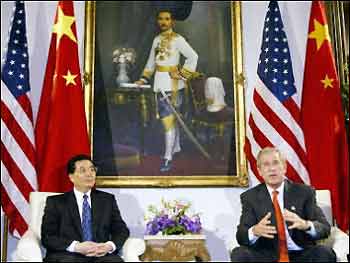
U.S. President George W. Bush and Chinese President Hu Jintao are expected to hold a series of high-level meetings later this year, opportunities to defuse disagreements over the valuation of China's currency, U.S. trade deficit and how to deal with North Korea, the BusinessWeek Online reported. Bush and Hu will meet briefly this month at the Moscow celebration of the 60th anniversary of the end of World War II. And, a source familiar with Bush administration reveals when Hu comes to the U.S. in September for the opening of the UN General Assembly in New York, he'll travel to Washington for a formal state visit.
BusinessWeek Online quoted analysts as saying the autumn summits will mark a healthy development in what's arguably the most important bilateral relationship for the 21st century. "This is really an unprecedented level of interaction at this level," says David M. Lampton, a China expert at the Johns Hopkins University. "Despite all the kinds of frictions that are very much in the news, this relationship seems to be getting institutionalized," Lampton said. Below the Presidential level, Deputy Secretary of State Robert Zoellick is chairing a strategic dialogue that will deal with a broad array of topics, from the environment to infectious diseases. And Commerce Secretary Carlos Gutierrez and U.S. Trade Representative Robert Portman are heading a U.S.-China Commission on Commerce & Trade. Kenneth Lieberthal, a China hand who served in the Clinton Administration and is now at the Brookings Institution, notes that a revalued yuan in theory would make exports to the U.S. more expensive, reduce imports, and lower the U.S. trade deficit. But because so much of what China sells in the U.S. is made up of parts that China imports, a stronger yuan would make those parts cheaper to buy. So the net impact of an appreciated RMB yuan might be negligible at best. What's more, those parts come from U.S itself and its allies, so any U.S. trade sanctions that crimp China could end up with significant collateral damage. "We can't punish China much economically without punishing our friends," Lampton said. Likewise, so-called six-party talks on curbing North Korea's nuclear weapons are headed nowhere. The talks are supposed to include Russia, Japan, South Korea, the U.S., and China. But sixth participant North Korea is boycotting the discussions, so none have been held this year. "I see no prospect that the North Korea nuclear (talks are) even on a track toward resolution," Lampton says. Washington and Beijing have an interest in seeing them at least limp along. That way, neither side will blame the other for their failure. While the dim prospect of negotiations flickers, it smooths over sharp differences between the two countries' interests. China wants stability on the Korean pennisula, while the U.S. would like regime change. "The U.S. is more willing to squeeze North Korea than China is," Lieberthal says. So China might block economic sanctions against Pyongyang that Washington wants. That could transform the nuclear issue "from being a major bridge between the U.S. and China to being a source of a fair amount of friction," Lieberthal notes. If the North conducts a nuclear test, however, China might line up with the U.S. in a solid phalanx. While Bush and Hu have many shared interests that are critical to global economic and diplomatic stability, they're also meeting because they have built up a constructive relationship that goes far beyond the bonds formed after 9/11. Both leaders appear to be intrigued by the potential upside of the relationship -- if they don't focus solely on the frictions. "That helps keep the relationship on an even keel," Lieberthal says. The summits may contribute to that. Such meetings often are disparaged as pageantry with little substance. But the U.S.-Chinese gabfests may serve a great purpose even if they produce few concrete initiatives. They could provide a rare opportunity for an existing power to help manage the entry onto the world stage of a rising power -- a transition that has historically been poorly handled almost every time. A positive result is more likely if Washington and Beijing can continue to tap the potential upside of their relationship. But if it shrinks in the coming months and years, it will be harder and harder to paper over growing sources of friction, said the BusinessWeek Online report. |
|
|
|
|
|||||||||||||||||||||||||||||||||||||||||||||||||
|
|
|
|
||||||||||||||||||||||||||||||||||||||||||||||||||||