<tt id="6hsgl"><pre id="6hsgl"><pre id="6hsgl"></pre></pre></tt>
          <nav id="6hsgl"><th id="6hsgl"></th></nav>
          国产免费网站看v片元遮挡,一亚洲一区二区中文字幕,波多野结衣一区二区免费视频,天天色综网,久久综合给合久久狠狠狠,男人的天堂av一二三区,午夜福利看片在线观看,亚洲中文字幕在线无码一区二区
            Home>News Center>World


          Japan PM to call election after postal defeat
          (Reuters)
          Updated: 2005-08-08 13:33

          Japanese Prime Minister Junichiro Koizumi will call an election for September 11, his coalition partner said on Monday after parliament's upper house rejected bills to privatise the postal system -- the core of Koizumi's reforms.

          The prime minister's bitterly divided Liberal Democratic Party, which has governed for most of the past half century, is also in danger of losing at the polls for the powerful lower house, politicians and analysts say, reported Reuters.

          Japanese Prime Minister Junichiro Koizumi waves as he arrives at his official residence in Tokyo August 8, 2005. [Reuters]
          Japanese Prime Minister Junichiro Koizumi waves as he arrives at his official residence in Tokyo August 8, 2005. [Reuters]
          Takenori Kanzaki, leader of junior ruling coalition party, the New Komeito, told reporters after a meeting with Koizumi that the election would be held on September 11, infuriating party rebels who had insisted that Koizumi should resign instead.

          "There is no justification. It's like suicide bombing," said LDP lower house lawmaker Housei Norota, who had opposed the bills to privatise Japan Post, a sprawling giant that has some $3 trillion in assets and includes the world's biggest deposit-taking institution.

          The defeat of the legislation raised concerns in financial markets that the reforms Koizumi pledged to implement when he swept into power in 2001 would be stalled.

          "It's a very sad day for the reform story of Japan, because with this vote, it's essentially over and the effects of this will be felt in the years to come," said Kirby Daley, a strategist at Societe Generale Securities' Fimat division.

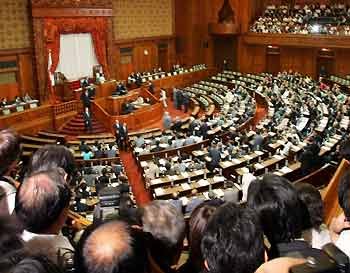
          Japanese lawmakers cast their ballots in a key vote on bills to privatise the postal system as local media crowd around the assembly hall at the Upper House of Parliament in Tokyo August 8, 2005. Prime Minister Junichiro Koizumi suffered a big defeat on the vote, and will call a snap election for parliament's powerful lower house, public broadcaster NHK said.
          Japanese lawmakers cast their ballots in a key vote on bills to privatise the postal system as local media crowd around the assembly hall at the Upper House of Parliament in Tokyo August 8, 2005. Prime Minister Junichiro Koizumi suffered a big defeat on the vote, and will call a snap election for parliament's powerful lower house, public broadcaster NHK said. [Reuters]
          Others were less pessimistic.

          "Koizumi tried to achieve reform within the LDP framework. He said that was possible. But he couldn't do that, so that means reform is only possible if there is a change in government," said Yasunori Sone, a political science professor at Keio University.

          The bills were rejected in the upper house by a vote of 125 to 108. Media said more than 20 LDP members had voted against the legislation.

          The spectre of political confusion in the world's second-biggest economy also made financial markets nervous.

          The yen and Japanese share prices fell when the results of the vote were known. The Japanese currency quickly recovered most of its losses, however, and the Nikkei share average was later trading in positive territory well above the day's lows.

          SCENARIOS FOR CHAOS

          The bills would have split Japan Post into four units under a state-owned holding company in 2007. Insurance and savings businesses were to have been sold off by 2017.

          Koizumi, who leapt to power promising reform and is now Japan's longest-serving prime minister in two decades, had said privatisation was vital to make investment flows more efficient and remove distortions from the financial system.

          The insurance business alone is as big as Japan's four biggest life insurers combined.

          But many in the LDP feared privatisation would weaken their political machines, which have long relied on powerful rural postmasters to get out the vote and on the postal system's assets to fund popular but wasteful public works.

          Japanese Economics Minister Heizo Takenaka, also minister in charge of postal privatisation, bows after the Upper House of Parliament rejected a bill to privatise the postal system August 8, 2005 in Tokyo. The rejection is a big loss for the nation and its economy, Takenaka said.
          Japanese Economics Minister Heizo Takenaka, also minister in charge of postal privatisation, bows after the Upper House of Parliament rejected a bill to privatise the postal system August 8, 2005 in Tokyo. The rejection is a big loss for the nation and its economy, Takenaka said. [Reuters]
          Japan Post has nearly 25,000 offices and 260,000 employees.

          Scenarios for political confusion following the defeat abound, including the mirror image of a 1993 drama in which pro-reform rebels bolted the LDP and the party lost an election and was ousted, albeit briefly.

          This time, though, the rebels are anti-reform.

          Analysts say the centrist main opposition Democratic Party has a shot at winning an election, but it would need help from other parties to get legislation through the upper house.

          "With the split of the LDP, the Democrats stand to gain. But the need a big victory," Sone said. "They need to win a majority. That's more difficult, but this is a huge chance."

          LDP anti-reformers have threatened to form a new party, although they might cooperate with the LDP. Coalition partner New Komeito has hinted it might switch sides if the Democrats become the top party but lacked a majority.


          Japanese PM launches general election campaign
          Katrina slams US Gulf Coast, oil rigs adrift
          Japan's 6 parties square off in TV debate
           
            Today's Top News     Top World News
           

          President Hu Jintao: Gender equality crucial


          Special grants offered to poor students


          EU takes steps to unblock China textiles


          Farmers sue county for illegal land use


          Search for 123 trapped miners suspended


          Hurricane Katrina rocks New Orleans


            Bush promises post-storm help for victims
             
            Sharon: Not all settlements in final deal
             
            Hurricane Katrina rocks New Orleans
             
            Sri Lanka PM focuses on ending civil war
             
            Musharraf warns Pakistan Islamic schools
             
            Katrina may cost insurers $25 bln
             
           
            Go to Another Section  
           
           
            Story Tools  
             
            Related Stories  
             
          Japan PM faces postal showdown, may call election
            News Talk  
            Are the Republicans exploiting the memory of 9/11?  
          Advertisement
                   
          主站蜘蛛池模板: 天天躁夜夜躁狠狠喷水| 久久国产精品一国产精品金尊| 国产精品女同性一区二区| 99热精国产这里只有精品| 亚洲精品国产精品国自产小说| 日韩本精品一区二区三区| 内射视频福利在线观看| 18禁无遮拦无码国产在线播放| 岛国av在线播放观看| 亚洲黄色性视频| 久久国产精品成人影院| 在线精品视频一区二区三四| 蜜臀av无码一区二区三区| 亚洲啪AV永久无码精品放毛片| 国产一区二区三区我不卡| 激情综合色区网激情五月| 亚洲老熟女乱女一区二区| 日韩在线视频网| 欧美成人黄在线观看| 最新永久免费AV无码网站| 亚洲AV无码国产永久播放蜜芽| 国产亚洲综合欧美视频| 亚洲日本精品一区二区| 久久精品国产再热青青青| 亚洲欧美综合人成野草| 久久99精品久久久久久9 | 欧美色丁香| 亚日韩精品一区二区三区| 日区中文字幕一区二区| 天堂a无码a无线孕交| 亚洲精品欧美综合二区| 亚洲一区精品视频在线 | 久久精品国产热久久精品国产亚洲| 国产精品98视频全部国产| 成人午夜福利一区二区四区 | 国产高潮刺激叫喊视频| 91密桃精品国产91久久| 亚洲人成日本在线观看| 亚洲日本中文字幕天天更新| 91中文字幕一区在线| 亚洲中文久久久久久精品国产|