|
Drama 'Teahouse' wows American audiences
By Raymond Zhou (China Daily)
Updated: 2005-11-16 07:27
WASHINGTON DC: Every town in America has at least one Chinese restaurant, but
Beijing-style teahouses?
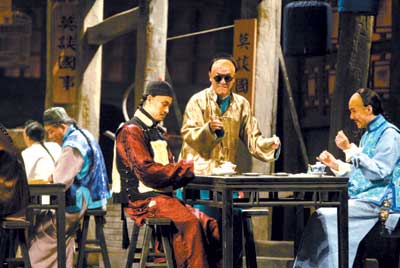
A scene from
"Teahouse," staged by Beijing People's Art Theatre, is known on the stage
of the Kennedy Center for Performing Arts in Washington DC in late
October. [Xinhua] |
That is definitely a first even in the shape of Lao She's immortal play put
on by the Beijing People's Art Theatre.
When the curtains rose at the Kennedy Center for Performing Arts in
Washington DC in late October, the sight of a bustling Beijing teahouse, circa
1898, took audiences by surprise. "It was visually stunning," said Alicia Adams.
Adams, Kennedy Center's vice-president of international programming, was
instrumental in bringing this production to the United States. She first saw the
play two years ago in Beijing, but had already zeroed in on it a year or two
earlier.
"I had always been impressed by the artistry of the company, and knew
immediately I would want it in our festival during my preliminary research on
arts and artists in China," she told China Daily in a recent interview.
Path-breaking
"Teahouse" is the first Chinese drama production to be presented in the US,
said Lin Zhaohua, artistic director of the Beijing People's Art Theatre. It is
part of the Kennedy Center's Festival of China with more than 50 performances
including three symphony orchestras, a ballet and the China National Peking
Opera.
The difficulty of presenting a Chinese-language play was obvious. "I was
worried that audience here would have the language barrier," admitted Lin
Zhaohua during the Houston leg of the tour.
"But after performing on both coasts, I can tell you that American audiences
have been more responsive than a typical Beijing audience."
Lin credited the success partly to the excellent subtitles, based on a
translation by the late Ying Ruocheng (1929-2003), a veteran of the company who
was himself in the original cast.
But there were other forces at play as well. To start with, a significant
portion of the audience was Chinese American, with various degrees of
familiarity with the language. For those curious about a Chinese play but with
no prior knowledge, the Kennedy Center had educational programmes before the
opening and even a panel discussion with the actors on board.
"Our audiences could gain an insight into the background of the play as well
its performance history," said Adams.
For the rest of the tour, which will go around the United States until late
November, local presenters also are holding seminars to shed more light on the
play.
In places such as Houston, local Chinese-language media have been providing
continuous coverage even before the troupe arrived, turning the play into a
focus of attention for the community as well as an opportunity for greater
cultural awareness.
But most of all, Adams and presenters like her want to arouse interest in an
authentic Chinese play among a Western audience, "done in its original
language," she emphasized, and they are willing to take the risks.
Although one can never expect such an endeavour to be as popular as Chinese
acrobatics or Peking opera, Adams felt this was the right time to expose
American lovers of performing arts to the excellence of a Chinese masterpiece.
To achieve the best possible attendance, the Kennedy Center kept ticket
prices affordable. At US$22-55 apiece, the house was sold-out.
Making it happen
Prices were somewhat higher in other cities because "we do not have any
government subsidy," said Yang Jun, an official at the Chinese Civic Center, a
Houston-based community group.
It was a daunting task to get a 58-person performing arts troupe from China
to tour in the United States. "The props alone take two trailers and have to be
driven from one city to another," explained Yang.
As participation in the Kennedy Center's Festival of China was part of an
official cultural exchange programme, the Chinese Government covered artists'
fees and international airfare. The Kennedy Center paid all the costs after the
company landed in Washington DC, which included transportation, hotel, daily as
well as production and marketing expenses, disclosed Alicia Adams.
Despite the full-house turnout, the cost could in no way be covered from the
ticket proceeds. "It was deficit spending," she said. "But we made sure
everybody who was interested would have access to it." This is contrary to the
practice in China where presenters typically push up prices to sky-high levels
to establish the production as a first-class one, at the expense of leaving
seats unfilled.
To maximize the reach of the production, Adams called up the Berkeley
Repertory Theatre and arranged the tour venues. In fact, once the Kennedy Center
performance was finalized, performing arts agents and representatives around the
US came forward with more offers.
Just as other shows from the festival, the "Teahouse" company also went on
tour "most of the legs arranged by itself," said Adams.
Performances outside the Kennedy Center have had to rely on ticket sales and
private funding, which is called "people-to-people cultural exchange" or
"commercial performances" in diplomatic parlance.
Future shows
Now that American audiences have a taste of an authentic Chinese play, would
more productions be forthcoming?
"This opens the door," said Adams, who thought the Kennedy Center's
invitation to three Chinese orchestras was even more risky.
"We are committed to theatre productions that are done in the native
languages. It's important that Americans hear other languages and see what is
being produced in other parts of the world. We've done it in Spanish, Portuguese
and some African languages."
A few years ago, a performing arts festival at the Lincoln Center in New York
staged a massive production of "Peony Pavilion," a Chinese play more "ancient"
or "classic" than "Teahouse." Originally a Shanghai company was to participate,
but it was substituted by an ad-hoc group of Chinese American performers, due to
reasons other than artistic.
Lin Zhaohua, current director of "Teahouse," is also confident about future
exchanges. American and European presenters are interested in Chinese plays, he
said, but he would like to see not only classics like "Teahouse" being
"exported," but also contemporary fare like "Nirvana of the Uncle Dog."
Since its premiere in 1958, "Teahouse" has had a cumulative run of more than
500 shows, which is a rare triumph in China. However, successful plays,
especially musicals, tend to have much longer runs in the United States.
Broadway shows customarily play eight times a week and run for months and
even years. Will "Teahouse" and other classics run continuously in a city like
Beijing, at least a few months a year?
Lin did not hold his hope high. "In China, a play like that has to have big
stars to draw people in night after night. But it's impossible to have actors
like Pu Cunxin and Song Dandan all the time." This is a reference to two of the
stars in the current cast who are better known because of their television
appearances.
"But we can produce four to five new plays each year and one to two from the
old repertory," he added.
Asked whether he needed to tone down some of the Beijing dialect for the sake
of understanding since even audiences of Chinese descent could be from Hong Kong
or Taiwan, Lin laughed: "No, I didn't change a thing. It's just as it's played
in Beijing and people are fascinated by it."
This was confirmed by Adams, who said audiences at the Kennedy Center "deeply
appreciated the work."
However, she had one regret and that is the play's ending, when the
proprietor of the teahouse commits suicide after years of struggle.
"That's a startling thing to see. I don't think Chinese people will ever give
up on themselves. Their resilience has been historically spectacular," she said.
"Every time you think there's been defeat, they rise again. They've continued to
progress and become stronger as a people."
Adams sounded the same note of optimism when she voiced hope of growing
acceptance of Chinese performing arts in the United States.
(China Daily 11/16/2005 page13)
|