|
Beijing's hutongs
( chinadaily.com.cn)
Updated: 2004-01-14 14:24
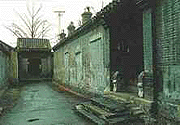 The word hutong came from the Mongolian language about 700 years ago. The original Mongolian word was hottog, meaning " water well." In other words, it means a place where people live, because people always gather where thereis water. Today in Beijing, the word hutong means a small alleyway or lane. They are typical of the old part of Beijing and are formed by lines of siheyuan (a compound made up of rooms around a courtyard ) in which most Beijing residents used to live. The word hutong came from the Mongolian language about 700 years ago. The original Mongolian word was hottog, meaning " water well." In other words, it means a place where people live, because people always gather where thereis water. Today in Beijing, the word hutong means a small alleyway or lane. They are typical of the old part of Beijing and are formed by lines of siheyuan (a compound made up of rooms around a courtyard ) in which most Beijing residents used to live.
In old China, there were clear definitions of what was a street and what was a lane. A 36-metre-wide road was called a big street and an 18-metre-wide road was called a small street. A 9-metre-wide lane was called a hutong. Most of the hutongs in Beijing run east-west or north-south. This is because most siheyuan were built along such axes according to the rules of feng shui and to take in more sunshine and resist cold winds from the north. Of course, not all hutongs follow the straight and narrow. There are also slant hutongs, half hutongs and blind hutongs. Beijing's shortest hutong is just 10 metres long and the narrowest is only about 40 centimetres wide. Some hutongs have more than 20 turns. As such, they are often a maze through which it is fascinating to wander, as long as you're not afraid of getting lost.
Hutong culture
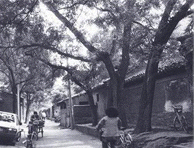 In many people's minds, Beijing is associated with the hutongs. They are an important part of the culture and way of life of Beijingers, especially the older generation. In many people's minds, Beijing is associated with the hutongs. They are an important part of the culture and way of life of Beijingers, especially the older generation.
Walking through the hutongs, it is common to see groups of elderly citizens sitting together playing cards, mahjong or Chinese chess. In the early mornings and evenings, they gather to practice traditional forms of exercise such as taijiquan as well as to dance and sing folk songs or Peking Opera arias. Also important to hutong life is the traditional foods being sold in carts or small stalls. These change according to the season, from flavoured ice in the summer to long kebabs of crab apples covered in sugar in the autumn and winter.
So imporant are the hutongs to the culture of Beijing that there have been many operas, plays and films about them. Lao She (1899 - 1966), one of 20th century China's greatest novelists and playwrights, is responsible for one such homily. His "Teahouse" is set in what is often the focal point of a hutong community and brings together several characters from the old streets of Beijing to discuss the problems of traditional society. A more modern love song for the hutongs is Zhang Yang's "Shower" (1999) about a tradtional bath house where men from the community gather to drink tea, receive massages, fight crickets and escape their marital problems. The film laments the loss of such old ways of life as the hutongs are being knocked down to make way for modern blocks of flats.
History
 According to historical records, there was already a small city on the site of present-day Beijing 3,000 years ago. It was in the 12th century during the Jin Dynasty (1115 - 1234) that Beijing became a capital city for the first time. At that time, there were no hutongs in Beijing, just streets and roads. Hutongs first appeared in the Yuan Dynasty (1271-1368) after the original city was destroyed during a war. Most of the hutongs still in existence today date from the Ming (1368 - 1644) and Qing (1644 - 1911) dynasties. It is, however, still possible to find some from the Yuan Dynasty. For instance, the Zhuanta Hutong on Xisi in the west of the city is one such ancient hutong. In dramas written during the Yuan period, the Zhuanta Hutong is often mentioned. The area was also the home of famous playwright Guan Hanqing, China's Shakespeare of the Yuan Dynasty. According to historical records, there was already a small city on the site of present-day Beijing 3,000 years ago. It was in the 12th century during the Jin Dynasty (1115 - 1234) that Beijing became a capital city for the first time. At that time, there were no hutongs in Beijing, just streets and roads. Hutongs first appeared in the Yuan Dynasty (1271-1368) after the original city was destroyed during a war. Most of the hutongs still in existence today date from the Ming (1368 - 1644) and Qing (1644 - 1911) dynasties. It is, however, still possible to find some from the Yuan Dynasty. For instance, the Zhuanta Hutong on Xisi in the west of the city is one such ancient hutong. In dramas written during the Yuan period, the Zhuanta Hutong is often mentioned. The area was also the home of famous playwright Guan Hanqing, China's Shakespeare of the Yuan Dynasty.
Many hutongs have a story behind them. Near the Forbidden City in the heart of old Beijing is a hutong called "the Weaving Girl" named after the daughter of a god who descended to the human world with her sisters to swim in a river and then proceeded to fall in love with a cowherd. Her enraged father, the Celestial Emperor, took the girl back and separated the couple with the Milky Way. On the opposite side of the Forbidden City, there used to be a Cowherd Bridge. Flanked by the cowherd and the weaving girl, the suggestion was that the feudal emperors living in the Forbidden City were the sons of Heaven.
Beijing's hutongs are more than just architecture. They are the people who live there. They are a museum of Beijing's folk custom and they are a witness to the city's history.
|