Comments
  Print
Print  Mail
Mail  Large Medium Small
Universal Pictures/Christian Clemenson as a passenger planning his next move in "United 93."
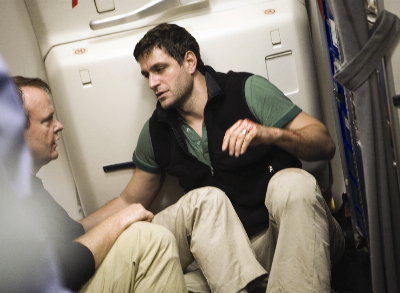
Christian Clemenson and Peter Hermann in "United 93."
A PERSUASIVELY narrated, scrupulously tasteful re-creation of the downing of the fourth and final plane hijacked by Islamist terrorists on Sept. 11, "United 93" is the first Hollywood feature film to take on that dreadful day. It won't be the last. (Next up, ready or not: Oliver Stone's "World Trade Center.") Preceded by both the expected bluster and genuine relief that the film is as good as it is — and it is good, in a temple-pounding, sensory-overloading way that can provoke tears and a headache — it was written and directed by the British filmmaker Paul Greengrass, who has crossed the pond to make the feel-bad American movie of the year.
Passengers discuss a plan of action in Paul Greengrass's "United 93."
Mr. Greengrass cut his teeth in British television working on a current-affairs program and directing factually grounded films. His breakout film, "Bloody Sunday," released in 2002, recreates a violent clash in 1972 between peaceful Irish protesters and trigger-happy British paratroopers that left more than a dozen marchers dead. Though produced for television, it toured the international film festival circuit and led directly to his next gig, "The Bourne Supremacy," a hyperkinetic Hollywood spy thriller about an amnesiac C.I.A. operative (played by Matt Damon). With jerky hand-held camerawork and nanosecond editing rhythms, Mr. Greengrass ratcheted up the action to Mach 5 and walked away with a canny box-office hit. Thrilling and gloomy in parts, it was the perfect warm-up for this new film.
Without ceremony, credits or introductory music, "United 93" opens with a cluster of Muslim men murmuring prayers in a hotel room. The four are the hijackers later identified by the F.B.I. as Ziad Jarrah (Khalid Abdalla), Saeed al-Ghamdi (Lewis Alsamari), Ahmed al-Haznawi (Omar Berdouni) and Ahmed al-Nami (Jamie Harding). Distinguished by his glasses and heavy black brows that hover over his worried eyes like the silhouette of a flying bird, Jarrah quickly becomes the most important hijacker in Mr. Greengrass's retelling. That's partly because Jarrah will pilot the plane, a photograph of the Capitol building taped to the control yoke, but also because in this recognizably human face we find a screen for whatever emotions we want to project: indecision, fear, regret or something more oblique, unknown.
Much of what happened on the plane remains unknown. According to the 9/11 Commission Report, some 15 minutes after the second plane hit the South Tower a United Airlines flight dispatcher began transmitting alerts to his planes, including United 93, warning pilots to guard against "cockpit intrusion." The message was received by United 93 at 9:24 a.m., three minutes after it had been transmitted. Two minutes later the pilot, Capt. Jason M. Dahl (JJ Johnson), asked for confirmation. Two minutes after that, the hijackers breached the cockpit and gained control of the plane, probably murdering both pilots and a flight attendant. At 10:03 a.m., after passengers tried to break down the cockpit door, United 93 plowed into a field in Pennsylvania, killing everyone onboard.
In its vivid details and especially its narrative pacing, the account of the United 93 hijacking in the 9/11 report reads like a nail-biter, something cooked up by Sebastian Junger. Drawing on different sources, including the report and family members, Mr. Greengrass follows the same trajectory as the report, with most of the screen time devoted to the period between takeoff and the excruciating moments before the plane crashed. The film carries the standard caution that it is "a creative work based on fact," yet Mr. Greengrass's use of nonfiction tropes, like the jagged camerawork and the rushed, overlapping shards of naturalistic dialogue, invests his storytelling with a visceral, combat-zone verisimilitude. And yet at the same time, beat for beat, the whole thing plays out very much according to the Hollywood playbook.
"United 93" not only gives us what happened inside the doomed plane: it also shows us the panic and chaos that seized those tracking air traffic that morning. Perhaps Mr. Greengrass felt it would be unbearably claustrophobic to stay inside the cabin for the 35 minutes between the moments when the hijackers seized and crashed the plane. Or perhaps because it's difficult to build and sustain narrative tension inside a single, confined set (as even Hitchcock proved), or perhaps because he just wanted to give us a larger view of that day, the filmmaker employs a narrative strategy as old as the movies themselves. He tells the story of "United 93" through cross-cutting, restlessly and with increasing rapidity moving back and forth between the plane and the F.A.A. and military personnel who are trying to understand what's happening.
The film's early, quiet scenes of these men and women preparing for another day of work — the co-pilot walking around the plane for a preflight check, air-traffic controllers exchanging technical small talk — are especially effective, since they underscore that before all these people became either heroes or, in the case of the F.A.A., heavies, they were men and women, people, not abstractions.
The problem is that it isn't the ordinariness of the passengers and the crew that most of us remember. What we remember are the accounts of their heroism and Todd Beamer's famous "Let's roll," here movingly uttered by the actor David Alan Basche almost as an aside, and their murder. And this is where writing about "United 93," as a movie, as an entertainment, becomes difficult.
Mr. Greengrass has worked hard to honor the victims, as has the studio releasing the film. The whole production has arrived in a hush of solemnity; the notes given to the press even include biographies of the crew and passengers, some by family members. But because Mr. Greengrass treats everyone onboard as equals (no one is a star, on screen or off), and because he throws us into the story without telling us who they are, they never become individuated. They are the guy in the baseball cap, the weeping woman, the man bleeding to death on the floor. More than anything, they are the instruments of the narrative's inexorable momentum, helping to push the story forward with their confused whispers, desperate plans and, finally, stunningly bold action.


Copyright 1995 - . All rights reserved. The content (including but not limited to text, photo, multimedia information, etc) published in this site belongs to China Daily Information Co (CDIC). Without written authorization from CDIC, such content shall not be republished or used in any form. Note: Browsers with 1024*768 or higher resolution are suggested for this site.
License for publishing multimedia online 0108263 Registration Number: 20100000002731