|
Remembering The Past
As usual, foreign "critics" jumped up before the Serfs Emancipation Day, saying China exaggerated the cruelty of traditional Tibetan life to disguise a power grab, and that "serfdom" is too loaded to describe the Tibetan system.
|

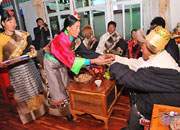
Tibetan people in traditional dress celebrate the first Serfs Emancipation Day at home in Qamdo, southwest China's Tibet Autonomous Region, March 28, 2009. [Xinhua]
|
But 73-year-old Baya in Qamdo, who was born to be a Tralpa, or a kind of serf whose life was better among all, said she would never return to the old society.
"I began to graze cattle when I was nine years old," she said. "There were many wolves in the pasturing area, and the aristocrats always asked us to deliver messages in midnight."
"We were afraid of the ghost, and I once witnessed a horde of wolves attack a lama..." she was apparently still in fear.
What they wore then was goat's skin, dried under the sun, because they didn't have cloth. They didn't have shoes.
"If the feet bled, we just apply the oil of the goat to the wounds," she said.
Dinner was potherb soup. "We didn't have Tsampa (food made of barley floor) to eat, let alone rice and wheat."
Baya said her first taste of sugar was after the People's Liberation Army (PLA) entered Tibet. The sugar was brought to there from Yunnan Province.
Zhao Qingui, a 73-year-old Tibetan veteran soldier, joined the PLA in 1950.
"At that time, only the aristocrats had tooth paste, tooth brush, biscuit, wool and fruits. The majority of people, or the serfs, could only wish not to be starved," he said.
Sun Huanxun, a PLA veteran who went to Tibet also in 1950 and stayed there, recalled what he saw in Lhasa before the democratic reform.
"Serfs wailed and begged from passers-by, some of whom had their legs chopped by the landlords, some have their eyes gouged out and some without hands," he said.
In contrast, the landlords were in luxurious dress, some riding on the backs of their slaves. "In their houses there hung whips, knives and shackles," he added.
|

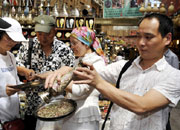
Local residents compete tug-of-war during the celebration ceremony to mark the first Serfs Emancipation Day in Gaba village in the suburb of Lhasa, capital of southwest China's Tibet Autonomous Region, March 28, 2009. A grand celebration ceremony is held here on Saturday to mark the first Serfs Emancipation Day. [Xinhua]
|
Qi Jiguang, a historian from the Deqen Tibetan Autonomous Prefecture, recited the sentences he read from slave contracts: "I would be your slave so long as the snow-capped mountain didn't collapse, the water from rivers didn't dry up."
The Khesum village in Shannan Prefecture was hailed as the first village to implement the democratic reform. Before the Serfs Emancipation Day, residents in the village wrote an open letter:
"We could never forget the old adage: there are three knives over the heads of serfs--heavy labor, heavy rent, and high interest; there are three paths before their eyes--flee from famine, become slave, or go begging."
"We would never return to the dark, backward, and cruel fuedal serfdom society. We would cherish the life now like cherishing our own eyes," it reads.
For Better Future
Chinese President Hu Jintao visited an exhibition marking the 50th Anniversary of Democratic Reform in Tibet, at the Cultural Palace of Nationalities in Beijing.
During his visit, he said that the "good situation" in today's Tibet was "hard-earned and should be highly cherished."
|

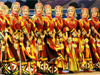
Tibetan people perform to mark the first Serfs Emancipation Day at Tianjin Square in Qamdo, southwest China's Tibet Autonomous Region, March 28, 2009. [Xinhua]
|
He also noted that the reform 50 years ago was "the most extensive, profound and progressive social transformation in the history of Tibet. Tibet should move from being "basically stable" to "peaceful and stable in the long run," he stressed.
On the Serfs Emancipation Day, 25 villagers from the Ngoklog village in Qamdo joined the Communist Party of China.
"I am happy to join the Party on this special day," said Asum.
Gyezang, 33, is an English teacher from Xigaze. "Establishment of the day could help us remember the darkness in the past and cherish the life more," she said.
Dawa Lhamo, a nine-year-old student from the No. 3 primary school in Lhasa, was happy on Saturday although she was not familiar with the past.
"I will become a soldier when I grow up, to protect Tibet," she said.
People from outside Tibet also expressed their wishes to Tibetans.
Chen Qiuxiong, leader of a working group dispatched from eastern Fujian Province to help with development of Tibet, said they have built a number of infrastructure projects serving farming and animal husbandry in Tibet and helped with the development of culture and education and health care as well as poverty reduction.
"Tibet is now in the period of development and stability, and we will do more for the development of the region," Chen said.
Liu Lumei, a deputy researcher with the Xinjiang Uygur Autonomous Regional Academy of Social Sciences, said that the establishment of the Serfs Emancipation Day embodies the common wish of all the Chinese people for the stability and development in Tibet.
|