|
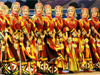
Last June, “Chinese Regional Opera Series” featured Hui Opera in Hong Kong. The troupe was composed of 44 performers, including the National Class One performer Li Longbin. The troupe has staged many well-preserved works in the traditional repertory, including Flooding the Army, The Drunken Royal Concubine, and The Legend of the White Snake. Their performance gained much attention and concerns over Hui Opera.

Review of history
Hui Opera is one of the most ancient operas in China. Based on the artistic foundation of Qingyang and Kunshan arias, the art form was gradually founded by assimilating the essence of various operas at the end of Ming Dynasty (1368-1644) and the beginning of the Qing Dynasty (1644-1911). In the Kangxi Reign of the Qing Dynasty, Hui Opera started a trend all over the country with its performer’s exquisite skills. In some economic centers of Southern China, rich businessmen even boasted their own private Hui Opera troupes and stages. It enjoyed a full development during Qianlong’s reign (1711-1799) and spread all over China during Daoguang’s reign(1820—1850).
In 1790, the 55th year of Qianlong’s reign, Gao Langting, a well-known local actor, led his Sanqing Hui Opera Troupe to Beijing, the capital in the Qing Dynasty, to celebrate the 80th birthday of Emperor Qianlong. Some other Hui Opera troupes also performed in Beijing successively. During the Jiaqing Reign, the “Four Great Hui Operas Troupes” - namely, Sanqing, Sixi, Hechun and Chuntai - aroused a sensation in the capital.

This was the first time that Hui Opera had been performed in Beijing, and after the birthday celebrations, the four troupes remained in the capital and began to perform for ordinary audiences. The Four Anhui Opera Troupes each has its characteristics: The Sanqing Troupe is good at complex and complete plays, the Sixi Troupe is best at Kunqiang, the Chuntai Troupe features young actors, and the Hechun Troupe is famous for fighting performance.
In order to suit their repertoire and tunes to the taste of cosmopolitan Beijing audiences, the performers of Anhui opera adopted elements from other types of opera, notably Hubei Opera and its typical Pihuang music.
During the Daoguang Reign, Cheng Changgeng, known as the leader of Hui Opera as well as the founder of Peking Opera, embraced and incorporated the advantages of various art forms, and introduced the Erhuang aria from Anqing, Anhui Province. After blending and localizing for about 50 years, the great Peking Opera was born.

Far-reaching effects
Hui Opera has had a major influence on Peking Opera. This form of regional opera laid the base on which Peking Opera developed. Beijing residents were not introduced to Hui Opera until 1790. Kunqu had been the dominant form of musical entertainment among the Beijing elite since the Ming dynasty (1368-1662). Characterized by convoluted narratives and poetic language, most Kunqu pieces, like the famous Peony Pavilion, were written by and circulated among the intelligentsia. Kunqu, which was regarded as elegant, quickly gained official recognition in the Qing dynasty (1644-1911) because the foreign sovereignty was eager to identify itself with Confucian culture in order to legitimize its rule. Most other opera styles, including Hui Opera, were condemned.
In 1790, the emperor Qianlong (reigned 1736-1795), a great opera fan, invited many of the most famous regional opera troupes around the country to Beijing to celebrate his eightieth birthday. And among them was the Hui Opera troupe Sanqing. Sanqing stayed on in the city after the event and performed for people in the city. Beijingers, including the emperor himself, fell for the new theatrical form immediately, and Hui Opera started to assimilate with other operas to become Peking Opera.
Seeing the extreme popularity of the Hui Opera, the Qing government worried that its licentious or superstitious elements would corrupt its officials and citizens, and it passed various laws in the eighteenth and early nineteenth centuries banning certain opera styles and works. But the actual effects of this legislation were minimal.
Hui Opera soon replaced Kunqu and dominated Beijing’s cultural scenes. The Qing emperors were such Hui Opera fans that they built the finest theaters, invested lavishly in stage settings, and invited the most talented performers to perform at court. Their performances were so widely loved by the townspeople of the capital that in every theatre Huizhou Opera was put on, and in every performance a Huizhou Troupe took a major part. After that, Cheng Changgeng helped develop Huizhou Opera into Peking Opera by combining it with Han, Kun and other operas. So Huizhou Opera in a sense is an ancestor of Peking Opera.
In addition, Hui Opera has had a historical connection with 10 other local operas both in the southern and northern parts of China with an influence reaching all over the country, Yunnan Opera, Cantonese Opera, Fujian Opera and Hunan Opera to be mentioned.
|