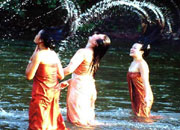
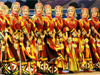
| The Daurs mostly live in Inner Mongolia Autonomous Region and Heilongjiang Province. The word Daur means explorer. Their race originated from Khitan. Hunting and agriculture are their main industries. The fishery is highly developed.

The Spring Festival is the primary one for the Daurs. They name the Spring Festival as Ah Nie, which is the most spectacular festival of the year.
The entertainment lasts from lunar December 23 to the next January 1. After sending off the Fire God and Kitchen God back to the Heaven, people prepare to celebrate the Ah Nie; they tidy up the house, wash beddings, make frozen raviolis, bean stuffed sticky dumpling, yellow rice flour cakes and wild-fruit-floured balls, etc. On the eve, people get up early. They clean the courtyards, paste the New Year pictures and spring festival scrolls. Then, a pile of dried cow dung is set in front of the courtyard door. Prior to the supper, people set firecrackers. It is a sign to announce the beginning of the family union supper -- Shoubarou (meat eaten by tearing with hands). The children traveling in the remote places should hurry back home prior to the eve as possibly as they could.
On the evenfall, people set fire on the pile of the cow dung, meaning to welcome the Fortune God. The elder will throw large pieces of meat and raviolis into fire blessing prosperity and safety of human and livestock and paying the gods a New Year call. On the eve of the festival, people sometimes find white thread on the raviolis, which foresees that the one who has it could live over 200 years old; someone put a coin in a dumpling; the one who takes it will have enough money in the future.
Late on at the night, the junior should toast and kowtow to the elder. That is to send off the former year and welcome the new one. During the eve night, the firecrackers blow everywhere, and lights from the residences keep shining. Many people stay up all night on lunar New Year's Eve.
On lunar January 1, people get up at the first crow, burn joss sticks and kowtow to Heaven God for blessing with peace. The do the same to their eldership. After taking raviolis by the breakfast, peers will, headed by the older one among them, pay the New Year call to each family in the village; afterward, to the relatives in the neighborhood. Once stepping up the door, they will uncover the pan of the host and scramble for the rice cakes. This is to show that they are on intimate term. Then, they take pork eaten by tearing apart with hands, and other foods. Gifts exchanged between women include tobacco, cream, cakes and frozen meat. The Spring Festival won't end until lunar January 15.
During the Ah Nie, people enjoy themselves as much as they like. Women, who are not good at sewing works, gather in a large room and perform a folk dance. Children play a special game. Callans play the field hockey.
The Daurs name lunar January 15 as Kaqin, which is referred to the date when the immortal return and people must, one day in advance, kowtow and burn joss sticks in front of their altar.
On January 16, the Daurs will set off to hunt or get ready for ploughing. On the morning, the elder of the family has to get up early and smear a little bit black on every one's face.
Hence, from the morning, the boys and girls have each of them a dark face. The Daurs think the black color can bring good luck to the children in the New Year.
The young people touch their hands on the black ash from the cauldron bottom and strive to daub each other on the face. The blacker the face is daubed, the luckier year people will have, as they consider that this black smearing game prefigures the good luck in succession.
In the past, the Daurs worshipped the Nature. In May, the villagers slaughtered cow or pigs to worship the heaven, terra, mountain and river deities. Each household had a Shaman in charge of the worship. Apart from the rogation and worship to a mountain god, he could treat diseases with wizardry. In the occasion, people had to slay cows and sheep, and prepared many offerings such as cream, butter and various cakes. But it is rare today. |