|

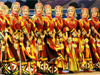
Another kind of Uygur music is called "Sanam," or "beauty," which involves singing and dancing to a group consisting of between seven to a dozen pieces of song-and-dance music. The music begins slowly and steadily, then picks up speed, and finally culminates in a climax of merry music and exuberant dances.
"Kuxak," "Eytixish," and "Maida" are spoken songs, which are common among the Uygur people. Accompanied by simple tunes, the speaker will talk his way through a song, usually about the love between a man and a woman. These songs can also be performed by two people.
Uygur music is accompanied by a variety of instruments. Back in the Sui (581-618) and Tang (618-907) dynasties, the five-stringedpipa(a plucked string instrument with a fretted fingerboard) andkonghou(harp, an ancient plucked stringed instrument) were popular in Qiuci and other areas. They arrived in the Central Plains along with music from the Western Region. The present Uygur music developed from ancientmusical instrumentsfrom the Western Region as well as modern Chinese and foreign instruments; it includes dozens of stringed, wind and percussion instruments.
The Mother of Uygur Music: 'Twelve Muqam'
Known as the "mother of Uygur music," the "Twelve Muqam" has a long history. Some scholars believe its origin can be traced back to the "Great Western Region Melody" that flourished during the Han (206BC-AD220) and Tang dynasties and enjoyed a high popularity in Central China.
In the mid-16th century, aided by other experts, the imperial concubine Amannisahan of the Yarkant Kingdom, who was also an esteemed poetess and musician, devoted all her efforts to collecting and compiling Muqam music, which was then scattered across Uygur-populated areas. She finally worked out 12 grand, yet light and entertaining compositions that are now known as the "Twelve Muqam."
|