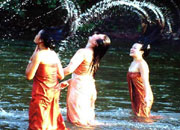
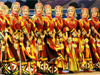
| The Jings mostly reside on the three small islands of Wuwei, Wutou and Shanxin in the Guangxi Zhuang Autonomous Region, which are known as Three Islands of the Jings.
Originally called as the Yue ethnic minority, the Jing officially got its present name in 1958. The Jings have their own language, but no letters. Their main industry is fishery.
Besides the Spring Festival, the Dragon Boat Festival and the Mid-Autumn Festival, which are similar to those of Hans, the most ceremonious and animated festival of Jings is the Changha Festival.
Spring Festival
During the festival, every family will makea kind of sticky rice cake with sugar fillings. On the morning of the first day of the New Year, no fish, meat or wine should be taken except sweet porridge, Zongba cake andthe sticky rice cake.
During the Spring Festival, all villagers gather in the Hating (public place for entertainment) in the village and worship the gods with the offerings such as swine, chook and fish. After getting home, people will worship their ancestors. While staying up late on the New Year's eve, people must place thesticky rice cake on the altar of the ancestors before they go to sleep.
Changha Festival
The Changha Festival is the largest traditional festival of the Jings. The word Ha means to sing or to invite gods to enjoy the song in the Jing language. The word Ha or to sing Ha, means to sing a song. The Changha Festival is the singing festival of the Jings.
Legend has it that a singing immortal came to the region where the Jings lived hundreds of years ago. When she saw that the local people were exploited and oppressed by landlords and suffered from extreme misery, she mobilized and organized, in the name of singing, the local mass to resist the oppression of the landlords. The resounding and dulcet songs of the immortal encouraged people to pursue freedom and happy life and were well appreciated by and moved many of them. In order to memorize her, the descendants of the Huis built up the Hating and regularly held traditional singing party, which gradually became the custom.
According to another legend, in the remote time there was a cave on the White Dragon Hill at the seashore of the South Sea, where lived a big chilopod spirit. Every time when a ship passed by the cave, someone had to be sacrificed for her as food. Otherwise, it would raise waves to overturn ships. One day, the King of Sea made up to look like an old beggar, and burned the chilopod spirit by a scalding pumpkin, which later on turned into three islands--Wanwei, Wutou and Shanxin. People constructed a folk-style Hating made of wood in superior quality in order to express their thanksgiving. They worshiped the spirit tablets of the King of Sea as well as the ancestors of different local families, and held the Changha Festival to worship the King of Sea.
The date of the Changha festival varies according to different regions. It is held on June 10 of the lunar calendar on Liwei and Wutou Islands but on August 10 on the Shanxin Island. The Hating of each village is the center of the festal entertainments. The construction is made of curved girders and painted pillars, and the roof is high with protruding eaves. The inner pagoda is divided into two side halls and a main hall. In the main hall, there are spirit tablets of gods worshipped by the Jings; and in the side halls, seats are provided for people to sit according to their ages while attending the singing party and having a feast.
The festival lasts three days. People dance and sing day and night. People from various ethnic groups will come to celebrate too. The songs performed during the Changha Festival are named Ha Songs, which have written lyrics and are sung by three appointed persons. A male singer named Brother Ha takes charge of playing the music instrument and two other women singers are called Sister Ha; one of whom takes a pair of bamboo clappers and the other a bamboo tube for tempo accompaniment. They sing in turn. Their singing sounds gracious, rich in tune and beat. The lyrics are about folk legends, parables, much-told stories, love stories, etc. Accompanied by the beating of gongs and drums, there is often a young girl dancing on the stage. The most featured program is the dance of Light on Head. The dancing girl has a bowl on her head, a plate on the bowls and lighted candles right up in the plate. She holds cups in both hands where a candle is also lighted. While the girl is dancing, the three candles keep flashing in the dark and it will be even more wonderful if many dancers attend the game together.
Young men and girls would like to express their affection in the moonlight, either coming across the first encounter, or fixing on the engagement, or exchanging inner feeling. They will take the chance of this nice night of perfect conjugal bliss to speak out their aspirations. People will be indulged in singing and dancing for several days. Near the end of the Changha Festival, people will send off the gods, announcing the end of the festival. |