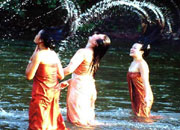
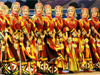
| Lhoba, which is the minority with the least population in China, is mostly distributed in the Luoyu are in the southeast of Tibet in Southwest China. Lhoba is the appellation given by the Tibetans, which means a southerner. It was in August 1965 that Lhoba was considered an independent ethnic minority. The Lhobas have their own language, but no letters. They use Tibetan for communication and keep their culture by passing down oral legends from the ancestors. The Lhobas believe in wizardry. They mostly deal with the agriculture and are engaged in hunting as side husbandry. They are good at arrow shooting. Though they reside in the vast Himalayas mountainous areas, they have common festivals.
New Year
Most clans of Lhoba annually celebrate the New Year three times.
The first time falls on November 1. By then, the crops have been harvested and the farmers have 3-5 days off. Every family slays three chooks and makes 40 liters of paddy and 20 liters of alcohol made from corns and 10kg fried rice cakes. During the festival, the villagers invite each other. Every family will gift the elders of the clan wine and alcohol, one bamboo barrel for each, and 10 large bowls of fried rice cakes. During the festival, nobody works. People enjoy the feast and revel every day.
The second time is on December 1. Whatever the harvest is good or not, people will ardently celebrate the festival. On November 29, they begin to slay pigs and cattle. On November 30, chooks will be slaughtered in the garner, one for each kind of cereals, and five chooks are usually required. People splash the chook blood over the crops to pray grain god for a bumper harvest in the coming year.
The third celebration takes place in January. The food supply has been prepared one month in advance. The amount of the meat is one of the evidences of wealth. On the evening of the 3rdand 4thday, the clan chief or the elders tell their tradition and stories in the public office of the village or around the need fire under trees. In this way, the rich literature is orally followed and developed by generations.
A small part of the Lhobas scattered in the Motuo and Milin areas celebrate the New Year in compliance with the Tibetan calendar. Other Lhobas have their own New Year's Festival determined by their own calendar. Although different in timetable, it commonly takes place after one year's hard work.
Xudulong Festival
Among the traditional festivals of Luobas, the most special one is the Xudulong Festival. In addition, there are entertainments with folk feature of which the ring arrow shooting is the most famous.
The Xudulong Festival is also named as Donggeng Gurumu, which means to congratulate the safety of the current year and look forward to a bumper harvest in the coming year. The festival is held in February of the Luoba's calendar.
Prior to the festival, people are busy pestling rice, brewing wine, slaying pigs and sheep. In some areas, people cut into pieces the cowhide and sheepskin, and send as gifts to the relatives and friends of kindred. They hang the cow skull on the wall of home, which is taken as the icon of the diligence and wealth pursued by generations.
During the festival, men and women, whatever old and young, gather together, worship and pray for a bumper harvest in the coming year. Early the next morning, every family slays a chook, fries and distributes it to family members with blessings for good health. After all ceremonies, villagers get together to regale. The elated lads perform folk dance. The vigorous performances demonstrate the strength and health of those diligent people.
When the night comes, people get seated around the fire and riot in feasting. Young men and girls express their affection via singing until the fire dies down.
The arrows that can make sound were used as a signal tool in case of hunting or battling in the past. Every year, The Luobas organize the contest of shooting arrows that can make sound. During the game, a target is set at one side of the playing ground. The quiver at the target will court cheering.
Longde Festival
The date of the festival is decided by the necromancer. On the first day of the festival, except one family member left at each home, all villagers will go to the nearby mountain with food and offerings and set up a fence, which they decorate with wild flowers. They pray to the Mountain God for his blessings for safety and good health, and offer the wine and meat as sacrifice. Afterward, they dine together and go back after the sunset. During the following four days, friends and relatives visit and bless each other. The Luobas used to believe in multi-deity, considering that everything in the world is spiritualized. The custom of festival derived from the close relationship between their life and the mountain villages.
Yangdelin Festival
The word Yangdelin is the transliteration of the Luoba language, which means the harvest festival. Prior to the harvest, men go hunting in mountains. They prepare food for the feast; women collect paddies of plump grains in the rice field, which are used for fresh rice making and offered to the elders of the village for fresh tasting. While fresh tasting, the Luobas also offer some to dogs, because, in the past, the standard of agricultural productivity was laggard in the Luoba area, collection and hunting played an important role as the assistant undertaking. Besides, they resided separately; dogs became capable co-workers as well as friends.
When harvest begins, men basically have three meals in the fields. After harvest, friends and relatives gather for the feast and the celebration of a bumper harvest. The entertainment often last all night. The oral language of Luoba is well developed. There are many beautiful legends on the origin of the agriculture. It is said that men were the first to know the cultivation and women to discover the seeds and brew wine. The Yangdelin Festival is held not only to celebrate a bumper harvest, but also to worship their ancestors. |