Retailers feel the chill from prepaid card controls
Updated: 2011-06-08 07:08
By Joy Li(HK Edition)
|
|||||||


|
Shoppers browse for goods at a department store in Beijing. The new measures on gift cards are likely to have an impact on the retail industry. Nelson Ching / Bloomberg |

The target may be corruption, but retailers are starting to feel the chill. Maybe not on their bottom line yet, but nevertheless a cold wind is brewing despite the sweltering summer heat.
On May 25, the State Council, or China's Cabinet, published an official document on its website vowing a tighter regulatory regime on the prepaid cards issued by the nation's retailers.
"The regulation on commercial gift cards aims to prevent money laundering, illegal cash withdrawals, tax evasion and bribery," said the document.
Although it acknowledges the benefits of gift cards, which help to facilitate payment and encourage consumption, there are evident risks. And lack of both supervision and risk control has created loopholes that can even be used for bribery, the document said.
"Such problems have severely disrupted taxation, financial management, and encouraged corruption," it said.
The new measures are going to have quite an impact on the industry if you take a look at the scale of the prepaid card business.
According to US-based Mercator Advisory Group, a research consultancy firm which specializes in the payment and banking industries, China was already the world's second-largest prepaid card market in 2009 with more than $200 billion in sales, surpassed only by the US.
In China, retailers, particularly department stores and supermarkets, are fond of issuing prepaid cards which carries a wide range of face values. But as a means of payment that is similar to cash, these cards readily slip into the bribery portfolio. In 2009, Du Hongmiao, the former head of a taxation bureau in Shengzhou, Zhejiang province, was found guilty of accepting more than 180,000 yuan worth of gift cards.
The new rules announced by the State Council will require that card issuers register the identities of customers with purchases of 10,000 yuan or more. Secondly, transactions involving prepaid card orders of 50,000 yuan or more and orders of 5,000 individual cards or more must be settled through bank account transfers.
"Sentiment sours on regulations for prepaid cards," wrote Forrest Chan, a consumer analyst at CCB International. He estimates that 10 to 30 percent of total sales of many Chinese department stores and supermarkets come through the prepaid card channel.
And he thinks that though it may be difficult to quantify the impact at this stage, the new regulations will have unfavorable implications on retailers as prepaid card purchases are likely to be deterred by the extra hurdles that have been placed.
But others are not quite convinced the new rules will act as a deterrent. Fu Lining, who has worked at various department stores and shopping centers in Beijing for almost a decade, said that the requirement of registering the identity of cardholders is something that can still be got around.
"They can break one 10,000 yuan gift card into ten 1,000 yuan gift cards. Virtually nothing has changed," said Fu.
And at department stores, where Fu estimated that some "big old names", which attain as much as 50 percent of their revenue from prepaid cards, will see an outcry from store cashiers if they have to handle substantially more transactions.
But quick check of retailers' balance sheets gives some insight into the widespread acceptance of prepaid cards in the industry. Among Hong Kong-listed retailers, the ratio of prepayments to its main business revenue in 2010 was 17.4 percent for Golden Eagle, 10.1 percent at Intime, 10.2 percent for Maoye, and 34.4 percent at Lianhua supermarket.
Liu Du, a consumer sector analyst with BOC International, commented that the new regulations are essentially "loud thunder that beckons little raindrops".
He said this is due to the fact that the new rules can be circumvented in a number of ways, making it more of a psychological shock rather than one which hits the bottom line.
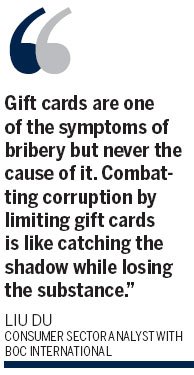
In an analyst's report, Liu said the central government was treating the sympton rather than the cause. "Gift cards are one of the symptoms of bribery but never the cause of it. Combatting corruption by limiting gift cards is like catching the shadow while losing the substance," he wrote.
Faced with these murky guidelines, retailers see only limited effects in the near-term. However, alarm bells should start to ring as prepaid cards carry an ever-growing weight as a source of financing.
Customer prepayment brings in a substantial amount of non-interest-bearing capital for retailers. According to BOC International research, from 2006 to 2009, the ratio of prepayment to its main business revenue increased from 4.5 percent to 9.3 percent for department stores and from 8.3 percent to 13.6 percent for supermarkets.
PricewaterhouseCoopers, the global accounting consultancy, published a report on the financial performance of Chinese retailers last November. And according to its findings, Chinese retailers usually find it hard to get loans from bank, which covers less than 20 percent of their total debt financing. Also, their enthusiasm for tapping the stock market for fresh capital is not very high. In contrast, foreign retailers seek more than half of their capital needs through long-term debt and equity financing.
But for Chinese retailers, accounts payable to suppliers and customer prepayment cards are the primary sources used to quench their thirst for capital.
According to PwC's figures,up to 80 percent of total liabilities for some retailers are accounts payable. For others, their reliance on customer prepayment can be as high as 50 percent. These short-term debts usually stretch less than one year.
And being short of financing channels, it is natural for retailers on the mainland to tap their growing sales network and customer base, issuing prepaid cards to draw "deposits".
"More and more retailers issue prepaid cards. Though it brings free cash, we should bear in mind its potential risks and pay attention to changes in the regulatory environment," the PWC report warned.
China Daily
(HK Edition 06/08/2011 page2)