Mass confrontation contrary to Hong Kong's core values
Updated: 2014-04-14 07:09
By Victor Chan(HK Edition)
|
|||||||


Recently, mass anti-government protests in Thailand led to the occupation of government buildings by opposition supporters in Bangkok. After this a similar mass movement was launched in Taiwan. Thousands of students occupied the Legislative Yuan, and then briefly, the Executive Yuan in Taipei. They demanded the government withdraw the Cross-Straits Service Trade Agreement (CSSTA) for re-examination, clause by clause.
Both incidents got out of control and prompted the authorities to send riot police to control the situation. Although these public campaigns have been labeled "democratic revelations" or "revolutions", they must not be emulated in Hong Kong.
Both Thailand and Taiwan are considered democracies whose political systems are based on Western models. Their heads of government and legislatures are elected by popular vote. They are held accountable by checks and balances within a constitutional framework. Citizens in any democracy can express their discontent about government decisions through peaceful protest and by voting in elections. If necessary, they can demand more constitutional checks and balances on governments. This is how democratic societies should behave.
But if people ignore these procedures and resort to violent confrontation, what is the point of having an electoral system? Is the rule of law still relevant in a society like this? It is little wonder Thai Prime Minister Yingluck Shinawatra responded to Thailand's anti-government campaign by saying: "It is my responsibility to defend the democratic system Everyone must abide by the law instead of destroying the authority of law with mob politics."
Her insistence on the rule of law was echoed by Taiwan leader Ma Ying-jeou. He responded to the protesters by saying, "Is 'Occupy the Legislative Yuan' the kind of democracy we really want?"
Ma added: "The rule of law is the foundation of democracy, which we must defend no matter what."
No one who prefers mass confrontation over the rule of law deserves any support in a democratic society. Resolving social issues through a democratic system is the only benchmark for progress. Therefore, it is puzzling that prominent opposition figures such as Lee Cheuk-yan, Lee Wai-ling and Tanya Chan went to Thailand and Taiwan to "learn from the mass campaigns" there. What exactly did they want to learn? How to build a democratic system or to sabotage it? I am worried the opposition camp intends to introduce a culture of mass protest into Hong Kong.
During the colonial era, the idea of democratic development and a civil society was effectively buried. A system of legislative elections was introduced shortly before the end of colonial rule. But selecting the governor by popular vote was unheard of. Despite the absence of political rights for citizens, Hong Kong managed to achieve remarkable economic success and social stability. It is also one of the world's safest places. I believe the fundamental elements of Hong Kong's success are its judicial system, efficient law enforcement and law-abiding citizens. These factors have made Hong Kong the success it is today.
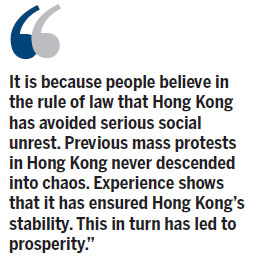
It is because people believe in the rule of law that Hong Kong has avoided serious social unrest. Previous mass protests in Hong Kong never descended into chaos. Experience shows that it has ensured Hong Kong's stability. This in turn has led to prosperity. Hong Kong residents know what they want and the right way to achieve it. That is why public opinion polls repeatedly show the illegal "Occupy Central" movement is not supported by most people. This is despite incessant coverage of its organizers by their supporters in the media.
Tai Yiu-ting, one of the "Occupy Central" leaders and a legal scholar, said abiding by every existing law is actually a lower form of the rule of law. This is absolute rubbish! He might as well have called law-abiding Hong Kong citizens fools. The truth is Hong Kong could not have been successful without the rule of law. Local residents know perfectly well what our core values really are.
The author is vice-chairman of the Hong Kong Young Commentators' Association.
(HK Edition 04/14/2014 page9)