Chinese borrowers cool on dim sum bonds
Updated: 2015-06-25 09:27
By Emma Dai in Hong Kong(HK Edition)
|
|||||||


Chinese companies' enthusiasm in offshore renminbi bonds, also known as dim sum bonds, has been cooled by fluctuating exchange rates and cheaper funding in the domestic market, bankers said.
In contrast, the momentum on the US dollar and euro bond offerings is building up rapidly, said leading bankers.
"Though the recent 4 billion yuan ($650 million) Lenovo offering was a positive sign, dim sum bond volume this year would probably be much lower than that of last year," said Ginger Cheng, managing director of DBS Bank.
According to data provider Dealogic, 15 Chinese entities have raised a total of $2.61 billion from the offshore renminbi market this year, 82.4 percent lower than the $14.85 billion raised by 57 issuers in the same period last year.
In the global dim sum bond market, total issues so far this year amounted to $10.24 billion, down 60 percent from $17.53 billion issued a year earlier.
The slowdown in the dim sum bond market is partly due to the volatility of renminbi against US dollar, said Cheng. "Investors' appetite in renminbi-denominated bonds has declined due to the end of yuan appreciation, which was part of the attraction of dim sum bonds other than yield. International investors do have a lot of other choices," she said.
In the five months to early March, the renminbi had depreciated 2.5 percent against the US dollar to 6.26 yuan. Since then, it has regained 1.1 percent to 6.19 yuan per dollar.
"It's particularly hard to issue dim sum of longer tenure because investors can't predict which way the yuan exchange rate is going to swing," Cheng said.
More importantly, cheap and easy credit on the mainland has made it more cost effective for mainland enterprises to raise funds in the domestic capital market. The costs of issuing domestic bonds have declined significantly this year, partially due to the recent monetary easing, said an HSBC report earlier in June.
With repeated cuts in the required reserve ratio (RRR) and benchmark interest rate, broad M2 money supply rose 10.8 percent year-on-year in May, accelerating from April's 10.1 percent. Outstanding loan growth was 14 percent year-on-year last month, the People's Bank of China said.
"For large SOEs (State-owned enterprises) particularly, who are traditional dim sum issuers, it has become even cheaper to raise fund domestically than in offshore market. Apart from the plentiful supply of liquidity in the domestic market, issuance process has also been streamlined. It's now much easier to issue corporate bonds, mid-term notes as well as short-term bills onshore," Cheng said.
"Even when credit spread is tight between onshore and offshore debts, SOEs would prefer the domestic market, because of the convenience in taxation arrangements, and there is no need to worry about cross-border fund transaction and related fees."
Bankers predicted that the central government's monetary easing policy will likely to last a bit longer. HSBC forecast another 50-basis-point interest rate cut and 250-basis-point cut on RRR in the remainder of 2015.
Chinese borrowers have shown great interest in issuing euro and US dollar bonds this year. Chinese international corporate bond offerings in G3 currencies - US dollar, euro, and Japanese yen - hit a record high of $57.1 billion, 21.1 percent above the $47.15 billion raised in the same period last year, Dealogic data shows.
In May alone, the gross issuance of dollar bonds by Chinese companies was $11.1 billion, up 65 percent from a year earlier. "We are unlikely to see issuing interests switching from US dollar to CNH (offshore renminbi) until the well-flagged rate hike," said the HSBC report.
"After all, the dollar bond market is the deepest and most mature in the world. With a wider investor base, one can sell bonds of larger scale and longer tenure. That's not what dim sum market can compare," Cheng said.
"Furthermore, we expect more borrowers rushing to offer bonds before the US Federal Reserve raises interest rates - especially those on longer-term debts, so as to lock up the relatively low funding cost at this moment. As the rate hike is widely expected to start in the fourth quarter or early next year, we are eyeing more offerings towards year end," Cheng added.
Separately, though the euro bond market is always a niche market for Chinese issuers, the depreciation of the euro has lowered the funding cost of the currency and attracted Chinese borrowers to the market.
"Despite the fact that post-swap yields of euro notes are similar to that of dollar offerings, the category is still appealing to Chinese companies. Some of the companies with debts concentrating in US dollar also want to extend their funding platforms to include the euro market. Renminbi's strength against euro has encouraged such moves. The case would be even truer, if the issuers have acquisitions and investments in Europe," Cheng said.
She added that, with Chinese enterprises' preference for dollar and euro debts picking up, more SOEs are seeking credit rating from international rating agencies. "While the rating agencies now have formed a more mature model for Chinese SOEs, there's also growing awareness among those SOEs to acquire the ratings," Cheng said.
"Endorsement by a creditable third party would allow Chinese companies greater flexibility in raising funds in the international capital market," Cheng said. "It's also much easier to control the funding cost. US dollar bonds with or without rating could have a credit spread of as wide as 50 basis points a year."
emmadai@chinadailyhk.com
|
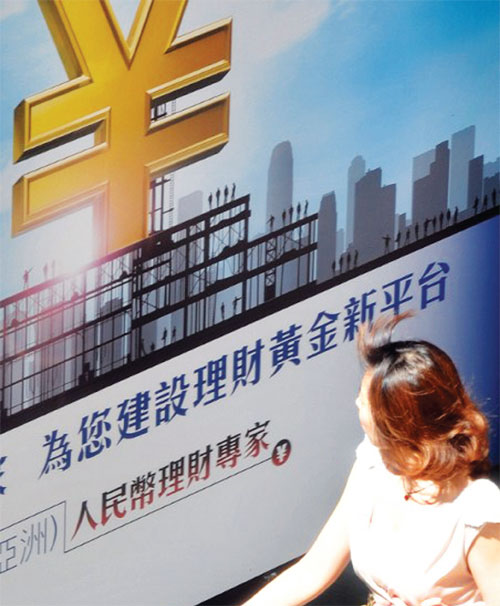
Chinese borrowers have shown great interest in issuing euro and US dollar bonds this year, because the possible US interest rate hike and depreciation of euro will lower the funding cost. Asia News Photo |
(HK Edition 06/25/2015 page9)