Taking baby steps on the Belt and Road Initiative
Updated: 2016-05-18 07:46
By Hu Yinan in Islamabad(HK Edition)
|
|||||||


Flagship China-Pakistan project presents platform to improve communication and foster human development
The Belt and Road Initiative needs no justification. Granted, a megaproject of this scale - which aims to revive ancient Silk Road trading routes - has never been attempted before, and would raise some eyebrows. But that's precisely why it is, and should be, a joint effort by all concerned parties.
Let's take the initiative's flagship project, the China-Pakistan Economic Corridor (CPEC), as an example. Just what does that $46 billion package entail? A mere trade route through which China and Pakistan are linked? A massive inflow of investment from Beijing to Islamabad? It may be all that. But it is so much more. And China's de facto role herein is merely that of a facilitator.
The recent call for an extension of the CPEC to the Red Sea and Africa by Adel al Faqih, Saudi Arabia's minister of economy and planning, bears testament to this and the proposition's apolitical nature.
Faqih told his Pakistani counterpart, Ahsan Iqbal, that considerable similarities can be drawn between the CPEC, Islamabad's Vision-2025 and Riyadh's own initiative, Vision 2030, and that both nations have much to gain by promoting trans-regional development.
And that is the very essence of the CPEC and the Belt and Road as a whole. It's a fusion of Chinese propositions and the policy frameworks of other nations. Particular emphasis is placed on infrastructure development, energy and industrial partnerships and regional interconnectivity.
The aim? Common development for all, for that is the condition for the free development of each, which in turn sets the tone for the free development of all.
This is where meaningful discussions should begin: Define ways in which the undertaking can benefit the common man from Pakistan to Ethiopia; clarify how projects can help put bread on the table for underprivileged populations; and work out innovative measures to overcome communication barriers.
Roads are always going to be built. Dams can be put up any day. The greatest challenge always lies in bringing people together, the result of which will by and large determine the fate of the CPEC, or the Belt and Road, altogether. The threats we face here are intertwined and profound, from security and malpractice to provincialism and red tape.
And that's exactly why it's high time to brush away confrontation and distrust, and address the lack of communication to reduce the likelihood of misunderstanding and miscalculation - not just across governments, but also in the private sector and civil society.
Baby steps are being taken. The National Institute of Strategic Communication at Peking University, where I work, became the first Chinese think tank to establish representation in Pakistan a few months ago through the assistance of its local partner.
The institute's offices in Islamabad and Karachi, which I head, are focused on opening up channels of communication in, and promoting effective dialogue among, private industry and the intelligentsia.
By breaking down communication barriers, the idea is to acknowledge existing issues and encourage open, frank discussions about them.
This, I believe, can help manage expectations, which is what the CPEC, if not the Belt and Road, is all about: A tale not of overlapping or conflicting routes, but agile ways to foster human development through concerted action.
The author is director of communications at the National Institute of Strategic Communication at Peking University.
For China Daily
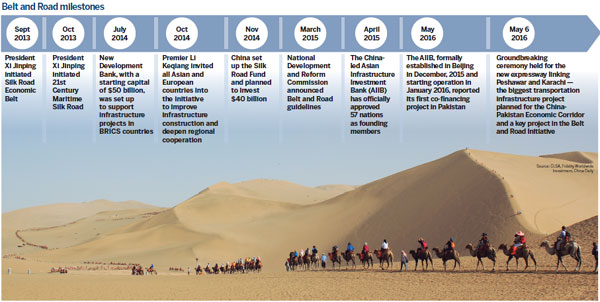
(HK Edition 05/18/2016 page8)