On the frontline against the Zika virus
Updated: 2016-09-01 07:24
By Sylvia Chang(HK Edition)
|
|||||||


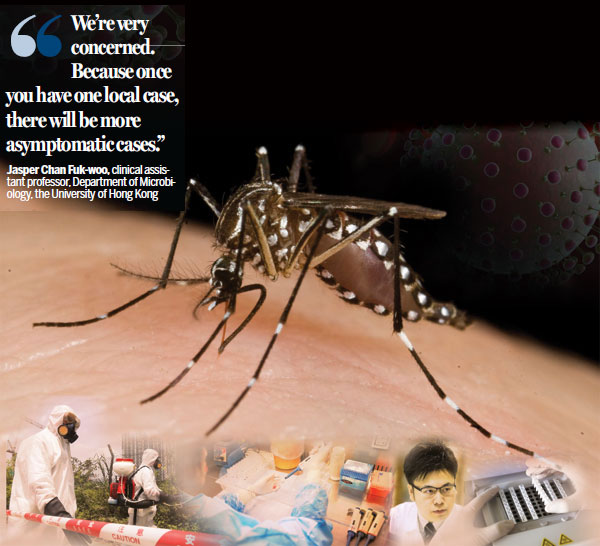
Hong Kong is manning the barricades as the prospect of increasing transmission of the Zika virus - now sweeping into Singapore and many other Asian countries - draws nearer. Sylvia Chang reports.
Jasper Chan Fuk-woo is snowed under lately, moving to the frontline in the city's battle to stop the rapidly spreading Zika virus, in addition to his regular duties, teaching and researching in microbiology at the University of Hong Kong (HKU).
Chan, a clinical assistant professor from the Department of Microbiology at HKU, is carrying out a study, initiated by the Food and Health Bureau, to test the blood, urine and semen samples of people returning from the Rio Olympics in Brazil and other Zika-endemic regions looking for antibodies and viral load. The intention is to enumerate cases of people as carriers of the virus who show no symptoms.
"We're very concerned. Because once you have one local case, there will be more asymptomatic cases," Chan said.
A Zika-infected patient showing no symptoms could transmit the virus to other people during the incubation period which could last for more than two weeks. Scientists are especially worried that around 80 percent cases of Zika infections are not accompanied by visible symptoms.
Field battle upgraded
Officials in Hong Kong are on heightened alert as the city is a hub for international travel and an outbreak of disease resulting from rampant breeding of the Aedes albopictus, an indigenous mosquito type which is able to transmit the Zika virus, could have serious consequences.
"Both the public and the healthcare sector should be highly vigilant," a spokesman of Centre for Health Protection (CHP) warned.
Hong Kong has intensified its efforts to stamp out Aedes albopictus. Then, there is the matter of educating travelers from Zika-affected areas, persuading them to apply liberal amounts of insect repellent for 21 days following their return. On top of that, different government departments have launched a drive to prevent mosquitoes from multiplying in suspected heavy breeding areas across the city. That includes construction sites, dumping grounds, wet markets and hawker bazaars. Standing water, even in small amounts, provides natural breeding ground for mosquitoes.
Begun on Aug 25, the drive to contain breeding of mosquitoes comes in the wake of an imported case of Zika infection in Hong Kong (the patient has tested negative in subsequent tests).
The case became front page news the next day, accompanied by photos showing workers in protective gear, using machines spraying insecticides. The public was warned to stay away from highly mosquito-infested areas.
Three days later, on Aug 28, local anxiety intensified when Singapore confirmed 40 locally transmitted cases of Zika infection within 24 hours of identifying the first such. Two days later the number of cases in Singapore rose to 82, resulting in the United States and other countries issuing travel warnings.
Although only a single case of Zika was reported in Hong Kong, officials say the battle against Zika must be fought on a broad front to keep the virus at bay.
A series of campaigns is under way to fight mosquitoes. Inspections at boundary control points have been upgraded to maintain strict environmental hygiene. Port Health Inspectors at sea ports and at terrestrial crossings have been given extra training on mosquito control. Pamphlets and posters on mosquito-control measures and health advice have been distributed to travel agents operating tours in Zika-affected areas.
"In addition to the numerous preventive measures already in place, there is a possibility that additional measures may be implemented, depending on how the situation evolves in the next few weeks,"Chan of HKU said, being aware that apart from Singapore, many other Asian countries - including Indonesia, Thailand, Vietnam, the Philippines, Cambodia, Laos and Malaysia - have reported instances of Zika virus transmission, according to the World Health Organization (WHO).
Laboratory actions
The Zika virus, initially, was isolated from a species of monkeys in the Zika forest of Uganda in April 1947. It is sexually transmissible in humans, and by infected, pregnant women, to their unborn infants. Victims may develop severe neurological complications. Newborns may suffer microcephaly (small head). Older people may become afflicted with Guillain-Barre syndrome.
Since the 1950s and all the way up to 2006, cases have been reported only sporadically in humans. Most of these were in Africa and Asia. In recent months, however, 70 countries and territories have reported Zika virus transmission (including 67 countries reporting in 2015), according to the WHO. This deepens the mystery about the rapidly expanding viral epidemic following 60 years of quiescence, when nobody took the virus very seriously.
Hong Kong has been backing up the global fight against Zika through laboratory research and animal experiments. At the frontline of the campaign, Chan and his team are tracing the prevalence of asymptomatic infections. At the current stage nobody knows exactly how long the virus can sustain in a patient, if no symptoms appear, said Chan, who feels the need of the hour is to carry out the study in this regard.
By Aug 31, the team had recruited more than 30 people and an additional 30 to 50 people have shown interest, Chan said. The first batch of test results should be available within the next two weeks.
The study, Chan hopes, will contribute to the global battle against this mysterious Zika virus. The city's health policy in controlling mosquitoes may also be updated to meet the challenge.
Chan expects around 1,500 people will take part in the testing of blood, urine and semen samples for antibodies. "If the percentage of asymptomatic infections is high, say 5 percent, more stringent measures may be required."Possible measures include limiting blood donations, upgrading advice on measures to prevent sexual transmission of the virus and suggesting suitable times to consider pregnancy.
Animal experiments
In a recent study, published in the Emerging Microbes and Infections, an international peer-reviewed journal, on Aug 24, scientists set out to breed the Zika virus in different kinds of human tissue and animal cells.
The idea, said co-author Chan, was to find out how well the virus can grow in different human tissues and animal species. This helps uncover the ability of the Zika virus to infect different human organs and cross species barriers.
"There is a possibility that they (the Zika virus) can infect these species in real life and then become transmitted to human organs," Chan explained, adding that further in vivo studies are needed to confirm these preliminary findings.
Other locales, such as Guangzhou in the Chinese mainland and the state of Florida in the US have adopted other approaches, mainly field studies, to control mosquito-borne diseases, Chan said.
One approach has been to cultivate genetically mutated male mosquitoes that usually do not bite humans. When the male mosquitoes carry mutated genes, female mosquitoes that mate with them will not breed.
Another way is to inject mosquitoes with Wolbachia, a genus of bacteria which helps to reduce infections in the animal. In countries and regions carrying out the study, usually there is "the need for immediate control of mosquitoes", Chan said. But there is no need for that as yet in Hong Kong.
"We must always see what the society needs before we adopt a new strategy. Side effects always come afterwards." Chan said scientists haven't confirmed the effects where large populations of mosquitoes were manipulated.
In future's study, he plans to develop an animal model to represent what happens in humans. He will use the model to study the pathogenesis of Zika virus infection and to evaluate the effects of drugs and vaccines on the model. He hopes the study will point the way to speed up treatment of the disease.
"If we continue the measures that we have been implementing, we're cautiously optimistic that Hong Kong can prevent the local spread of Zika virus," Chan said.
Contact the writer at sylvia@chinadailyhk.com
(HK Edition 09/01/2016 page10)