How to facilitate a voluntary medical insurance system
Updated: 2016-10-06 07:12
By Raymond So(HK Edition)
|
|||||||


Raymond So offers advice on how to reinforce the effectiveness of the Voluntary Health Insurance Scheme so as to better deal with the challenges of an aging population
A growing aging population is becoming a serious problem for Hong Kong, leading to a greater demand for healthcare. The experiences of many foreign countries have clearly demonstrated that public healthcare systems cannot cope with such huge demand. Therefore, Hong Kong needs to plan ahead on reforming its public healthcare system so it can deal with the many demands of a growing aging population. Currently, the city's public healthcare system accounts for over 90 percent of healthcare services. Needless to say, such a high percentage of government involvement in healthcare requires enormous public resources. When the demand for public healthcare services grows further, the current system simply cannot survive. Reforming the public system is inevitable. There is an urgency to have a greater percentage of private healthcare services being utilized.
Achieving a higher percentage of utilization of private healthcare requires financing, or to be more exact, an insurance system for healthcare. The issue of how to finance medical services has been discussed for more than 20 years. Yet there has been no concrete solution. Consensus, however, was reached in the previous round of consultation eight years ago. The consensus reached was that the public opposes introducing mandatory health insurance. This is not surprising, given that the city's Mandatory Provident Fund has yet to yield results which meet public expectations. People are not ready yet to accept another mandatory contribution scheme.
Now, the SAR government has recommended a voluntary medical insurance scheme. The idea is to encourage people to buy healthcare insurance when they are young so they can use the insurance protection in case they use private healthcare services. Also, the plan is to require private hospitals to make their pricing schemes more transparent to ease people's worries about high medical charges. This is a good idea; the public healthcare system, supported by massive government subsidies, charges much lower medical fees than the private healthcare system. In particular, the charges for specialists and in-patient services at private hospitals can easily surpass the level of affordability for an average middle-class patient. If the voluntary medical insurance system is properly planned, it can help divert some demand for public healthcare services to the private sector. This will alleviate the burden on the public system. It will also allow it to concentrate on its original objective of providing healthcare services to the low-income people.
However, the effectiveness of such a voluntary medical insurance system hinges on two critical factors.
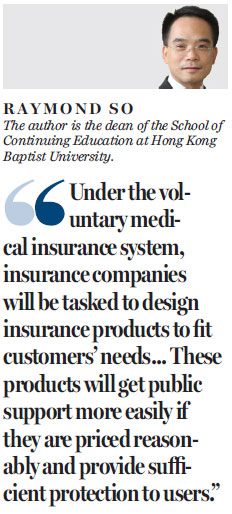
First of all, it is about the ability of the target users to afford it. Under the voluntary medical insurance system, insurance companies will be tasked to design insurance products to fit customers' needs. These will be subject to some minimum requirements imposed by the government. The government also has a plan to make sure that even the high-risk group will be insured. These products will get public support more easily if they are priced reasonably and provide sufficient protection to users. The government needs to have good monitoring over the pricing issue so the public will appreciate the advantages of medical insurance. The government must continue to monitor the market. It cannot take this monitoring role lightly. The important point is that future success depends on a good beginning. This can only be achieved through sufficient government monitoring over the pricing.
Second, the transparency of fees charged by the private healthcare system is also important. To many people, even though they believe they can afford the medical services of private hospitals and are willing to use private medical services, the uncertainties over service charges can turn them away from the private healthcare system. There are many cases in which medical charges rise unexpectedly. To be fair, charges for medical services can be complex because in many cases there are complications in treating a disease. It is difficult to set a fixed charge for a certain disease, but this does not mean that there should not be a transparent system of charges. To the public, the transparency of medical charges is very important. With more transparency, medical insurance can play its role better. The public can have greater confidence in using private medical care services.
Voluntary medical insurance is expected to progress into legislation soon. We must pay attention to the transparency of medical treatment charges and the appropriateness of medical insurance pricing. These two important parameters will directly affect the success of the planned Voluntary Health Insurance Scheme.
(HK Edition 10/06/2016 page6)