HK fintech growth revs up as Alibaba joins fray
Updated: 2017-06-30 06:44
By Duan Ting in Hong Kong(HK Edition)
|
|||||||


City's institutions in foray to provide online services to maintain strong customer link
With AliPayHK - the Hong Kong version of Alibaba Group's flagship mobile wallet and payments app - launched in the city in June, the global leader of online third-party payment has finally taken root in the city amid a wave of tech fever in the region.
Industry experts, however, have warned that a mature payment serves as a double-edged sword - while protecting the SAR from financial crises, it drags down the city's development of innovation.
Alibaba's move came close on the heels of Bank of China Hong Kong (BOCHK), which said in May it would team up with WeChat Pay - the rival mobile wallet platform of another Chinese mainland tech giant Tencent Holdings Ltd - to promote mobile payments through the binding of bank credit accounts with WeChat payments in Hong Kong.

China Construction Bank - one of the mainland's "Big Four" leaders - had also signed a strategic cooperation agreement with Alibaba's Ant Financial Services Group in late March this year.
Emil Chan, chairman of the Association of Cloud and Mobile Computing Professionals, said third-party payments serve as the foundation of fintech (finance technology) development, which also includes peer-to-peer lending, crowdfunding, cryptocurrency and algo trading.
However, he said the lack of talents, technology and laws and regulations is stalling innovation's advance in the local market, adding that only if people can dump obsolete ideas and embrace the changes can the situation improve. But, this may take at least three to five years.
In the past two to three years, third-party payments have started to evolve in the local market, and 2016 could be seen as the first year of an era for its progress in the city. But, due to the inconvenience of the long outstanding instant auto money transfers in the banking system and very rigid operating license requirements, as well as users' habits, the progress has been slow, said Chan.

He pointed out a breakthrough would be for UnionPay - the mainland's bank card services giant - to play a vital role by in launching the QR code payment program in Hong Kong to fill the gap. He noted that Octopus, as Hong Kong's leading smart-card payment company, could have taken the lead but since it has already well-developed its business locally, it lacks the momentum to promote innovation in new areas.
Li Ting, chief executive officer at Yunfeng Financial Group, said Hong Kong, which was hit by the 1997 financial crisis, has been more conservative in introducing financial regulations and it might be time for the financial regulator to redefine Hong Kong's strategic position.
She recalled that 12 years ago, when she firstly came to work in Hong Kong, she felt the super convenience of using Octopus, but there's still no big change in terms of payment methods at present.
Alibaba-backed Yunfeng Financial Group recently launched Hong Kong's first 2.0 global robo-advisor mobile app "Youyu Robo-Advisor" targeting investors with a bank account in Hong Kong with at least $800 to allocate global assets. The company joined 13 top-tier asset managers around the world to provide 343 funds that are easily traded on the mobile platform.
Tan Yueheng, chairman and executive director of investment bank BOCOM International Holdings Co Ltd, said Hong Kong is a mature international financial center with sound regulations that give priority to maintaining market health and protecting investors, and it has been keeping up with the market in terms of innovation and introducing the latest innovation to the market.
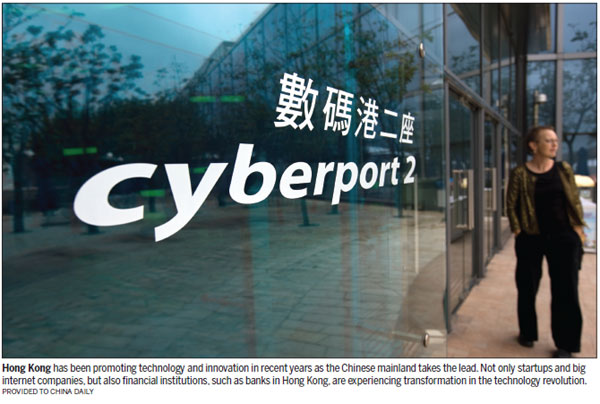
Hong Kong has been promoting the technology and innovation initiative in recent years as the Chinese mainland takes the lead.
The Hong Kong Trade Development Council and the Shenzhen Science and Technology Innovation Commission signed a cooperative agreement contract in April this year to help startups in both cities go global and improve cross-boundary technology exchanges and the intellectual property business.
Ceajer Chan Ka-keung, Hong Kong's secretary for financial services and the treasury, told the Internet Economy Summit in April that, in the past two years, Hong Kong has attracted HK$3.12 billion from globally investors in fintech companies, and up to August last year, the number of fintech startups had reportedly grown by 16 percent to 138.
Chan said that, with the support of the Hong Kong Monetary Authority (HKMA) - the city's de facto central bank - local banks have been providing more diversified products and services through financial technology to their customers, including fund assistance to startups, to attract startups from various countries to develop in Hong Kong.
According to Chan, the HKMA is cooperating with several local banks in setting up distributed ledger technology to assist in the work of banks, trade parties and logistics companies, and the regulator is planning to launch fast payment systems to be used in government services. He said the Legislative Council's HK$2-billion injection into the Innovation and Technology Fund will be used in the coming months to fill the funding gap of startup companies.
Not only startups and big internet companies, but also financial institutions, such as banks in Hong Kong, are experiencing transformation under the technology revolution.
Rocky Cheng Chung-ngam, general manager with the information technology department at BOCHK, said they have been working on utilizing technologies, including blockchain, electronic payments, cyber security, big-data analytics, artificial intelligence and vein recognition, in the financial industry. Since last year, the bank has set up an e-Finance Center focusing on developing new projects, such as electronic banking. The center has hired about 60 people and is expected to grow fast.
Cheng said the SAR government has been striving hard to advance technology and BOCHK has teamed up with the government-founded Hong Kong Applied Science and Technology Research Institute (ASTRI) to develop the latest fintech technology. ASTRI was founded by the SAR government in 2000 with the goal of enhancing Hong Kong's competitiveness in technology-based industries through applied research.
In November last year, BOCHK launched a property valuation system for homes loans based on blockchain technology, and is trying to apply it initiatively to the mortgage business and then trading finance and cross-boundary payments or remittances. The lender had closed the first local trading financing case and more than 6,000 property valuation cases by adopting blockchain technology by late May.
As for competition between internet companies and banks, Cheng said internet companies engaged in third-party payments have a large client base and their services link with customers is strong.
But, he noted that part of banks' operations cannot be replaced by internet companies, including private banking business and corporate finance.
Cheng agreed that fintech's development is hindered by regulations and its traditional ways of operation. He said banks may learn from internet companies that concentrate most on clients as business is all about clients' consumption experience.
He added that the mainland's fintech regulations represent a "do first and regulate after" approach, such as in crowfunding, peer-to-peer lending and third-party payments, which encourage its development.
tingduan@chinadailyhk.com
(HK Edition 06/30/2017 page6)