A golden era for stock market
Updated: 2017-07-01 08:30
By Duan Ting in Hong Kong(HK Edition)
|
|||||||


The bourse has become a magnet for mainland companies looking to list
The unstoppable wave of Chinese mainland enterprises that have headed south in the past 20 years, swarming the Hong Kong stock market and catapulting market capitalization to record highs, has led to a historic remaking of the local bourse.
The scramble for funds in the SAR through initial public offerings (IPOs), along with the enormous tide of mainland capital flooding the city's securities markets, has been immeasurably propelled by the country's opening-up policies and the insatiable urge of mainland businesses to get onto the world stage.
The figures that have emerged since 1997 have been astounding. The number of mainland enterprises that have gone public in Hong Kong has gone through the roof, having skyrocketed from a miniscule 101 in 1997 to well past 1,000 by last year - more than half the total number of companies listed in the SAR - with mainland companies' market value having escalated from just 20 percent to more than 60 percent of the city's total market capitalization since the handover.

And, in the words of Charles Li Xiaojia, chief executive of Hong Kong Exchanges and Clearing Ltd (HKEx) - the city's bourse operator - Hong Kong has all it needs to attain much of the accolades it deserves in the coming two decades - evolving from being the mainland's fundraising center into the nation's global wealth management hub, top offshore risk management center and global asset pricing pivot.
"Hong Kong has developed from simply a regional market with regional companies listed on the exchange for local investors and limited foreign investors to an international financial center in the past two decades. It's attracting not just international but also mainland funds."
What has transformed Hong Kong into a world financial center, Li said in an interview with Jeffrey Garten of the Yale School of Management in 2013, was the ability of both the city's and the mainland's regulatory authorities to make decisions to encourage the mainland's State-owned companies to float in the SAR.
Working together, both sides came out with the H-share regime - a special set of regulations that initially allowed State-owned enterprises to list in Hong Kong, governed by international standards. It triggered a massive flood of listings of State-owned companies, followed by those in the private sector, using the city as the first stop in their global aspirations.
Qingdao, Shandong province-based Tsingtao Brewery Co Ltd - the mainland's second-largest brewery after Beijing-based China Resources Snow Brewery Ltd - fired the first salvo in 1993 by going public on the Hong Kong stock exchange as the first H-share enterprise.
Li told Garten in the 2013 interview the mainland was still an economy lacking company or securities laws, but desperately needed capital and a way to reform its State-owned sector.
Today, mainland companies are playing a much more vital role in Hong Kong's capital markets.
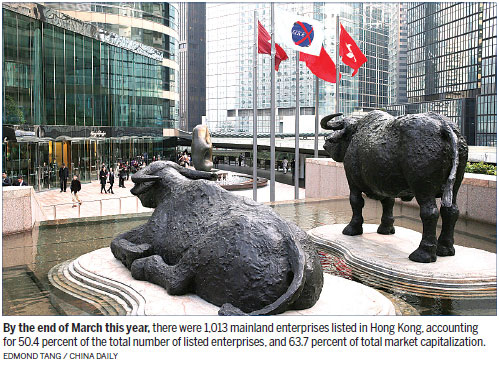
According to the HKEx data, the number of locally listed companies had soared from 658 in late 1997 (with only 101 listed mainland enterprises then), representing 15 percent of the total, to approximately 2,009 at the end of March this year. Statistics show there were 1,013 mainland enterprises listed in Hong Kong as of March this year, accounting for 50.4 percent of the total number of listed enterprises.
Total market capitalization had multiplied approximately eight times - from HK$3.2 trillion at the end of 1997 to HK$27.2 trillion by March this year, with mainland enterprises accounting for 63.7 percent of total market capitalization at the end of 2016, compared to less than 20 percent in 1997.
Total funds raised through IPOs, along with funds raised from 1997 up to April 30 this year, reached HK$8.7 trillion, with mainland enterprises including H-shares, red-chips and private businesses, having secured HK$5.4 trillion, or 62 percent of the total. The average daily turnover on the local bourse had grown from HK$15.5 billion to HK$82.1 billion.
According to Bloomberg, nine out of 10 IPO underwriters are from the mainland, with China Construction Bank Corp, Haitong Securities Co and Agricultural Bank of China Ltd heading the list. In 1997, Morgan Stanley, HSBC Holdings and Merrill Lynch were the leading IPO underwriters among the top 10, which included only local and international companies.
Hu Zhanghong, chairman and chief executive officer of CCB International (Holdings) Ltd, told China Daily that Hong Kong's status as an international financial center has been further strengthened after the handover, especially over the last decade. The city has attracted enormous mainland capital and has become the top prior destination for mainland enterprises seeking to raise funds offshore. "Today's Hong Kong is the 'super-connector' between the mainland and the rest of the world. It has also been evolving into a strategic platform for renminbi internationalization and the Belt and Road Initiative," he said.
Hong Kong government statistics show that, by the end of last year, mainland banks' assets in Hong Kong had made up approximately 33 percent of the local banking system, compared with 13 percent in 1997. Currently, almost all State-owned banks and national joint-equity commercial banks have branches in Hong Kong.
According to the Hong Kong Chinese Enterprises Association, Hong Kong currently hosts nearly 4,000 mainland companies - the number having more than doubled from 1,800 in 1997, with total assets up 22 times to almost HK$20 trillion.
Yim Fung, chairman and chief executive officer of Hong Kong-based Guotai Junan International Holdings Ltd, said with the collapse of the city's largest brokerage Peregrine Investment Holdings Ltd in early 1998, the China Securities Regulatory Commission (CSRC) - the mainland's securities watchdog - had been encouraging financial enterprises to innovate and prodding them to "go out" by 2006. As a result, the number of mainland-owned brokerages in Hong Kong had surpassed that of their local and foreign peers in recent years.
Amid its astronomical growth, the Hong Kong stock market had overcome a host of financial storms, such as the 1997 Asian financial crisis, the internet bubble burst in 2000, the SARS (Severe Acute Respiratory Syndrome) outbreak in 2003 and the global financial tsunami in 2008. Market watchers said Hong Kong had demonstrated its tenacity in the face of these crises and kept losses to the minimum.
The Hang Seng Index - the barometer for the local stock market's performance - had stood at 15,196 points on June 27, 1997 - the last trading day before the handover. By Dec 29, 2006, it had surpassed the 20,000-point barrier for the first time before hitting a record high of 31,958 on Oct 30, 2007.
Cheah Cheng Hye, co-chief investment officer of asset management company Value Partners, agreed that Hong Kong's overall market performance is tied to the growth of China's juggernaut economy.
He said Hong Kong listed stocks are still relatively cheap, trading at about 14 times its earnings capacity, adding that for mainland companies with dual listings, there's an average discount of 25 percent, for Hong Kong listed shares, they're a good buy compared with the shares listed on the mainland. "In the long term, Hong Kong's capital could become very exciting due to the potential offered by the Belt and Road projects, and the development of the Pearl River Delta economic zone," he said.
tingduan@chinadailyhk.com

(HK Edition 07/01/2017 page1)