Innovations transform retail industry
Updated: 2017-09-08 08:57
(HK Edition)
|
|||||||


Robot stores, mass customer profiling and RFID tags for checkout, inventory count set to shake up traditional models. Chai Hua reports.
Zhu Yanxia has been working in the retail industry for decades but now her professional knowledge is being challenged by new technology.
"The largest investment of the latest retail facilities is no longer rent and labor, but technology," Zhu said after witnessing the opening of the first unmanned convenience store in Shenzhen by locally listed Rainbow Department Store Co Ltd last month.
Zhu, who heads the company's convenience-store sector, said the operating structure of the avant-garde store is completely different from traditional ones.
"Traditionally, one convenience store needs about six staff but now one employee could manage at least 10 self-service ones with the help of hardware and computer systems," she explained. "And the 'box store' can be placed in residential common space so rent is much cheaper than retail property."
Development of supermarkets and department stores used to rely on rapid expansion but consumption upgrade and e-commerce competition force them to transform to more efficient business models.
Technology is regarded as the new drive to win the retail revolution, because it can create new forms of selling and escalate operating efficiency of traditional stores.
Zhang Yun, analyst at market consulting firm iResearch, said artificial intelligence and other advanced technology can provide solutions based on big data analysis for retailers to make business decisions.
Application of such technologies involves pricing, promotion management, demand prediction, logistics and almost every process in the retail industry, he noted.
Machine vision
Ding Xiaogang, founder and chief executive of Shenzhen Xiaozhou Technology, said traditional retailers either don't collect data on operating processes, such as number of visitors, or rely on reports from staff at each store. The accuracy and update rate of manual records is relatively low, however.
Established in 2014, the startup developed a camera that can observe, record and analyze customer traffic and consumption behavior based on machine-vision technology so retailers have accurate knowledge of each outlet's performance.
Installed at the ceiling of a store's entrance, the camera can make video recordings and, more importantly, count the number of people passing by, entering and leaving the store by recognizing the head and shoulders of humans.
The smart hardware is also connected to software which analyzes detailed operating statistics such as number of visitors, experience ratio and number of returned clients, in each outlet of a chain store all over the Chinese mainland. The cloud-platform updates every two minutes and operators can check it real-time on their mobile phones.
Ding believes these are all significant indicators to tell if a store is operating well or poorly so proper management decisions could be made accordingly that some retailers may overlooked before.
"Based on our clients' sales record, we can help one store increase sales volume by 3 to 5 percent on average," he noted.
The startup also states their accuracy rate is as high as 95 percent and more than 50,000 stores have been equipped with their device on the mainland, including supermarket operator Yonghui Superstores, Chinese sportswear company Anta Sports and shoe seller Crocs.
Cashier-less payment
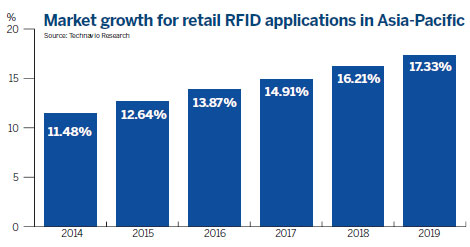
Radio Frequency Identification (RFID) is another technology that has become popular in retail-store management. The RFID mini-chip can emit a microwave signals to quickly recognize multiple targets from a relatively remote distance.
"Traditional bar codes utilize optical technology, so we could only scan one product in a close distance to pay," said Tang Jun, president of Shenzhen-based Invengo Information Technology, a listed company which has developed and applied the technology in many industries for more than 20 years.
RFID tags permit several things to be scanned together from a distance as remote as 20 meters, Tang said. Many retailers developed cashier-less payment systems based on the technology.
RFID tags can also help shop assistants locate a product more quickly and increase inventory-check efficiency. In logistics processes, the company said it can also boost stock accuracy 99 percent.
The technology has been widely applied in different sectors, such as train-signal recognition and self-service book returns in libraries, but the retail industry did not start using RFID until recently.
Tang said the cost and innate problems with the technology had hindered its uptake. "It has high-demand working environment," he said. Large amounts of metal of water in the environment can block signals.
Each RFID tag costs less than 1 yuan (15 US cents) now but some analysts fear this is still too high for the retail industry, considering tags are usually discarded once a product is sold.
But he believes the cost will decrease when RFID chips are mass produced, as the market is booming with sales growing 40 percent a year and expected to reach $10 billion this year.
These are just the tip of the retail technology iceberg. Like mobile payment changing our way of shopping, just imagine how AI, robots, virtual reality, drones and internet of things will shape the retail industry in future?
However, Zhu Yanxia believes technology alone is not enough to make retail successful in future. The core of retail is still improving production quality and consumer service, she said.
Contact the writer at
grace@chinadailyhk.com


(HK Edition 09/08/2017 page9)