Achieving progress with innovation and technology
Updated: 2017-10-10 07:26
(HK Edition)
|
|||||||


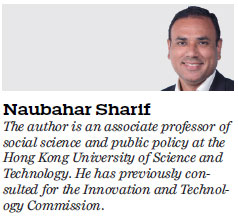
Naubahar Sharif, as Carrie Lam's first Policy Address approaches, explains why HK must continue to promote the development of innovation and technology
We learn through comparisons. We learn what hot is by comparing hot things with cold things. We learn what tall is by comparing tall things with short things. We learn what big is by comparing big things with small things.
So, making comparisons is vital to learning, but only if we make the correct comparisons. If we are to consider the state of innovation and technology development in Hong Kong, comparisons help us gauge how far we have come as well as how far we have to go.
This year, 2017, is important not only because it marks 20 years since the return of Hong Kong to China, but also because it brings us our first female chief executive. As Chief Executive Carrie Lam Cheng Yuet-ngor prepares to deliver her maiden Policy Address - which is rumored to contain a raft of significant initiatives related to innovation and technology development - this is as appropriate a time as any to assess Hong Kong's innovation and technology development comparatively.
For this comparison, we can choose either of two benchmarks: First, we can compare Hong Kong with its peers. Second, we can compare Hong Kong with itself: The state of innovation and technology in Hong Kong today as compared with the state of innovation and technology in the past, say, in 1997.
Hong Kong fares relatively poorly compared with its peers. According to the latest figures, Hong Kong spends a paltry 0.76 percent of GDP on research and development. This is a measly sum given Hong Kong's riches. Following the post-war industrialization of Japan, the next group of "tigers" or "dragons" or "newly industrializing economies" to develop rapidly were South Korea, Taiwan, Singapore, and of course Hong Kong. As such, it makes sense to compare Hong Kong with others in this group. According to the latest statistics, South Korea spends over 4 percent of its GDP on R&D, Taiwan spends over 3 percent, and Singapore spends over 2 percent.
Thus, Hong Kong not only trails its peers, it trails them significantly. An astute reader with some knowledge of R&D spending might well argue that all these economies run military budgets. As we have learned from the United States, many technologies created by the military sector have spilled over into the civilian realm: Government-financed research- and procurement-fueled industries have produced hybrid seeds, radar, synthetic rubber, microchips, global positioning systems, and the internet, to name a few significant innovations. That is indeed true.
While it might be difficult to determine how much of South Korea's, Taiwan's, or Singapore's annual R&D expenditures involve the military, we can circumvent this issue altogether by comparing Hong Kong with another set of peers - Chinese mainland cities. Here are 2014 expenditures on R&D for some of these cities: Beijing, 5.95 percent; Shenzhen, 3.68 percent; Shanghai, 3.66 percent; Hangzhou, 2.98 percent; Tianjin, 2.95 percent; Foshan, 2.46 percent; Guangzhou, 1.25 percent; Suzhou, 0.74 percent. Only Suzhou spends as little on R&D as Hong Kong. We rank far behind Beijing, Shenzhen and Shanghai.
We can apply another basis for comparison, however, when attempting to evaluate the development of innovation and technology in Hong Kong. How, for example, do Hong Kong's initiatives and policies for promoting innovation and technology in 2017 compare with those in place in 1997? Against this benchmark, we fare far more favorably.
Before 1997, perhaps only one British colonial governor, Sir Edward Youde, gave serious thought to the idea of technological upgrading. He, along with Sir S. Y. Chung, created the first and only technical university in Hong Kong - the Hong Kong University of Science and Technology. Apart from establishing the Hong Kong Institute of Biotechnology in 1988, there had, sadly, been little else of note undertaken to promote innovative and technological development in Hong Kong.
In 1997, annual expenditure on R&D amounted to 0.38 percent of Hong Kong's GDP. In 2015 (the latest year for which official figures are available), Hong Kong spent exactly twice that sum. The increase in formal R&D expenditures aside, Hong Kong has made progress in other ways as well.
The infrastructure for innovation and technology has grown significantly. Today, we can count the following institutions that are directly related to promoting innovation and technology: The Applied Science and Technology Research Institute, the Hong Kong Science and Technology Parks Corporation, Cyberport, the Hong Kong Design Center, and the five R&D centers, to mention some important examples.
In policymaking, the government has progressed by leaps and bounds. As compared with having no formal body concerned primarily with innovation and technology in 1997, we have today the Innovation and Technology Commission (ITC), which in November 2015 was subsumed by the Innovation and Technology Bureau. The structure for creating innovation and technology policies is much clearer and more forceful, and has marshaled significant resources in the effort to promote technological development (as Lam's maiden Policy Address will note).
Finally, the funding resources made available have increased significantly. Having spent almost nothing in 2000, Hong Kong has since established the Innovation and Technology Fund, comprising HK$5 billion, which was replenished with another HK$5 billion in 2016. This is not to mention an array of other smaller funding bodies run by the ITC to support innovation and technology development.
(HK Edition 10/10/2017 page10)