AI revolution gets multi-front lift-off
Updated: 2017-11-03 06:27
By Oswald Chan in Hong Kong(HK Edition)
|
|||||||


Engineers take artificial intelligence trend to new level with platforms for accurate diagnosis and restaurant bookings
Artificial intelligence service providers are campaigning for greater government support to create a more vibrant startup ecosystem and lure adequate AI talents so that Hong Kong can throw down the gauntlet in the AI technological revolution.
Four young AI engineers - Chris Shum, Thomas Wong, Issac Wong and Ryan Lam - have placed their bets on the growing need for local tailor-made medical services, and developed AI engine-powered platform ClinicBot to give patients an accurate diagnosis.
After downloading ClinicBot in Facebook's Messenger or WeChat and adding ClinicBot as friend and with the necessary clinic information on ClinicBot's website, users can obtain specific medical advice in the following sequences.

When you type disease symptoms into the ClinicBot conversations bloc, the AI technology-powered platform will analyze the symptoms described and conduct big data analytics to generate tailor-made medical referrals, sparing a lot of time wasted in the trial-and-error process just to find the right doctors for medical consultation.
To date, five specialty clinics in Hong Kong have signed up to join the ClinicBot platform. Asiabots, the company behind ClinicBot and an incubatee company at the Hong Kong Science Park (HKSP), is targeting more than 10,000 specialty clinics in the city, as well as thousands of beauty salons and nursing homes for the elderly.
The engineers are looking into the possibility of adding ClinicBot in WhatsApp to enhance its popularity among local residents.
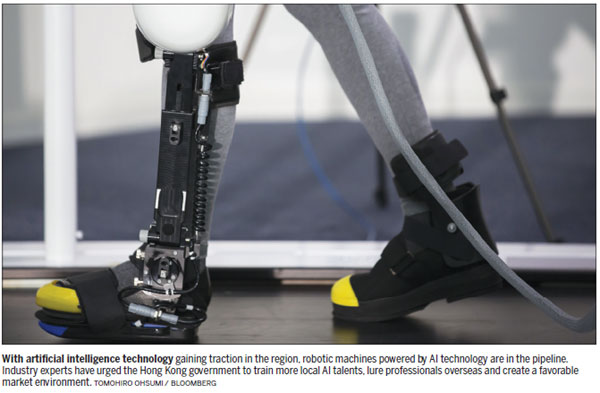
After developing the proprietary technology for one year, the company is mulling the next step of business development - installing a language processing technology to facilitate users using Cantonese in the conversations, riding on the business strategy of localization to satisfy residents' needs for medical services. Other hardware products are also in the pipeline, such as AI technology-powered concierges and robotic machines.
Having poured their personal savings into establishing Asiabots, the four AI engineers are seeking a further HK$7.75-million funding for their business expansion. Given Hong Kong's aging population and an acute shortage of doctors, the company is confident that its services will be popular.
However, Asiabots is cautious about the prospect of widespread AI adoption in the city.
"Hong Kong has been lagging behind in AI technology adoption for several years, but it's catching up," Asiabots Co-founder Chris Shum told China Daily.
"But, I'm still worried that Hong Kong's tech startup ecosystem is not strong enough to induce widespread AI utilization."
"It does not help when the administration is just pouring tons of money into boosting innovation. It should consider doing more in relaxing cumbersome legislation, creating a more favorable market environment, and training local AI talents and attracting overseas talents," he suggested.
Shum's views concur with those of INSEAD, Cornell University and the World Intellectual Property Organization, which say that human capital and research are still the weakest spots in bolstering innovation in Hong Kong.
According to Global Innovation Index 2017 released by the three parties in June, the SAR was ranked the 16th most-innovative economy in the world - down two spots from the previous survey. In the Asia-Pacific region, Hong Kong was the fourth most-innovative economy after Singapore, South Korea and Japan, according to the poll.
While the report said Hong Kong still retains good positions in institutions, market sophistication and infrastructure, its performance in knowledge and technology outputs, creative outputs, as well as human capital and research, is still deemed as the weakest spots in fostering innovation.
In her maiden Policy Address last month, Chief Executive Carrie Lam Cheng Yuet-ngor pledged to double the government's annual spending on research and development - from the current 0.73 percent of gross domestic product to 1.5 percent in five years -which translates into HK$45 billion.
However, even the proposed 1.5 percent is lower than that of South Korea (4.23 percent), Japan (3.49 percent) and the Chinese mainland (2.07 percent) in 2015, according to the Organization for Economic Cooperation and Development.
Lam will personally lead a high-level and inter-departmental Steering Committee on Innovation and Technology to examine and steer measures related to innovation and technology and smart city projects.
It's not just Shum who is having difficulties in hiring suitable AI talents.
Christopher Francisco - co-founder of Bid N Eat, an incubatee company at the HKSP - grappled with the same problem when he started his business two years ago.
With seed capital and an initial round of funding amounting to HK$3.3 million, Bid N Eat utilizes US-based IBM's AI technology to provide restaurant selecting and booking services. Its services are set to be available through Facebook's Messenger and WeChat in the first quarter of next year.
The company's logistics is the same as that of ClinicBot. After adding Bid N Eat as friend in these two social platforms, users can input location information, as well as food and dietary requirements in the Bid N Eat conversation bloc. The AI technology-powered platform then conducts big data analysis to sort out the information, propose the most suitable restaurant, and let you decide whether to make the booking or not.
The startup sees tremendous market potential as there are just a few AI-powered platforms in the food industry. Francisco is confident that up to 200,000 people will add Bid N Eat as friend.
Quite the contrary to Asiabots, Bid N Eat already had the business expansion plan for Southeast Asia even before it introduced its services in Hong Kong. This is because while medical consultation services demand more localized knowledge, restaurant booking is a standardized service that can be replicated anywhere.
But Francisco feels the development of AI technology in Hong Kong's economy is rather uncertain at the moment.
"Hong Kong faces intense competition pressure from the mainland and Singapore, whereas the two places have cultivated a good startup ecosystem and attracted AI talents successfully," he noted.
"It's very hard for us to recruit suitable talents in the fields of computer science and statistics to do the job. The administration should think harder on how to attract the best AI talents to work in Hong Kong," Francisco reckoned, adding that the government should consider granting subsidies to attract global AI companies to establish their operations in the city, otherwise Hong Kong's competitive edge in the AI industry will be further eroded.
Hong Kong's weakness in technology research is echoed by Our Hong Kong Foundation (OHKF) - a think tank established by former chief executive Tung Chee-hwa.
OHKF suggests that Hong Kong strengthen its ties with the manufacturing base in the Pearl River Delta region, especially Shenzhen's electronics manufacturing hub advantage, to drive product commercialization of Hong Kong's translational research in areas such as consumer Internet of Things and robotics, and to liaise with overseas translational research centers to promote the city as a hub of product prototypes.
For Shum, the significance of AI technology lies not only in enhancing worker productivity, but also in taking their productivity to a new level.
"Imagine humans can spare a lot of tedious and manual work, and hence, can spend more time in learning and communication. That's what humans should do. Through learning, they can know how to improve businesses, and through communication, they can make better responses to satisfy market demand," he said.
oswald@chinadailyhk.com
(HK Edition 11/03/2017 page8)