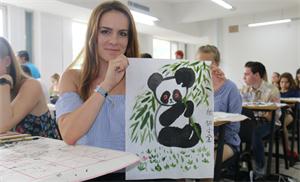
Studying a foreign language and being able to speak and use it, in my opinion, embodies intense attachment to the roots of the language, the cultural essence it represents and moreover manifests the willingness to inherit it.
Starting April 3, Bay Area residents have the opportunity to tune-in to a brand new radio program - US Chinese Radio on AM1450 - for news, entertainment and community information all in Mandarin.
"We decided to launch this program in order to quench a growing community thirst for China-relevant information," said Ren Hongyu, general manger in the west coast office of the China Press, sponsor of the service. "Among our target listeners, some are parents who want their children to be adept at speaking Chinese."
To serve this need, Ren and her staff have included some programs for children only. "We will use audio clips submitted by our young listeners that include poem recitation, reading, cross talk and talk shows," she explained.
Learning Chinese, some may argue, has become way too pragmatic. Given the fact that China is now the world's second-largest economy and continues to surge forth, to study its language and learn how to communicate in Mandarin is relevant and useful.
But for some immigrants from China who are now parents of American-born Chinese, speaking and writing the language is the equivalent of keeping their culture and traditions alive.
Gracie Lee, an 11-year-old San Franciscan who is a straight A student at a public school, had a hard time memorizing her Mandarin Chinese lines during rehearsals for a big fundraiser on March 26.
She burst into tears several times when the instructor tried to correct her intonation. "You are a child of Chinese descent," the instructor told her. "We audiences will associate you with Chinese culture, language, performances, anything about China."
"I can't do it," Lee complained. "I'm so embarrassed and it doesn't sound like me."
Lee is not alone. For many American-born Chinese, learning Mandarin is a challenge. Parents, full of expectations for their children, often run into the resentment of their children who can be reluctant to do what's necessary to master the language.
"Going to Sunday Chinese school is traumatizing," said Lee.
There are several factors that contribute to the "Chinese-is-difficult-to-learn" mentality, according to Cindy Wei, principal of an afterschool with a Chinese immersion program in the Bay Area.
"Unlike English which contains only 26 letters and is phonetic and inflected, Chinese is a tonal language with many more strokes and characters," Wei said.
A syllable in Chinese pronounced with a rising tone, for example, may have a different meaning from the same syllable without the rising tone.
In English, one generally finds a rising tone at the end of a question, said Wei, adding that the sentence structure of Chinese is much more complicated than that of English.
"Chinese can be daunting for young learners, especially if they are not required to use the language at schools and with friends," said Lisa Xiong, Lee's mother, who acknowledged that opportunities for her daughter to practice Chinese conversation were rare.
In 1964, a group of Chinese language teachers in California established the Chinese Language Teachers Association of California to promote the study of Chinese, share ideas and expertise and enhance the quality of Chinese language teaching. The association currently has about 300 K-16 Chinese language education professionals in California and organizes an annual Mandarin speech contest, conference and workshop.
Jenny Liu, founder of the afterschool Loving Tree Academy in Fremont, CA, introduced a Chinese-immersion program for children aged 5-12. Teaching pinyin, simplified Chinese writing and speaking through a variety of games and activities, Liu and her team put "fun-filled" at the top of their curriculum.
"We did a lot of role playing when we introduced our children to the novel Journey to the West," Liu said, adding that children not only learned the character traits of the Monkey King but also the ancient oriental wisdom behind the characters.
"Curiosity is always the best teacher when it comes to Chinese learning," Liu said.
Contact the writer at junechang@chinadailyusa.com.




Copyright 1995 - . All rights reserved. The content (including but not limited to text, photo, multimedia information, etc) published in this site belongs to China Daily Information Co (CDIC). Without written authorization from CDIC, such content shall not be republished or used in any form. Note: Browsers with 1024*768 or higher resolution are suggested for this site.
License for publishing multimedia online 0108263 Registration Number: 130349