


DaVinci is luxury code for Chinese consumer
| ?
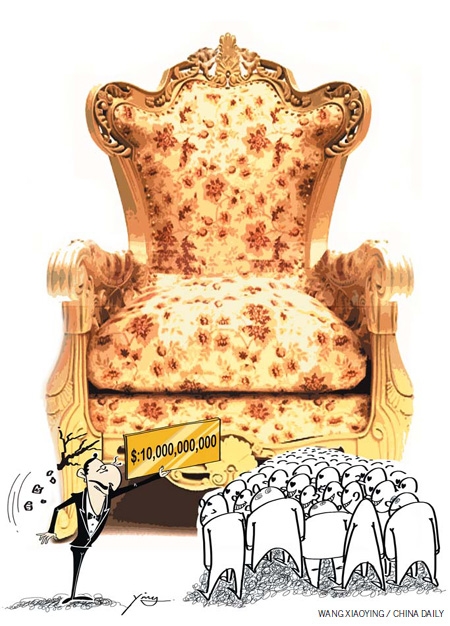 |
Twelve Chinese brands feature among the world's top 100, but it is Chinese consumers' insatiable appetite for Western brands that appears to dominate the domestic market. This appears to be a uniquely Chinese phenomenon unlike other transitional economies. The controversy surrounding DaVinci Furniture serves to highlight this aspect of Chinese consumer behavior.
DaVinci Furniture was established in Singapore and branched out into China in 1998, eventually becoming the country's largest dealer in luxury furniture. The company has now been accused of selling fake Italian furniture, which it denies. In a recent interview, DaVinci's chief executive Doris Phua said she would compensate customers 10 times the price of a product if it can be proved that it was made in China, exported to Italy and then re-exported to China.
The point here is not whether products sold by DaVinci are Italian fakes but that most Chinese consumers are not bothered about the genuineness of a product as long as it can impress people around them, that is, colleagues, friends and family.
Italy and France enjoy an unrivalled position in consumers' minds as the origin of "luxury", "style" and "sophistication" and therefore, according to Chinese consumer logic, "status". This is definitely the case with clothes, shoes, furniture and cosmetics. Germany and "quality", "precision" and "engineering" is another association firmly imprinted in the minds of Chinese consumers.
It is the Italian name, DaVinci, which evokes such a powerfully appealing image among Chinese consumers. Some of these consumers will stop buying the brand if it is proved that the furniture is not made in Italy. They will now search for what they consider status-enhancing furniture that is out of reach for most Chinese consumers. This is the double-edged sword that distinguishes any "luxury" brand positioning.
"Luxury" and "status" are perceived as "elite" and, therefore, can only be enjoyed by a certain few "at the top" of the social ladder. To expand, though, a brand has to increase its customer base because catering to existing customers usually severely limits growth, especially in the case of furniture. Since efforts to increase the customer base of a luxury brand includes lowering prices and the cost of production, hence the probable switch by DaVinci to production on the Chinese mainland.
Many Chinese consumers, however, will not be too bothered even it is proved that DaVinci makes its products in China and not Italy. They will still enjoy the association that the Italian name conjures up. But again such consumers lack the purchasing power to switch to more expensive, genuine brands, which means that DaVinci would lose some of its exclusivity and may have to change its current market niche approach to a volume-base strategy.
In the long term, the answer may well be two slightly different brands: one, an exclusive "made-in-Italy" brand for the super elite and the other, "made in China" for the wannabe elites. Indeed such an approach has been pursued by BMW for many years, in which a Germany-made Beamer is distinguished from the one made in China.
DaVinci could react boldly and follow the strategy of companies that retain their brand's country-of-origin image but have publicly shifted production to a country where the cost of production is lower. Waterford Crystal, luxury glassware maker, made this move a long time ago. Though its products are no longer made in Waterford City, Ireland, consumers still consider it a prestigious brand. Or, DaVinci could go the way of Chinese clothes brand Romon, which uses the Italian-sounding name to create a positive image among consumers despite being a Chinese company which has never ventured into Italy.
The controversy shows the DaVinci management in poor light and highlights the fickleness of Chinese consumers. But more importantly, it raises serious questions on brand owners in China that seek protection of intellectual property rights (IPR).
Though IPR violations and corruption remain genuine concerns in China, great progress has been made in curbing them. As an increasing number of Chinese companies appreciate the need for a more modern business environment to continue attracting investment and developing internationally, the fight against corruption and IPR violations should intensify. Corruption exists and rights are violated in the developed world, too. For corruption of the highest order look no further than the controversy facing Rupert Murdoch's News Corp. In comparison, the DaVinci saga is like a storm in a teacup.
But will Chinese consumers continue to treat what they perceive as luxury and status-enhancing brands with as much adoration? It is hard to give an answer now, given China's unique history and rapid economic growth. But the Chinese consumer certainly has "elitism" firmly etched in his heart, which would prolong his brand fascination longer than expected.
It is the nouveau riches who will continue this brand adoration, and a majority of them can be found in China's second- and third-tier cities. So it should not come as a surprise if the next DaVinci-type controversy is reported from such a city.
The author is a visiting British professor of brand management at China Agricultural University.
















