


Poland rolls out red carpet for Chinese firms
|
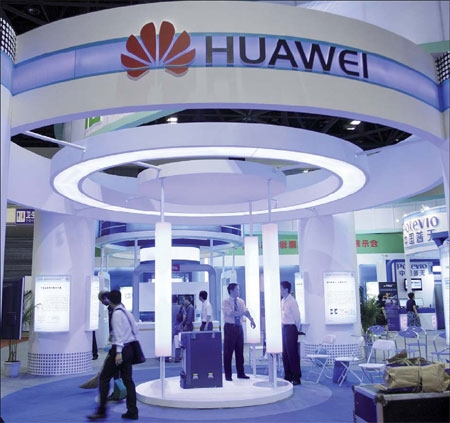 Many Chinese companies, like Huawei Technologies, are scouting for business opportunities in Poland. [Provided to China Daily]
|
Strong economic growth, financial support from eu top draws
Michal Wojtaszek, 27, a public relations specialist at the Polish Information and Foreign Investment Agency (PIFIA) in Warsaw, can use chopsticks pretty well although he has never been to China.
Since the beginning of this year, the agency has accepted more than 60 delegations from China to visit Poland, the sixth-largest economy and a new growth engine of the European Union.
Pawel Tynel, executive director of tax at Ernst & Young Audit Sp. zo.o. based in Cracow, says the number of the company's Chinese clients has risen in recent years, as businesses from the world's second-largest economy are increasingly interested in investing in Poland.
Those clients include Huawei Technologies Co Ltd, a leading global information and communications technology solutions provider.
"There will be more clients from China. We are seeing their great interest in investment in financial institutions, mining, manufacturing, and buying shares in existing companies," he says.
Chinese foreign direct investment (FDI) to Poland has grown rapidly over recent years. According to figures from the National Bank of Poland, China invested 97.2 million euros in 2008, a 50-fold rise since 2004. However, in 2009, the flows were negative against the backdrop of the financial crisis, cutting the FDI stock value from China by 107.5 million euros to 130.9 million euros.
By the end of 2009, there were 392 entities with Chinese capital in the country. In 378 of them, Chinese capital accounted for more than 50 percent, according to the Polish Central Statistical Office.
The number of Chinese companies in Poland had grown by nearly 423 percent from 2006 to 2009, it says.
Tynel says Poland's strong economic growth and its financial support from the EU all point to the country's increasing attractiveness for investment.
Poland witnessed a sharp recovery in GDP growth of 3.8 percent in 2010 and quarterly GDP growth has averaged nearly 4.4 percent since mid-2010, the fastest among European countries.
It is also the biggest beneficiary of European funding. The country is due to receive approximately 70 billion euros from the EU between 2007 and 2013, of which 66.3 percent has already been allocated. Poland is applying for another 300 billion euros after 2013.
Wang Weidong, the board chairman of Nuctech Warsaw Co Ltd (NWCL), a local subsidiary of Chinese security inspection product manufacturer Nuctech Co Ltd, says the parent company plans to inject more capital into the Warsaw company this year.
NWCL realized a profit for the first time at the end of 2010 after launching in 2004. Local private enterprises hold 1 percent of the company's shares.
The company's products are usually designed in China but manufactured, processed and sold in Poland. "In Europe, 90 percent of the products are manufactured in Poland. This year we plan to transfer core maintenance technology to Poland," says Wang.
He says the decision to set Poland as a pivot for developing its business in European markets was mainly because of the low labor cost there at twice that of China. In western Europe, labor costs may be as high as eight times that of China.
"The local education level also meets our requirements," Wang says, adding the company is targeting the European market partly because, unlike Africa, it is mature and composed of high-end clients, which encourages upgrades and innovation.
Slawomir Majman, president of the PIFIA, said the political and economic stability of Poland, and the fact that it has performed better than other European countries since the financial crisis, have jointly made it more attractive to foreign capital inflows.
But China has acted a little slowly in seizing opportunities, he adds.
"Polish investment in China far exceeds China's investment in Poland. We are not satisfied with that," says Majman.
He says it is a very important moment for Sino-Poland relations with the Polish president visiting Beijing on Dec 16. "We strongly expect a series of breakthroughs in the economic sector. China is very important to Poland's development strategy in the long term," adds Majman
To attract investment from China, Polish authorities approved a plan to set up a center for Chinese cooperation in October. It was designed to be a one-stop shop for Chinese enterprises that are interested in investing in Poland, Majman says.
In 2011, 93 percent of Poland's foreign investment came from the United States and European countries. The US contributed 31 percent, followed by France, the United Kingdom, South Korea, Sweden and Germany.
FDI to Poland has gone up by 22 percent this year. As of September, the figure surged by 80 percent compared with one year earlier.
The investment is mainly going to areas including auto-part manufacturing, business process outsourcing, machinery, aviation and information and communication technology.
"There has been no better investment environment than 2011 in nearly 10 years," Majman says, adding he is convinced that investment from China will rise inexorably.
But not all the Chinese enterprises are finding conditions sweet in Poland. Setbacks encountered by a Chinese State-owned construction contractor aroused worries among investors that the local environment may be much more complicated than they thought.
China Overseas Engineering Group Co Ltd (COVEC), a Beijing-based subsidiary of China Railway Engineering Corp, a major construction and engineering company in Asia, withdrew from a $447 million (330 million euros) highway construction project in Poland in the first half of this year after incurring potential losses of $394 million.
The cancellation came just two years after the company became the first Chinese enterprise to win a large European highway contract - to build two sections of Poland's A2 highway, which will stretch 49 km and run from Warsaw to the German border.
COVEC said the total cost of the construction will be 76 percent higher than the original estimate, as its Polish partner imposed a higher construction standard and the price of building materials soared unexpectedly.
Following COVEC's cancellation, Guangxi-based Liugong Machinery Co Ltd halted its purchase of Huta Stalowa Wola S.A. (HSW), a Polish construction equipment manufacturer, in June.
Following COVEC's decision, rumors arose that Liugong Machinery could not reach a consensus with HSW's trade union on issues such as the tenure of employment contracts and wage increases.
Pawel Tynel from Ernst & Young also warns that a labor cost rebound after 2009 may be a major risk for those thinking of investing in Poland.
In response to reported disagreements between Chinese enterprises and Polish institutions, Hong Lei, a spokesman at the Chinese Ministry of Foreign Affairs, said in June that China expects some friendly countries in Europe would continue to grant Chinese enterprises more support and understanding.
Waldemar Pawlak, deputy prime minister of Poland and minister of the economy, says: "Chinese enterprises should learn a lesson from the COVEC incident that they need to get familiar with local laws, partners, cultural differences and fiscal conditions when they invest in Poland."
Chinese enterprises should proceed with care when they are considering direct investment in Poland and other European countries, says Mei Xinyu, a senior researcher at the Chinese Academy of International Trade and Economic Cooperation under the Ministry of Commerce.
"The legal system, especially that of labor statutes in Europe, is too complicated. The best path is to start with sales and some contracted projects to get familiar with local circumstances before increasing investment in the region directly."
He says the biggest obstacle for Chinese enterprises is the fact that hidden costs will be huge because the highly efficient approach that they are accustomed to in other regions doesn't work in Europe.
To Mei, the advantages of Poland such as its rapid economic growth and comparatively low labor costs are far less attractive than in some countries in East Asia, even disregarding labor productivity. "One should invest directly into the targeted market instead of using Poland as a springboard for other European markets," he adds.
Some argue that the blurred economic prospects for Europe would make investors from China more cautious when they are planning to explore the market.
"We noticed that businessmen now hold very undecided views about investment in Poland and other European countries, mainly because of the increasing uncertainties of the European economy. They have become more prudent and hesitant," says Chen Yuehua, director of the foreign trade and economic cooperation department of Guangdong province.
Dong Xian'an, chief economist at the Peking First Advisory Co Ltd, says recent indexes continued to indicate the downward risks of the European economy, and that in the fourth quarter Europe would formally enter a recession.
Nonetheless, a group of more than 600 businessmen from Guangdong province and Hong Kong came to Warsaw in late October and signed economic cooperation contracts valued at nearly $10 billion with European countries, including $2.8 billion in direct investment and construction contracts.
















