


Report hurts long-term trade prospects
|
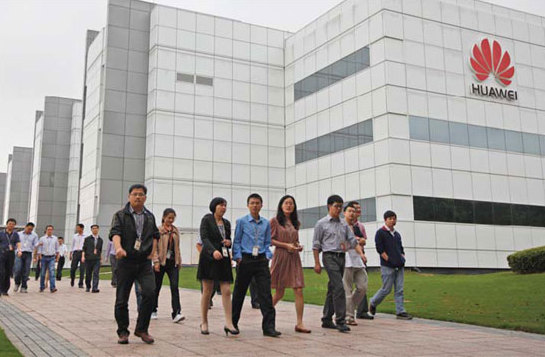
Employees of Huawei Technologies Co Ltd, the Chinese telecom equipment maker mentioned in the US congressional panel report, walk past the company office in Shenzhen, Guangdong. Tyrone Siu / Reuters |
Actions on Chinese firms smacks of trade protectionism: Experts
From New York subway-train ads featuring its handsets to slick, national TV commercials introducing its name, China's Huawei Technologies Co has been working to raise its profile in the United States.
A recent congressional report, however, has drawn unwanted - and, Huawei says, unwarranted - attention to the world's second-biggest maker of telecommunications equipment.
On Oct 8, the Intelligence Committee of the US House of Representatives issued a report claiming that Huawei and ZTE Corp - another Chinese telecommunications-gear provider that has established an American presence - pose a threat to national security and "cannot be trusted".
At a hearing in September, the committee raised questions about Huawei and ZTE. Citing its own and others' investigations, the panel said it "took seriously recent allegations of backdoors, or other unexpected elements" that the two companies installed in their software at the request of the Chinese government as well as their business activities in Iran.
After a year-long probe, the committee recommended in its report that regulators block any acquisition or merger involving Huawei or ZTE, through the Committee on Foreign Investments in the US; advised the federal government against using equipment from the companies; and said American businesses should buy telecommunications equipment from other vendors.
Huawei's corporate senior vice-president, Charles Ding, and ZTE senior vice-president for North America and Europe, Zhu Jinyun, denied all of these allegations at the September hearing.
Much of the House committee's claims stem from the Chinese companies' links to the People's Liberation Army and the central government in Beijing, as well as complaints that it has stolen technology from competitors.
However, Huawei has said when founder Ren Zhengfei set up the company in 1987, he had already left the PLA.
In May, a congressional delegation that included some members of the Intelligence Committee made a fact-finding trip to China, where they met with the chairman of Huawei's board of directors and officials from ZTE. Both companies are based in Shenzhen, a manufacturing hub in southern China.
Clif Burns, a lawyer in the Washington office of Bryan Cave LLP who specializes in export controls and economic sanctions, points out that the report reiterates general accusations about the two companies but doesn't present evidence supporting the claims.
Burns described the report as a "two-man" draft of a document that struck him as "very odd". The report doesn't state whether its conclusions were endorsed by any of the other 18 members of the committee.
"I think it's a publicity stunt," Burns says. "I don't think anybody is going to stop dealing with Huawei and ZTE because of this, nor should they."
Huawei's US spokesman, William Plummer, told reporters in Washington the day after the report's release that the committee's recommendations to block Huawei and ZTE's access to deals or business opportunities could set "a monstrous market-distorting precedent which could be used against American companies doing business overseas".
The report is the latest in a series of recent US moves that have caused trade frictions with China.
In late September, President Barack Obama cited national-security concerns to block Ralls Corp, owned by executives of China's Sany Heavy Industry Co, from buying four wind farms near a US Navy testing site in Oregon. It was the first time in 22 years that a US president had barred a foreign investment in the country.
In early September, while campaigning in Ohio, Obama announced a trade complaint against Chinese automakers and auto-parts suppliers, which many saw as part of an effort to appeal to voters in a crucial "swing" state in the Nov 6 election.
The president's Republican challenger, Mitt Romney, has accused China of forcibly keeping down the value of its currency to make Chinese exports cheaper. Romney has promised to label China a "currency manipulator" on his first day in office if elected president.
Regardless of the timing, the actions and rhetoric could harm both countries' economies.
"Clearly in a situation where you want to increase more jobs in the US, actions that will decrease the willingness of any investors, US or otherwise, isn't a good policy," Burns says.
Since setting foot in the US in 1992, Huawei has built four research facilities and hired 1,700 workers. In the past five years, the company has invested about $500 million in its US operations.
Dan Steinbock, research director of international business at US-based India, China and America Institute, argues in an independent report on Huawei that the company's further expansion in the US could be seen as an opportunity for the US government, companies, innovation and consumers because it brings jobs, capital and tax revenues.
Steinbock thinks Huawei's major expansion in the US would most likely have a similar outcome to what happened when it entered Europe where the industry margins decreased significantly,
"Due to its competitive advantage - low-cost production, rising degree of innovation - Huawei can achieve more and greater innovation, with lower expenditures. In the US, Huawei's major expansion would most likely have a similar outcome," Steinbock says.
"That is of great concern to Huawei's rivals in the US, including Cisco; but it would benefit US consumers," he says.
The Chinese giant's main US rival, Cisco Systems Inc, which recently cut business ties with ZTE, has created a marketing document that's circulating in the telecommunications industry, the Washington Post reported on Oct 10.
According to the newspaper, Cisco's document says "fear of Huawei spreads globally". "Despite denials, Huawei has struggled to de-link itself from China's People's Liberation Army and the Chinese government," it adds.
Burns, the Washington lawyer, says, "It's really a 'tinfoil hat' theory that has been floating around: If the Chinese are doing it, why not the English or the French? Why not accuse other foreign companies we deal with of posing a security threat?"
Despite the congressional committee's call to block the two Chinese companies from expanding in the US market, the rest of world has welcomed them.
In September, Huawei founder Ren met British Prime Minister David Cameron and signed a $2 billion investment deal in London. Ethiopia's minister of communication and information technology told Bloomberg News in an interview last week that it will sign a two-year contract with Huawei and ZTE in the coming weeks.
"There is no reason for the Chinese to risk devastation of that trade by pulling a stunt like that," Burns said, referring to the House Intelligence Committee's accusation that Huawei and ZTE insert "backdoors" in the software they make.
Burns also addressed the recommendation in the report that the Committee on Foreign Investments in the US - an interagency panel that reviews transactions based on security concerns - closely scrutinize the Chinese companies' dealings.
"I don't see the attitude of the committee toward Chinese investment in critical infrastructure changing. It is going to pose some barriers to certain Chinese investments," he says.
Yitai Hu, a partner in the Silicon Valley office of Alston & Bird LLP who litigates intellectual property cases, says the committee's move "is not about US protectionism" but does serve as an indicator to other Chinese companies.
"It is vital for Chinese companies to understand that when faced with any governmental or judicial inquiry, they must immediately engage competent US counsel so that they can fully respond to any such inquiry while protecting the companies' rights and interests," Hu says.
Contact the writer at yuweizhang@chinadailyusa.com.
















