


A new Chinese Internet buzzword
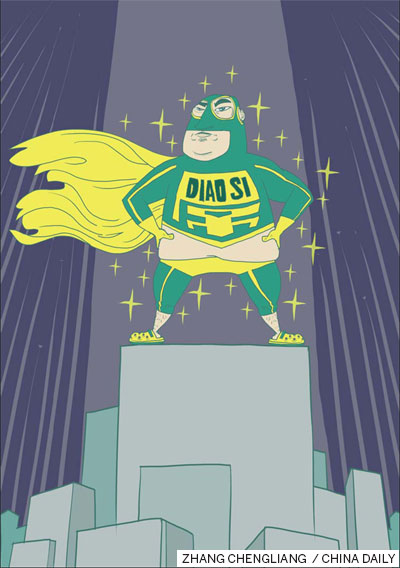
Are you a diaosi? And if you are, should you be happy to admit to it?
As with other languages, Mandarin has a long evolutionary history during which it takes on new words. In the past year or so, 屌絲 (diǎo sī), a Chinese Internet term, arrived on the scene. 屌 (diǎo) means men's sex organ and 絲 (sī) means public hair.
Of course, diaosi is a coarse, informal term. Originally it referred to the down at heel, those who are unattractive physically and lack social privileges or resources.
If we classify people according to the term's literal meaning, diaosi are from all corners of the country. Generally they are from the countryside or urban petty bourgeois families. Some are science graduates who have found that despite the time and money put into their obtaining a degree, the rewards are scant.
The person concerned may be a farm worker, a hairdresser or a network administrator who quit middle school and is restricted to a minute share of urban prosperity, or a habitual loafer who hesitates to admit his or her status and often regards himself or herself as self-employed.
In short, the original diaosi includes poor people, farm workers, small-handicrafts people, industrial workers, disgruntled employees, rootless proletarians and distressed graduates or undergraduates. Compared with 高富帥 (gāo fù shuài), who are tall, rich, young and handsome, they often describe themselves as 窮矮丑 (qióng ǎi chǒu) - poor, short and ugly youth.
Thanks to the Internet, more and more young Chinese now quite like the idea of self-mockery and call themselves diaosi, which has helped the term take off, and caters to a desire by millions to express their repressed feelings about life and its pressures. As a result, more young people are attaching the word to themselves, even though they are nowhere near as underprivileged as the original term was meant to suggest.
Basically, diaosi has the following common characteristics:
First, it is a reflection of the anxiety and resentment of many youth. This is based on their realization that the continuity of social hierarchy is increasingly formed by family power, and will not change easily. 富二代(fù èr dài), the second-generation wealthy youth, enjoy easy and prosperous lives, while ordinary folk struggle for limited resources. Describing themselves as diaosi is a way of expressing collective resentment and disappointment.
Second, diaosi reflects that youth take themselves less seriously, laugh at themselves as a way of misinterpreting their dark reality and openly admitting they are trivial, insignificant and live meaningless lives. In claiming to be diaosi, these people are affirming the hard work it takes to achieve personal progress. Their cynical outlook on life helps to release disappointment and cheers them up.
Third, diaosi often long after an idyllic soul mate. The problem is that the person they want to hook up with would be anything but attracted to them. Thus frustration turns into onanism, ultimately leaving them with nothing but their actual diaosi, their loneliness and their depression.
Fourth, diaosi always toil away in hard, exhausting and gloomy jobs. Rapid social and economic development produces injustices, which deprive the diaosi the chance of improving themselves. However, they are not the most tired and hard-working people. They are usually at the middle of the social stratum and never the lowest. Their pay is not as meager as they claim, and in fact roughly equates with their abilities and talents. It's just that they feel they deserve a better job and are undervalued at work.
Fifth, diaosi includes people who under the pressures of life are happy to mock themselves and their lot. These young people attach the word to themselves even though they are not nearly as hard up as the original diaosi. In that sense, diaosi are much like Ah Q, a character created by Lu Xun (a celebrated Chinese writer) in a novel.
Ah Q is a rural peasant with little education and no fixed job and famous for "spiritual victories", Lu Xun's euphemism for self-deception even when faced with extreme defeat or humiliation. Ah Q is a bully to the less fortunate but fearful of those who are above him in rank, strength, or power. He convinces himself that he is spiritually superior to his oppressors even as he succumbs to their tyranny and suppression. Lu Xun exposes Ah Q's extreme faults as symptomatic of the Chinese national character of his time, the 1920s. The ending of the piece - when Ah Q is carted off to be executed for a minor crime - is equally poignant and satirical.
The domain of the diaosi has never been a purely Chinese one. Japan has its otaku boys, Internet addicts who stay at home playing computer games, and "inertia girls", who lack the energy or motivation to face life. In American culture, "loser" is a serious word that refers to those who lack work and life skills. The term is highly derogatory, because while most people can stomach failure, they can never tolerate losers.
However, just as the word diaosi has become popular in China, there are youth in the US for whom being called a loser has lost its sting. In one song, Beck, a rock star representing the consumer generation, says, "I'm a loser, baby, so why don't you kill me?"
Contact the writer at weibaoliang@pku.edu.cn.
China Daily
















