


A small step for Ren, a big one for Huawei
CEO's media foray should spell a new beginning for technology giant
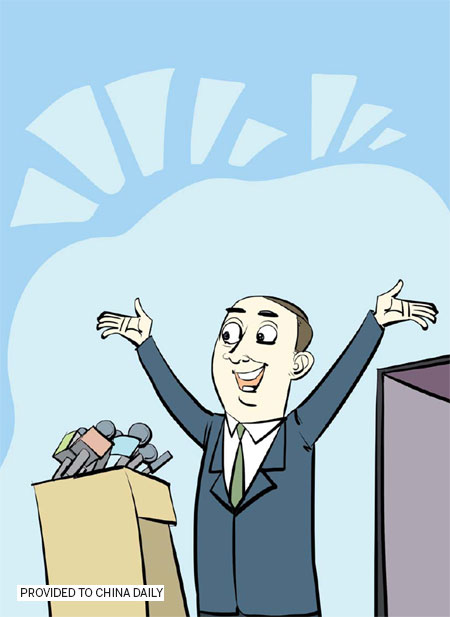
When Ren Zhengfei, the founder and president of the Chinese technology giant Huawei, talked to journalists in New Zealand a week or so ago, much was made of the media-shy businessman publicly expressing his views. But there was much more to it than that.
As China, the most populous country, began to implement its policy of reform and opening up in 1978, few people could have predicted what it would be like 35 years later.
That policy has gone through three stages. The first was to attract foreign direct investment. The second began when China joined the World Trade Organization in 2001 and the country stepped up exports of its products. Now, with $3 trillion (2.3 trillion euros) in foreign exchange reserves, overcapacity and exports facing more and more anti-dumping and countervailing measures, the third stage has arrived: investing abroad.
These days, for many Chinese companies investing abroad is not an option but a necessity; they need to do so to become integrated in the process of globalization.
As a member of the WTO, China's companies face competition worldwide, and if they do not build their strength by going overseas they are liable to pay the price at home, confronted with fierce competition from abroad.
Last year Huawei, which not many years earlier had been a small company that barely anyone overseas had heard of, overtook Ericsson to become the world's largest telecommunications equipment maker.
It had revenue of $35.5 billion last year, more than 70 percent of that from overseas operations. It sells products to more than 140 countries and reckons it services more than one-third of the world's population. It has more than 140,000 employees, about 46 percent of whom are engaged in research and development, and in 2011 alone invested about $3.7 billion in research and development.
As one of China's biggest private companies, Huawei can be regarded as a towering monument to reform and opening up and as a beacon for the third phase of that process.
But as it has achieved its success it has become a threat to others. It has large operations overseas but because of ostensible security concerns has failed to expand in the US, the world's largest economy.
In that light, the fact that Ren, 68, who founded Huawei in 1988, and who until last week in New Zealand had never done a media interview anywhere, finally found his voice.
It demonstrated how uneven the road is for Chinese companies to become global, more so than was the case with Japan and South Korea.
The culture of companies in those countries is closer to those of Western countries than is the case with companies in China, where the government's strong hand in industrial development means private companies need to maintain a good relationship with governments.
Chinese companies, having grown up in a developing market, have also been forced to play catch-up, putting highly trained staff under huge pressure to work harder for less pay to keep costs low and quality high. The demand for industrial and commercial flexibility has also required that management be kept in just a few hands. The Chinese companies have also needed to invest in developing markets before entering developed ones.
In the case of Huawei, even with its at-arms-length relationship with the government, the EU may find a pretext for trying to levy duties against it. After all, even Ren's past service as a military officer has been enough to feed the imaginations of those who raise concerns about security and telecommunications equipment.
Huawei is the only private company from China in the Fortune Global Top 500, which may give it some mystique, but which may also be a short-term tactic to keep talented employees, since their shares cannot easily be sold in the secondary market.
Those who run Huawei can point to the company's hard-won position to argue that its strategy has been right, but it is now probably time for it to change.
Its revenue growth was in double digits for each of the five years to 2011, but at only 8 percent last year. As the markets of developing countries become saturated, its main growth will be in developed countries.
However, it now faces the prospect of the EU levying duties, and the US market may be beyond reach for a long time because of the ostensible security concerns.
In short, Huawei has hit a barrier of protectionism and mistrust. New Zealand is a small country, but it is a typical developed country, which is why its friendly attitude is so important to Huawei. But as much as the company will welcome New Zealand's attitude, it will hardly provide the breakthrough the company needs.
The company needs to look at other possible reasons for the bind in which it finds itself and make appropriate changes. After all, its products and services are tried and tested so why should larger countries not trust it?
Many Western countries are apt to mistrust enterprises from Communist countries, and politicians can manipulate such suspicions for their own ends. However, Huawei is in no position to change the way the world sees China, and will need to persevere.
There is no doubt that the charges leveled against Huawei either lack substance or are irrelevant, and the company needs to make an extra effort to defend.
Huawei could include tighter measures in its commercial contracts to ensure security. In India the government has appointed particular bodies to ensure the trustworthiness of Huawei's equipment.
There is a broad consensus in developed countries that state-owned enterprises represent an unequal form of competition. Since many global Chinese companies are state-owned, Huawei, being private, has advantages over them. But it needs to be more transparent and media savvy. For this reason, Ren's small step is a big step for the company.
The author is a research fellow at the China Europe International Business School Lujiazui International Finance Research Center. The views do not necessarily reflect those of China Daily.
















