Symbols, superstition and playing the numbers game
How many roses does it take to show true, everlasting love? For one guy in Guangzhou, it seems several thousand is the answer. On Feb 13 last year, Xiao Fan proposed to 21-year-old university student Yin Mi after giving her a gown made of 9,999 fresh red roses.
Seated in Guangzhou's Chimelong Park, the train of her dress of roses spread behind her, Yin received another single red rose from Xiao Fan, along with a ring and a proposal. He then kissed her on the cheek as cameras flashed and dozens of people looked on.
"Such a lady killer!" one netizen commented after the story circulated online. "Marry him."
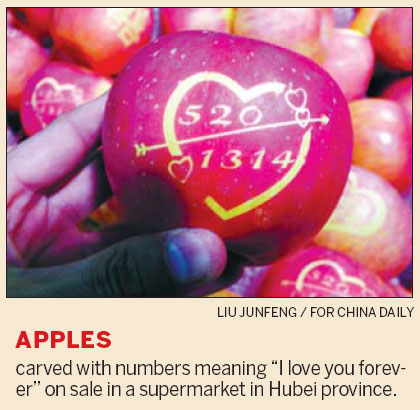
The crimson dress captivated many Chinese as it embodied not only affection, but a prayer for everlasting love. Nine is an auspicious Chinese number, being a homonym in Mandarin for "a long time". So you can say that a dress made of 9,999 roses suggests being together for a very long time.
Throughout history, numbers have become more than just symbols of quantity. Some have become associated with either good or bad luck, and few cultures take the symbolic meaning of numbers more seriously than the Chinese.
The organizers of the 2008 Beijing Games, the first Olympiad hosted by China, chose to launch the affair at one of the most auspicious moments for the Chinese: Aug 8, 2008, at 8:08 pm.
Eight, a homonym for "good fortune" in Mandarin, is probably the most desirable number for the Chinese.
In July 2009, according to reports, five men in Beijing were sentenced to up to 16 months in jail for beating up people near a machine issuing new car plates. Their goal: to ensure their ringleader got his hands on a license plate ending in 8888.
In August 2003, Sichuan Airlines placed a winning bid of 2.33 million yuan ($380,000) for the Sichuan telephone number 8888-8888. It remains one of the most expensive phone numbers ever bought. Besides being easy to remember, an airline spokesperson told The Associated Press: "It's a number that will make customers happy when they call."
At the other end of the spectrum is the number four, a homonym for "death". Some Chinese refuse to purchase a cell phone number with the digit, calling it "taboo". Also, many buildings in Hong Kong and the mainland do not designate a fourth floor so that the fifth floor immediately follows the third, as shown on elevator buttons.
Why is Chinese culture so infused with what seems to be numerical superstition? And what has kept these beliefs strong in modern times?
"It's part of the Chinese people's culture to use symbols to represent themselves," says Lee Cheuk-Yin, head of the Department of Chinese Studies at the National University of Singapore and a specialist in Chinese history and traditional culture. "They like to use symbols, because Chinese culture is more conservative and implicit."
A principle of this symbolism, Lee says, is the use of punning a play on words based on the similar pronunciation of different characters. This also explains, he says, why the Chinese consider fish and bats auspicious animals. "Fish" is a homonym for "abundance" in Mandarin, while "bat" sounds like "good fortune".
Using this principle, the Chinese have also come up with auspicious number combinations. Some of the most popular, according to a paper by Chen Rudong, a professor at Peking University's Department of Communication Studies, are: 168 (which sounds like "to always be rich"), 518 ("I shall be rich") and 666 ("everything will remain well").
These beliefs end up being passed on for generations since people develop an emotional attachment to symbols.
"Encountering a symbol, whether it's a number or a word or a picture, is a bit like encountering the thing itself, leading to a bit of ambiguity in the brain," says Matthew Hutson, author of The 7 Laws of Magical Thinking: How Irrational Beliefs Keep Us Happy, Healthy and Sane.
"We begin to treat symbols as the things themselves. So if you have eight with you on a license plate or in an address, it feels like having prosperity itself with you."
Amid China's growing economic wealth and people's scramble for a slice of the pie, such beliefs have become even more entrenched. Acquiring lucky numbers, researchers say, provides people with a sense of security and hope in the face of huge challenges to achieving success.
Chiu Chi-Yue, a social psychologist and business school professor at Singapore's Nanyang Technological University, calls this the belief in "negotiable fate". The term, he says, refers to the acceptance of one's fate as fixed and one's luck as malleable, which helps its subscribers remain hopeful in their pursuits.
"Although people cannot alter their fate, 'changing one's luck' through acquiring commodities associated with lucky numbers is within one's control," says Chiu, who has been studying this phenomenon for five years.
"As long as life's outcomes are believed to be determined jointly by one's fate and one's luck, people can maintain faith in lucky numbers' efficacy in achieving their valued goals."
The downside of this practice, he says, is that it can direct people's attention from more rational ways of overcoming obstacles and managing risks, like purchasing health insurance, seeking mentoring at work or accepting relationship counseling.
In matters of the heart, it turns out that Xiao Fan's pre-Valentine's Day proposal last year was all for show - a beautiful dress and event manufactured to put Chimelong Park in the headlines.
This is another problem with lucky numbers: They have gained such power in China that they can be exploited for commercial gain.
Niu Meng contributed to this report.
tiffany@chinadaily.com.cn.