


Farmers toiling in careers
|
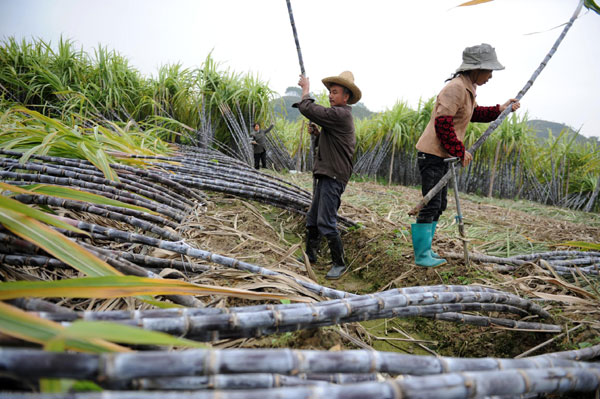
Sugar cane is a major cash crop for farmers in Shaoguan, Guangdong province, but farmers said fewer buyers have approached them in recent years due to an overabundance of the crop throughout the country. Zhou Wenjie / Xinhua |
Many pessimistic about improving their lives through farming: survey
Become a farmer to make more than a banker? US investment guru Jim Rogers once predicted that farming could be the best job this century.
But farmers in Guangdong province, one of China's richest regions, have a different view, if a recent survey is any indication.
Slightly more than half of the rural respondents in Guangdong province said farming is not the way to get rich, and 59 percent said farming cannot continually improve their lives.
The findings, experts said, reflect the growing wealth gap in the world's second-largest economy amid fast urbanization and population migration.
Only one-third of those polled said farming could improve their income, according to the survey by the Guangzhou Public Opinion Research Center, which interviewed 1,500 villagers across the province in June.
"I don't think farming can make a fortune. It simply is a living," said Huang Kanzhao, a pineapple grower in Zhanjiang, western Guangdong.
The 60-year-old toils with his wife on one-third of a hectare. The couple earn 17,500 yuan ($2,860) a year, half the average of their urban counterparts, even when "harvests are good".
Huang encouraged his children - two sons and a daughter, all in their 30s - to work in cities as government employees and office workers.
"They earn much more than I do," Huang said, without elaborating.
Rural families with members working in non-farming sectors earned an average of 49,668 yuan in 2011, while rural families engaged in farming reported an average income of 21,905 yuan, according to a report issued by the Center for Chinese Rural Studies of Central China Normal University last year.
The increasing wealth gap has prompted more farmers, especially young people, to migrate to cities.
Sixty percent of farmers in Guangdong said they observed that the number of farmers in their villages had dropped, while only 11 percent saw an increase, with similar figures recorded in both the more-developed Pearl River Delta and underdeveloped northern part of the province, according to the survey.
Eighty-three percent of the villagers said young people in their villages were unwilling to farm, citing reasons such as low income, hardship, bleak job prospects and the availability of other ways of making a living.
Only 7 percent said young people in their villages were willing to farm.
China's rural population stood at 642.22 million at the end of last year, accounting for 47.4 percent of the total.
Migrant workers, coming from rural areas to work in non-farming sectors, grew 3.9 percent year-on-year to 262.61 million last year.
Migrant workers in Guangdong's Pearl River Delta, the major economic powerhouse in the country, grew 2.5 percent to 51.99 million, accounting for 19.8 percent of the total across the country.
Peng Peng, a researcher of Guangdong social studies at the Guangzhou Academy of Social Sciences, said young rural people migrating to cities is an irresistible trend amid fast urbanization and a manufacturing labor shortage. Rural-urban income disparity is another major reason behind the trend, he said.
To correct this, Peng said, Guangdong should modernize its agriculture by promoting advanced technology and industrial farming, under which fewer people but more machines will work on the farmland to achieve economies of scale and bring handsome incomes.
"By then, young people, including college students, will be lured back to the farmland," he said.
As a traditionally agricultural country, China saw most of its population work on small, scattered patches of farmland.
As more people are moving to cities, the government is promoting family farming, under which a small number of farmers, usually from one family, are encouraged to rent large tracts of farmland.
















