


Rooftop bees help keep a city green
On the rooftops above the office canyons of Midtown Manhattan, there is a corporate life for bees where new colonies pollinate green roofs and produce honey for the lucky tenants working below.
Richard Kohlbrecher, who is allergic to bee venom, first saw hundreds of honeybees darting in and out of the sprawling sedum ground cover on the green roofs he was inspecting at One Bryant Park a year ago. He turned his initial alarm into a housing plan for the secret tenants.
"I had never seen that before and it got me thinking: if there are that many bees in Midtown, maybe it makes sense to put up some hives," said Mr. Kohlbrecher, vice president for operations for The Durst Organization, a major New York realty company that owns the 51-story tower.
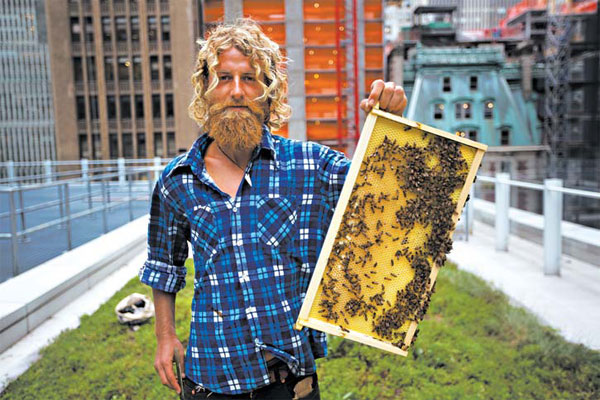
And so, unbeknown to the office workers, above them on the seventh-floor rooftop there are now some 100,000 European honeybees, brought in with two main hives during the summer.
|
Bees are used in New York to speed up the pollination of sedum, which is planted on rooftops. Mike Densham of Brooklyn Grange maintains the hives at One Bryant Park office building. Photographs by Demetrius Freeman / The New York Times |
Perhaps it's not surprising that Durst has become a proponent of beekeeping. The company has green roofs on eight of its commercial buildings.
And beekeeping has a long tradition in New York, now including such lofty perches as the terraces of the Waldorf-Astoria Hotel and the Whitney Museum of Art. In fact, beehives are becoming increasingly common across the city, said James Fischer of
TheHoneybeeConservancy.org, an advocacy group.
That increase has accelerated in the last three years, since a ban on beekeeping instituted in 1999 was lifted. It is costly to plant a lot of sedum and can take several seasons before it fills out; bees are a way to hasten this process.
Beekeeping has been catching on atop urban buildings outside of New York as well. In London, the number of urban beehives has exploded in recent years, to the point there was concern that the city had an insufficient supply of bee-friendly plants to feed the growing populations.
"Putting honeybees in a location supercharges the normal pollination process," said Chase Emmons of Brooklyn Grange, an organic rooftop farm in New York that provided the beehives to One Bryant Park and helps maintain them.
The honeybees are a Russian variety, known for their hardiness and ability to survive cold winters. That could come in handy because bees have been plagued in recent years by colony collapse disorder, a mysterious malady that has wiped out as much as 50 percent of America's commercial beehives in the last year alone.
Beekeeping is a relatively cheap endeavor. It can cost just $125 to buy a package of bees, and there is no real maintenance involved.
The Durst Organization plans to hand out the honey to its tenants as holiday gifts.
While their pollination efforts can help maintain the health of green roofs, bees are not commonly used for this purpose, mostly because of the fear of stings. Yet honeybees are inherently docile creatures, and in fact, they die after stinging. "So for evolutionary reasons, for a hive to expend the energy to defend itself, there has to be a clear or present danger," Mr. Emmons said.
But, he noted, "you wouldn't want the Time Warner guy coming up to the roof to install a cable and accidentally stumbling onto a hive, so it is important to know who will be accessing the area."
The New York Times
















