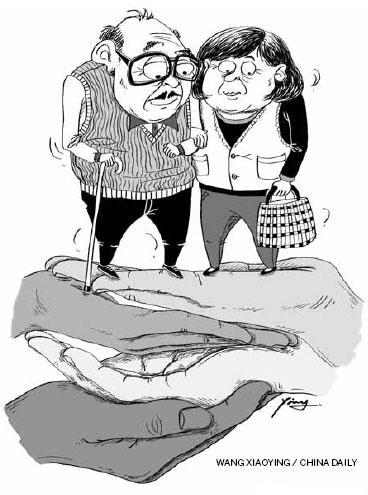
Reality of China's aging society
China has changed beyond recognition in the past 30 years. Therefore, the challenge for the Third Plenary Session of the 18th Communist Party of China Central Committee was not only to recognize those changes, but also to set a policy course that would enable the country to get ahead of its challenges. In terms of the new policy directions that have emerged in the final report of the plenum, the general response has been "so far, so good". Whether these directions can be translated swiftly into action remains a major issue.
The plenum was all about responding to the need to change, and no bigger change will take place in the next two decades than in demographics, in the acceleration of the migration of people to cities and the remorseless march of the aging society. For that reason, a significant focus of the plenum's deliberations was on providing common rights to all citizens.
The focus of urbanization will be the reform of the hukou (household registration) system and unifying the rights and entitlements to healthcare and social security. The emphasis in the demographic change will be to try and make the transition to an aging society smooth while, at the same time, pushing forward the involvement of the State in social care and well-being of senior citizens.
A look at the plenum's report will reveal the potential of these policies to affect the pace and have an impact on demographic changes. At the base of the demographic pyramid, the decision to change the family planning policy - allowing couples one of whom is a single child to have two children - is a welcome but overdue change. Whether it will have a significant impact on society, given the rising cost of bringing up children, remains to be seen, although the evidence from other countries in East Asia such as the Republic of Korea and Japan suggests that having just one child is often the private choice of couples and is not dependent on public policy. But for rural families and more affluent urban couples in the 25-to-34-year age group, it may have some impact.
More significant in terms of creating a larger working population is the decision to look at increasing the retirement age. Hu Xiaoyi, deputy minister of Human Resources and Social Security, has said that China will raise the retirement age in progressive steps.
As China becomes a more knowledge-based economy, the skills of more mature workers may be necessary to maintain the country's competitive edge. But as raising the retirement age in Europe has shown, such changes are difficult to "sell" to the public. They need to be phased in over a long period of time and linked to financial incentives such as higher deferred pension benefits and lower social security costs.
A focus on the social care and well-being of senior citizens (as opposed to more narrowly focused healthcare) is almost a necessity given the rise of the 75-plus age group and the "empty nest" phenomenon resulting from migration and the strict family planning policy.
But it is necessary to ensure that that provision is software focused - on the human side of daycare, stimulation and attending to personal needs such as help with cooking and cleaning rather than just adoption of construction programs for old people's homes. Some institutional care will also be needed in rural areas and to address growing problems of dementia and Alzheimer's disease. The nature of care, however, must be driven by the needs and desires of the elderly, not by GDP calculations of local officials.
This expansion of care will cost money and while China may experiment with long-term insurance for its younger workers, there is little choice but for the State to dig deeper into its pockets to meet the needs of the retired and close-to-retirement people.
A key proposal of the plenum is to expand the contribution of retained profit of State-owned enterprises to the government social security, although the 30 percent limit seems too low. Still this proposal should have multiple benefits - a better return on the State's investment in State-owned enterprises, less money sloshing around to be wasted in unwarranted expansion of non-core businesses and more resources for social security. Whether this extra funding will be paid to the general budget or to the National Social Security Fund and whether it will only be used to finance pensions or other health and social care benefits is one of the details still to be answered.
Indeed while almost every policy change is to be welcomed, "the devil lies in the detail". For example, the plenum talked about integrating social planning and individual accounts in the basic pension system (which has been de facto the policy for the last few years) but at the same time it said inputs into personal investment accounts would be increased to get higher annuities. These propositions are not necessarily contradictory but do not clarify whether the government is opting for funded or notional individual accounts, a long-standing contention between the Ministry of Finance and the Ministry of Human Resources and Social Security.
The plenum report also talks about the integration of health and social security rights between urban and rural areas. But this could mean nationalizing, as opposed to merely "coordinating", the local-governments-controlled pools of social security across the country and taking the management of rural healthcare insurance away from the Ministry of Health. Only three years ago, the MOH fought a successful battle to keep rural health insurance outside the ambit of the social insurance law. On that and on many other issues, defeating long-standing institutional "interest" in the maintenance of the existing order will represent a formidable challenge.
The plenum recognized that the economic and social development model developed 30 years ago for a vastly different China was no longer "fit for the purpose". But translating the right policy directions into concrete and quick actions will not be easy.
In November 2007, China Daily published an article on the problems of healthcare reform with the headline, "Policy debate hinders reform". There have literally been thousands of pieces of research producing many different policy options on all aspects of demographic changes, urbanization and the aging society. The time for debate and analysis is over; the time for the senior leadership to make and implement concrete choices has arrived.
The author, based in Kuala Lumpur, is an international financial consultant and former fund management expert on the EU-China Social Security Project.