


Revenge of the online copycat victims
|
Lesies, which originated in Hangzhou, was established in 1993. Provided to China Daily |
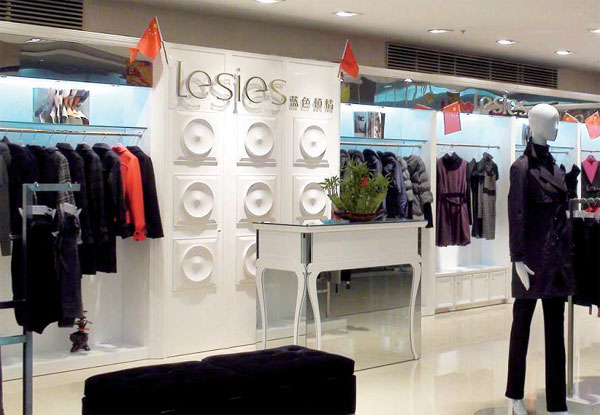
Fashion retailers find the way to beat unfair competitors is to beat them at their own game
If you have not heard about Hangzhou's fashion scene, you do not know about China's fashion industry.
Hangzhou labels, which are mostly known for women's clothing, focus on quality fabrics such as silk, cotton and cashmere. And their low profile but unique designs, a fusion of Western and Chinese aesthetic values, are giving the brands increased visibility on the Internet.
Gu Xiaohua, secretary-general of the Hangzhou Textile and Garment E-commerce Industry Association, says 2010 was a turning point for the garment industry. That year, many companies launched their online businesses.
The sector became one of the pillar industries of the city in 1993, and thanks to Sijiqing, the country's largest wholesale and shopping area for women's clothing in the city, the industry has developed fast in Hangzhou since 1996.
According to data provided by the Hangzhou Textile and Garment Association, more than 1,000 clothing factories operate in the city. Half of the 600 or so medium and high-end brands in China have their headquarters in Hangzhou.
Brand names such as Lesies, Cocoon, JNBY and Chiu Shui have become popular in the country, and franchise stores for them are scattered across China.
Chiu Shui, for instance, opened its first shop in 2005, and by last year, the company had more than 2,000 shops across the nation.
In 2010, women's garment companies in Hangzhou started to expand business through online shops. Now, 70 percent of the about 2,500 registered women's garment companies in the city have online businesses.
"Although our companies did not enter the online space very willingly initially, the results indicate brand new opportunities for traditional manufacturers in this industry," Gu says.
Gu says that in 2009 the owners of several popular local garment brands went to the association, complaining about plagiarism among online shop owners on Taobao.com, China's largest shopping website.
They complained that their designs for new seasons were often copied by Taobao.com shops, and they asked Gu to talk with local government officials and website operators to stop the copycats.
With the development of e-commerce and the growing popularity of shopping websites, traditional garment companies in Hangzhou faced great challenges.
"Low prices, convenience and abundant choices are the advantages of online shops," says Qian Feng, founder of Lesies.
"After we released new-season collections, we would see copycat designs online a week later. It was almost impossible for us to stop it," says Qian, who is also president of the Hangzhou Garment Designers Association.
A manager at Taobao.com suggested a solution. Why not set up their own Taobao shops? After hearing that, Gu figured out that they might have found a way out.
"Many of my peers were complaining about sluggish business. It was not that we hadn't considered doing business online. It's just that there were so many things to worry about," Qian says.
For brand owners like Qian, the biggest concern about e-commerce was how to maintain the brands' high-end positioning.
Qian launched the Lesies brand in 1993. After almost 20 years of hard work, he turned it into a high-end label. And even though Lesies' online shop was established at the end of 2011, Qian is still worried about whether the brand will be seen as a low-level product because it has an online presence.
"The prices of clothes sold in online shops are only half or even a third of those sold in brick-and-mortar stores," he says.
Although Qian was initially highly dubious about e-commerce, the sales revenue of Lesies' online shop in 2012 reached 50 million yuan ($8.13 million; 6.12 million euros), accounting for 10 percent of the company's total sales.
Gu says that at first many brand owners, like Qian, were unwilling to set up online shops, but since the brands had already made their names in China, once their online stores were launched, the sales results were satisfactory.
Last year, two Hangzhou brands were in Taobao.com's top 10 list for women's clothing sales in terms of revenue, according to a report issued by the China E-commerce Research Center.
One of the two brands, Na Wain Garment Co, ranked fifth with annual sales revenue of 190 million yuan.
Hu Changcai, general manager of Na Wain, says that it was fortunate that the company caught the e-commerce train at the last minute.
The company established an e-commerce department in December 2010.
"Before 2010, we regarded Taobao shops as distractions, hampering the healthy development of the industry, because there were so many shops that didn't do business according to the rules," Hu says.
However, after Hu had a taste of e-commerce, he had to admit that the field offers significant opportunities.
"Last year, the sales revenue of our online shop grew four times year-on-year. That's an unimaginably high figure for brick-and-mortar shops," he says.
To maintain a good relationship with the company's fast-growing customer group, Na Wain launched more than 150 online chat rooms for customers. Employees also get in touch with regular customers for suggestions and advice.
But just like Qian at Lesies, Hu worried about brand positioning before the company launched its online store.
"Our solution was to diversify our products online and offline. Our target customers for the online shop are five to 10 years younger than those for the brick-and-mortar shops," Hu says. "High-end customers can still enjoy our services in brick-and-mortar shops, while younger ones can select more affordable clothing online."
Meanwhile, to maintain the design advantage of the online shop amid the fierce competition, Na Wain established a design team with 15 people. For this year's spring collection, for instance, a total of 96 new designs were put on the market within two months.
Na Wain's brick-and-mortar shops continue to offer customers high-end and professional services at higher prices, while its online shop sells clothes to younger people. Hu views online shoppers as potential customers for his brick-and-mortar shops.
"As they get older, online customers will gradually become offline customers," he says.
However, for Hu, the development of brick-and-mortar stores is still and will continue to be for some time the focus of the company.
"After all, sales revenue of our online shop last year accounted only for 8 percent of our total sales. The online business helps us to expand rapidly and to a larger range of customers, but the main profits still come from our brick-and-mortar shop sales," he says.
Qian echoes that view.
"The online business can only be a complementary service to our brick-and-mortar shops. The question is how to balance the branding strategies of online shops and those of the other shops. That's a big problem because both of them share the same brand name."
Gu says that brand owners in Hangzhou should not be afraid to venture online.
"Willingly or not, Hangzhou's fashion brands have entered the e-commerce era along with other companies. Concerns and challenges remain, but opportunities and profits will come as well."
yanyiqi@chinadaily.com.cn
















