Fisheries ride the ebbing tide
|
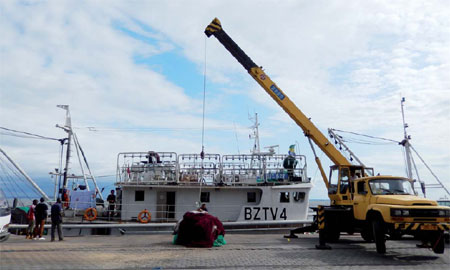
Fish are unloaded from one of Sino-Gabon Fisheries Company's 10 trawlers in Gabon. About 90 percent of the fish the company catches are sold in Gabon. Photos by Wang Chao / China Daily |
Gabon has been lucrative for Chinese fishing companies, but things are changing
Twenty-six years ago when Lin Wei's company arrived in Libreville, capital of Gabon, it planted a sapling outside its offices.
These days the tree towers over the premises, often swaying giddily in the strong winds that come in from the sea, and once in a while Lin snaps off a bunch of bananas to give himself and others a burst of energy.
Lin, 51, director-general of Sino-Gabon Fisheries Company grew up on the beaches of Dalian, the most important port in Northeast China. Over the past 20 years he has surfed a career wave that has taken him to Guinea, then to Argentina and on to Gabon.
The birth of Sino-Gabon Fisheries in Gabon was as serendipitous as a message in a bottle landing on one of the country's many beaches. The company's arrival was part of the "going overseas" call from the Chinese government, when each coastal city was assigned a "sister city" to expand their overseas businesses with, and the sister chosen for Dalian was Gabon.
At the time, Gabon had no fishing industry, just hundreds of small boats owned by fishermen, and there was barely any Chinese economic presence in Africa.
Some construction companies that came to the continent looking to make their fortunes enjoyed a few years of success working on aid projects but folded when the work dried up.
In contrast, Sino-Gabon Fisheries Company has prospered like that tree, and it and another Chinese fishery firm each own 10 trawlers.
The two companies combined have 80 percent of Gabon's fish market, and Lin's trawlers are the biggest in the country, each holding up to 200 tons of fish.
Gabon's coastline stretches over more than 800 kilometers, and the equator almost bisects the country. The warm waters on the coast provide good breeding ground for fish such as red snapper. Many of the species are quite different to those in China, and some are expensive delicacies in China's upmarket restaurants.
But 90 percent of the fish that Sino-Gabon Fisheries catches are sold in Gabon.
"We have better margins by selling fish here than shipping them back to China," Lin says. "Here the retail price is really high."
A report by the magazine BusinesWeek in 2012 ranked Libreville as the world's 19th most costly city to live in, more expensive even than Paris. A kilogram of rice there can cost more than $7.
For revenue, Gabon depends heavily on natural resources such as oil, and agriculture is very backward, so almost everything is imported, including meat and vegetables.
"Of the 10 percent of our fish catch that we ship to China, most of it is stuff that is not accepted here, such as cuttlefish and hairtail," Lin says.
Even if fish nets are cast and retrieved by machine these days, fishing remains extremely hard work. Sino-Gabon Fisheries' vessels sail to areas 10 hours out to sea, and each trip keeps crew members away for a month.
During that month nets will be cast and retrieved, and fish will be classed, then stored in huge refrigerators. When the trawlers return home, fish dealers descend on the port like seagulls, having been alerted about the vessel's imminent arrival, and eager to cut a tidy deal with the fishing boat owners.
By noon, the fish will be lying on plates in the restaurants of Libreville.
Sino-Gabon Fisheries has 120 staff, 110 of them fishermen, and most of those Chinese. That means that when the fishermen are at sea, the company's large yard is reduced to a skeleton of itself.
"Fishing is so hard that few local people are willing to do it," Lin says. The employers who are not fishermen, almost all of them local, work in the office or as drivers and guards.
Once the fishing waters off Gabon were an El Dorado for the company, its profits far exceeding what it could make in China. But those days are long gone, Lin says, because, just as in China, labor costs have risen and profits have eroded.
Because crew members are separated from their families for a month at a time, and with the cramped, smelly conditions of trawlers, attracting fishermen can be difficult, he says.
Locals have been reluctant to do the job, and the company has relied on Chinese fishermen, but now it is becoming harder, even with good pay, to lure them to this hard job on another continent, he says.
"Because people's pay has risen in China, I have to offer more money to get them here."
Ten years ago the fishermen were paid 2,500 yuan ($400) a month, he says, and now it is double that.
French-speaking Africa has always been at a disadvantage to the rest of the continent in attracting Chinese business and investment.
Fifteen months ago Gabon's government announced that the country would adopt English as its second language, and Xinhua News Agency quoted a spokesman for the presidency as saying "if you do not speak English, you are almost handicapped".
On the face of it, wider use of English would be helpful to any foreign businesses entering the country, but Lin has found that recent winds of political change have not necessarily been good for Sino-Gabon Fisheries.
He says that since 2009, business has become tougher.
Renewing operating licenses has become more difficult, and he complains of carping criticism from environmental groups about fishing. The groups receive advice from US and French consultants close to the government, he says.
The economic counselor at the Chinese embassy in Libreville, Wu Jingchun, says he has had many similar complaints from other Chinese companies in the country.
There is no doubt that political complexities affect what Chinese companies do in Gabon, he says.
"In major pillar industries such as gas and oil exploitation, Western companies already have a major influence, so there is no room for Chinese companies. In recent years they have turned their attention to less critical areas like fishing and timber."
Lin says that his company's applications for new trawler operating licenses take months to process, and that other Chinese companies have faced similar problems.
That treatment has put the jobs of many small fish dealers at risk, he says.
"This is the trade-off of the business opportunities here, we have to adjust to it. On one hand we must abide by the laws of the country, but on the other we need to diversify the business and seek opportunities in other areas such as aquaculture."
Contact the writers at wangchao@chinadaily.com.cn