


Toward doctor-patient rapport
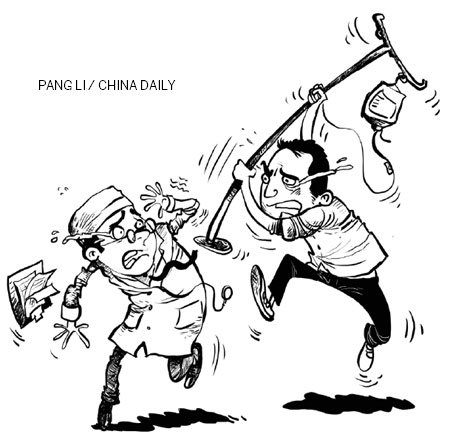
Accelerating the healthcare reform to ease tensions between doctors and patients deserves more attention of the annual sessions of the National People's Congress and the Chinese People's Political Consultative Conference.
Even on the opening day of the NPC, a Guangzhou doctor was pilloried on the street by more than 100 relatives of a patient who died at the hospital the same day. Despite the reason of patient death was unknown yet, such humiliation was unacceptable for most people. Before the Guangzhou case, another two recent incidents exemplify the strain that has developed between doctors and patients or patient parties. The first was the murder of a doctor by a patient in Heilongjiang province. And the second was the physical assault on medical workers of a Nanjing hospital by the parents of a girl because the hospital management had allotted a bed to a male patient in the female ward she occupied.
Violence in hospitals has escalated rapidly in recent years. According to the Chinese Society for Hospital Management, on average a hospital deals with 27 cases of violence (including murder) every year, and the targets are mainly doctors. And there is evidence to suggest that people in general no longer view the medical profession with respect. Once widely respected, doctors are now suspected of violating medical ethics. What are the reasons behind this irony? What can be done to rebuild the harmonious relationship between doctors and patients?
After the foundation of the People's Republic of China, its healthcare system was structured to resemble the Soviet system. All hospitals were virtually public. Governments funded the hospitals and their operational costs were taken care of by heavy subsidies. Patients' fees were nominal to ensure everyone got proper medical treatment. Health workers in hospitals were State employees, receiving fixed salaries. Revered as the "angels in white", doctors and nurses were respected by one and all.
The reform and opening-up, however, dismantled this "mini welfare state". Because of the decline in its revenues, the government, starting from 1980, had to substantially limit its funding to the healthcare sector, which had accounted for 50-60 percent of hospitals' income in the planned economy. Unable to finance public hospitals, the government allowed them to generate income from patients to ensure their financial survival. That created strong incentives for hospitals to shift from providing cost-effective healthcare to the over-utilization of high-tech diagnostic tests and expensive medicines.
Motivated to generate as much profit as possible, most hospitals have now tied physicians' incomes to the revenue they generate, adding a further perverse incentive for making profit while ignoring patient care. The abuse of profitable medical tests and the over-prescribing of drugs, especially antibiotics, have become common in hospitals. Receiving half their income from selling drugs, hospitals are run as profit-making entities. As a result, medical ethics have largely evaporated and mistrust toward the medical profession has become widespread, which has been exacerbated by the disclosure of medical accidents and scandals in the past years.
A survey conducted by China Youth Daily shows that nearly 70 percent of patients are suspicious of doctors' diagnoses and treatments. Another recent nationwide survey shows that merely 26 percent of physicians feel their patients trust them, and 70.9 percent would choose another occupation given the opportunity. More surprisingly, 76.7 of the doctors do not want their children to attend medical school.
These facts reflect a rather antagonistic environment within the medical profession. Worse, the doctor-patient relationship in the past decade has deteriorated from mistrust to conflicts leading to outright violence, and even murder.
Being the target of pervasive resentment, doctors on the Chinese mainland too are the losers. Compared with their peers in Hong Kong and Taiwan, and East Asian countries, mainland doctors are poorly paid. Several surveys show that doctors are unhappy with their income and heavy workload. Trained in medical school to be "angels in white", they have to face the hard realities in hospitals. It's no longer a secret that many doctors supplement their incomes from various sources, including red packets (hongbao), commissions on drugs and kickbacks (huikou), contributing further to the deterioration in medical practices and loss of patients' trust.
I was part of a survey on doctors in two provinces in December. Strikingly, 54.3 percent and 23.9 percent of the respondents described the current doctor-patient relationship as "tense" and "very tense". It was also disturbing to know that more than half the doctors surveyed had had at least one medical dispute with a patient in the past year. More startlingly, nearly 25 percent of the doctors had been physically assaulted by patients or their family members in the past year.
The mainland is in the midst of its ambitious national healthcare reform, and the initiative is on the right track. But the bloody violence targeting doctors sends an alarming signal to policymakers. And the problem cannot be solved until the healthcare reform addresses the root causes of the tension.
The government has to take decisive action to ameliorate these tensions and rebuild a healthy mode of interaction between doctors and patients. But this is easier said than done, because the existing situation mirrors the systematic dysfunction of the entire healthcare system rather than just the low trust between isolated individuals.
Nevertheless, several intermediary instruments are available for policymakers to consider, such as the adoption of medical malpractice insurance, participation of professional social workers in conflict management and using patient satisfaction surveys as a basis for distributing bonuses among medical workers.
The author is assistant professor at the Department of Asian and Policy Studies, Hong Kong Institute of Education.
















