Chinese investment in Africa 'exaggerated'
|
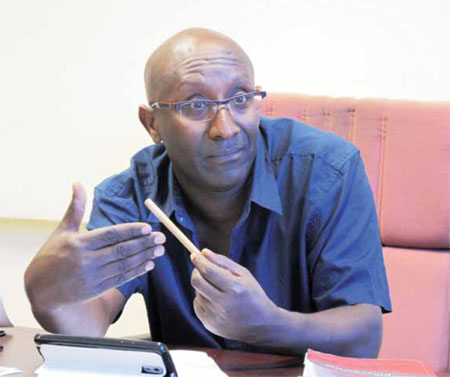
Alemayehu Geda, professor of economics at Addis Ababa University, says the West has a bigger economic impact on Africa than China. Wang Chao / China Daily |
One of the major concerns is the continent's danger of getting locked into a commodities trap, economist says
Alemayehu Geda says it is the West, and not China, that still has the bigger economic impact on Africa.
The professor of economics at Addis Ababa University insists that while the current spotlight might be on the impact of the world's second-largest economy on the continent, it is former colonial powers and the United States that are the largest investors.
"The conclusion one would make from all the media coverage and even the views of ordinary people is that China is this huge foreign investor.
"Yet 90 percent of the (cumulative) foreign direct investment into Africa is still from the West, the United Kingdom, France and the US. China's contribution is actually quite small. China combined with India is less than 6 percent. This gets lost in all the reports," he says.
Alemayehu, casually dressed and with the cosmopolitan air of a new generation of African academics, who was speaking in his office on the university's lush campus, says China has had its biggest impact on just a narrow select number of resource-exporting countries.
It is these that have had the double-digit growth rates over the past decade, which has led to the recent economic optimism about Africa, he says.
This has led to the continent being rebranded as Africa Rising in a recent Economist magazine cover or in the recent Lions on the Move report by management consultants McKinsey & Co.
"If you look at the prices of commodities over the past century they have declined against those of manufactured goods. It was only after 2002 with the demand for resources by China and also India that this began to change," he says.
"This impact has been limited to just nine or 10 countries, including Angola, Sudan and the DRC (Democratic Republic of Congo), which have accounted for 65 percent of (African) trade with China."
Alemayehu, who is regarded as a leading authority on the Ethiopian economy, is also a renowned development economist.
He has not only lectured in Africa but also at the School of Oriental and African Studies in London and at the Institute of Social Studies in The Hague, Netherlands. He also worked at the World Bank in Washington in the 1990s.
He has written a number of books, including Finance and Trade in Africa and Readings on Ethiopian Economy, as well as numerous papers.
One of his major concerns is that Africa is in danger of getting locked into a commodities trap.
"With commodities the big question is as to whether it is sustainable. We have already seen with the global financial crisis of 2008 and 2009 how the impact of a fall in prices affected Africa's resource exporters. It is the primary sector locking in effect," he says.
There are those who argue that this type of growth is better than none at all since Africa has consistently failed to develop a strong manufacturing sector.
Alemayehu says that Britain used to think the US was incapable of developing manufacturing but soon found its former colony producing goods and undercutting its own domestic industries.
"Britons used to say 200 years ago that Americans can't manufacture but they did and in the 1850s they had to introduce a rule that prohibited them from exporting manufactured goods to protect the domestic industry."
He says Japan, China and many other Asian nations have been at some point viewed as not being capable of joining the industrialized world.
"Countries comparable with African ones have managed to become manufacturing success stories, South Korea being a good example. If you properly manage your economy and resources then you can manufacture," he says.
Alemayehu, the second of six children, was brought up in Nazareth, a city 100 kilometers from Addis Ababa. His parents, both now dead, were small traders.
"My father never went to formal school, just a traditional religious one where he learnt to read and write," he says.
The academic says that the famines that badly hit the country in the 1980s did not directly affect him or his family.
"We could always afford to eat. We had a house and they could also afford to send me to school. The famines were in a different area. We were from one of Ethiopia's richest provinces. It used to snow in winters," he says.
He went on to study economics at Addis Ababa University and then went on to both a master's and a doctorate at the Institute of Social Studies at Erasmus University in The Hague.
Many might assume that Ethiopia might be a backwater of economic thinking but Alemayehu was influenced by Gebre Hiwot, a homegrown early 20th century development economist.
"He was writing then how if Ethiopia just traded commodities with Europe and didn't process them it would end up poor. He was writing in Amharic (the main Ethiopian language) 100 years ago but he proved prophetic."
Alemayehu has pursued an academic career, holding posts in Kenya, London and Addis Ababa, where he has been professor of economics for more than a decade.
Ethiopia is one country that might lead the way for Africa in terms of manufacturing.
China Eastern Park on the edge of Addis Ababa is now a hotbed of manufacturing and one of the main companies there, the Chinese-owned Huajian Group is planning a $2.5 billion investment to create 100,000 jobs in shoemaking within 5 years.
"The problem for Ethiopia is that the share of manufacturing has been stagnant at about 10 percent for the past 40 years. I am hopeful that the manufacturing facilities that are being established here, particularly at the Eastern Park, will make a difference," he says.
With China building the $124 million African Union building in the center of Addis Ababa, Ethiopia has been a key axis of China-Africa relations.
"The country has always been politically active across the continent, even before the African Union was based in the city.
"It is a huge potential market for a start. It has a population of more than 80 million, making it the second most populous in Africa."
Alemayehu says he is skeptical about some of the economic optimism about Africa with many talking of a new consuming middle class driving development.
"There is still a shocking level of poverty in Ethiopia and I don't think some of the statistics give you that. The majority of the population are young and poor. Every young person you speak to is desperate to leave the country."
The economist says that from the current vantage point it is difficult seeing the 21st century belong to Africa as well as Asia, as some have suggested.
"We still don't have the human capital. If I didn't go to school, I wouldn't have the opportunity to talk to you like this.
"There are some reasons for optimism. You can see some development but do we really have the human capacity and strategy? I really doubt it. We are still just blowing in the wind."
Contact the writers through andrewmoody@chinadaily.com.cn