


Expert taps safe water for Africa
Li Fengting gets excited when he talks about Africa. He has formed profound feelings for the continent over the past decade.
"Every time I get in a plane heading for Africa, I am always brimming with anticipation and excitement. It's just like coming home because I know everything and everyone there," says the 51-year-old, who often jokes that he goes to Africa more than he visits his hometown in Shangdong province, less than a two-hour flight from Shanghai.
Li is the vice-dean of the College of Environmental Science and Engineering and UNEP-Tongji Institute of Environment for Sustainable Development (IESD) at the Shanghai-based Tongji University. The institute was co-established by the United Nations Environment Program (UNEP) and Tongji University in 2002 for the purpose of strengthening scientific research and providing educational programs in environment and sustainable development.
Since then, Li, as the head of the institute and scientific specialist to UNEP, has been devoting himself to the supply of safe water resources in Africa, which is facing severe scarcity of ecological resources.
Climate change and soaring demand for economic development has led to a shortage of safe water, and has become a top priority for leaders in Africa.
In order to improve the technological ability in African countries, China's Ministry of Science and Technology (MOST) and UNEP signed the Memorandum of Understanding on Technical Cooperation on Water Resources in Africa in 2008. Marking the start of the Technical Cooperation on Water Resources in Africa with 16 African countries. Four projects were launched in Africa, mainly relating to water treatment.
Under the UNEP-MOST-Africa water project, a series of projects on safe water supply and technology were implemented by Li and his research team.
"When I first came to Africa, the landscapes natural beauty, breathtaking scenery and great wildlife really appealed to me. But at the same time, I was shocked by the condition of the local water," Li says.
"Many local people got sick due to the scarcity of safe water and the lack of sanitation supplies. Since then, a powerful sense of mission has developed and that underpins everything we do there," Li says.
Despite the many difficulties, Li and his team constantly travel throughout Africa, and they have struggled on tirelessly and without complaint.
"Whenever I arrive in an African country, I will take some time to visit local museums and markets to try to understand more about the local culture and life-style. I think this will help improve collaboration," he says.
Li and his research team work on two main projects, the re-use of waste water for forest plantation irrigation, and the development of new technologies for the supply of safe water. The team has gained first-hand knowledge about water resource distribution and the main barriers to water treatment in Africa.
Three memorandums of understanding on safe water supply and water treatment technology were signed with partners from Addis Ababa, Ethiopia and Kisumu, Nairobi of Kenya and demonstration projects have been ongoing.
In order to adapt to East Africa's unstable raw water quality such high turbidity and frequent variation, Li and his team carried out thorough technological research at Nairobi City Water and Sewerage Company, and made technical progress in water process design, monitoring and management as well as emergency response systems, which effectively ensured the safety of the city's water supply.
Meanwhile, the new water treatment chemicals provided by China not only lowered the chemical and energy costs, but also helped save about 355,000 tons of backwash water each year.
As an educator, Li often says, "Giving a man a fish is not better than teaching him how to fish". He hopes that more environmental talents can be trained to help people in developing countries promote sustainable development.
In addition to undertaking research on international environment issues, he also provided training for both domestic and overseas environmental officers and students for sustainable development through the UNEP-Tongji Institute for Environment and Sustainable Development (IESD).
The institute developed a number of specialties for the cultivation of senior technical and managerial personnel, such as water resource reservation, industrial ecology and environment management, eco-city planning and management, energy and environment, economic development and ecological protection, environmental informatics, environmental monitoring and remote control, environmental value analysis, regional and global environmental studies.
So far, more than 3,000 representatives from governments, NGO, institutions and private sectors from developing countries have benefited from more than 50 training programs at the institute.
Li's tremendous efforts have paid off. Last year, he was honored with the UN prize "In Recognition of Special Contribution to South-South and Triangle Cooperation" due to his significant contribution to the China-Africa cooperation on the safe water supply technology transfer during the 2013 Global South-South Development (GSSD) Expo held in the UNEP headquarters in Nairobi, Kenya.
"In spite of substantial progress achieved in the projects, there is still a long way to go due to the factors restraining cooperation among developing countries, such as regional conflict and asymmetric information, But we will spare no efforts in the poverty reduction and economic development and most importantly, maintaining a sound ecosystem in this beautiful African continent," Li said at the awards ceremony.
This month, Li went to Africa again, working as special coordinator of UNEP in a one year stint. This is his 40th trip to the continent. "Here, I will continue to devote myself to strengthening the South-South Cooperation. Africa is still lagging behind other places in terms of social and economic development, but I think the continent will definitely have a better future in next 10 years," he says.
wanghongyi@chinadaily.com.cn
|
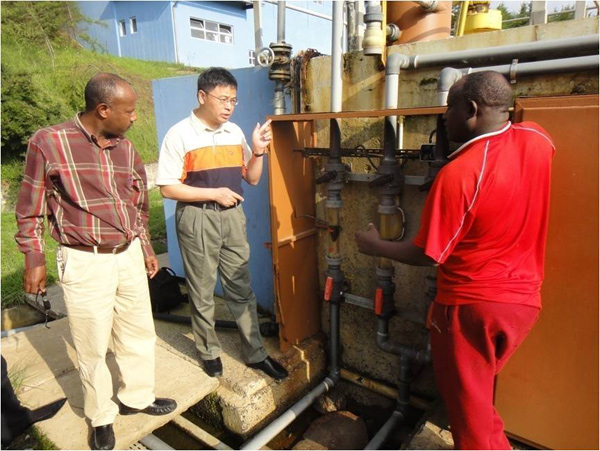 Li Fengting investigates a water treatment plant in Ethiopia. Provided to China Daily |
















