A place for education in building bridges
|
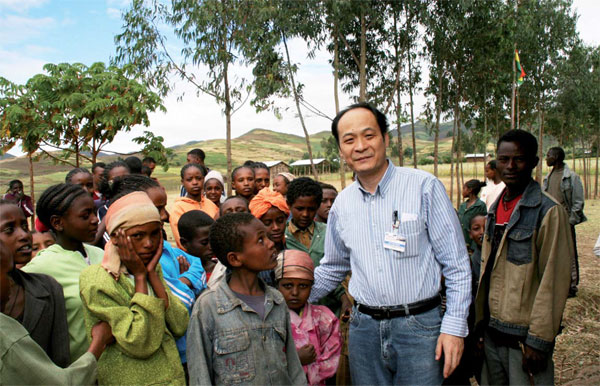
Wang Li with African students. He says China's achievement in rural education can be a valuable lesson for many African countries. Provided to China Daily |
Classrooms seen as a place for sound investment, especially with China's achievements in improving rural facilities
Wang Li is overwhelmed by both sympathy and hope when he recalls a trip in 2007 to a rural school in Ethiopia, about 100 kilometers from the capital, Addis Ababa.
"There was nothing in the school, only a blackboard, some chairs and a table, which all looked quite new. Apart from that, the rooms were as basic as they could be," says Wang, deputy director of a UNESCO research center.
The center, known as the International Research and Training Centre for Rural Education, has been supporting China and other emerging countries' rural education reforms for the past 20 years.
The school had three classrooms, taught by teachers responsible for four different grades.
But what struck Wang most was the realization that the entire school was built with between just 2,000 yuan ($320, 230 euros) and 3000 yuan.
"I was shocked," says Wang, who spoke to China Daily at the second annual Global Education and Skills Forum in Dubai last month.
"This amount of money for our businesses and organizations may not be enough for a meal. Yet if you give it to Africa, an entire school can be built, so many children of all ages could benefit."
This convinced Wang that China should give more support to Africa, because he believes it can foster the long-term Sino-African relationship.
Such action offers not just profits and soft power, but, more importantly, can also help Africa to grow, he says. He still vividly recalls the smiles on the children's faces as they gathered around him outside the school.
"Each face was different, but each smile was so beautiful. I was so happy to see them."
In 2005, China started to fund African education through the International Institute for Capacity Building in Africa, a UNESCO organization, a project in which Wang was closely involved.
The funding has grown over the years, and in March 2012 China signed an agreement with UNESCO to provide $8 million of funding support over four years.
In addition, staff of the international training center also frequently visit different countries to pass on their expertise in rural reform.
The center was founded in 1994, and its history reflects China's tremendous achievement in rural education and its desire to pass on its expertise to other emerging economies.
In 1990, delegates from 155 countries agreed at the World Conference on Education for All in Jomtien, Thailand, to make primary education accessible to all children and to greatly reduce illiteracy before the end of the decade.
"It was a consequence of the ending of the Cold War, because people realized they no longer had to fight, and it was time to invest in education," Wang says.
A follow-up meeting took place in Taian, in China's Shandong province, in 1991. Known as the International Symposium on Rural Education in the Developing Countries, it was the first international conference on rural education.
"Earlier, it was not conventional to separate rural education as an individual concept, but by this time UNESCO highlighted this concept, so the idea was that real progress on universal provision of education could only be achieved through the improvement of rural education," Wang says.
After the conference, delegates were invited to visit nearby rural schools and were amazed to see how much reform had already happened in China's rural schools since it began in 1984.
"Then somebody suggested it would be nice for China to host such an organization that helps developing countries to learn from China's experiences."
The topic was again considered by UNESCO in 1993, and the International Research and Training Centre for Rural Education was set up the following year. It has two aims: to help China's rural education reform and to help China share its knowledge with other developing countries.
Wang says the center has carried out many activities to achieve these two objectives, including research on different skills needed for inclusion in rural education, and rural women's access to education. It has passed on China's knowledge of rural reform.
China's rural education reform has come a long way since the Chinese government officially made it an objective in 1984, he says.
"One reason for its success is that it started early, because 1984 was six years before UNESCO introduced the concept of education for all. Second, it's down to the willpower of the Chinese government to effect change, and finally China's political stability helped, because it meant policies could be executed properly."
There was a historic change to China's rural education in 2006 when the government decided to make primary school and the first three years of secondary school free for all rural students, and simultaneously give financial support to their living costs, he says.
According to government figures, 99 percent of children across the country now attend primary schools, and 97 percent attend secondary schools, Wang says. However, in some poorer regions students still drop out of school because of financial pressure to work.
China's experience in the reform of rural education can be valuable for many African countries, particularly in areas such as devising effective teaching methods and designing curriculums, he says.
One difficulty in sharing this experience with Africa is the cultural divide that can exist in any form of training China delivers to Africa.
"I personally don't believe we are at the stage where our teachers are ready to give African teachers training," Wang says. "Most of our teachers don't speak the local languages in Africa."
Wang recalls visiting a tribe in Ethiopia where his host gathered food with his hand from a bowl and fed it to Wang. Because of the unusual way of serving the food, Wang hesitated, but quickly gulped down the food.
"I had to eat. It is not good enough to just say that China and Africa are brothers and sisters, We have to put it into action. Brothers and sisters share; if our African hosts can eat it, I can eat it too. But I'm afraid most Chinese teachers don't think this way."
Despite the challenges, Wang believes education training and exchanges between China and Africa are particularly useful.
"We help Africa build a lot of infrastructure, but I think we are not doing enough to help it improve education, because education is where China and Africa can build common values and emotional bonds."
In addition to supporting schools in Africa, Wang says, the Chinese government should give more scholarships to African students at Chinese universities.
The amount of money Chinese universities give to African students is small compared with what developed countries like the United States and Europe, or China's Asian neighbors South Korea and Japan, give, he says.
"This has meant the most talented African students go to the US and Europe, and those who do not make it to those places choose South Korea or Japan, and only after that do they consider China."
Even if China funds fewer African students, each should receive a good amount, he says, so that Africa's top students will be attracted to Chinese universities, and grow up to build bridges between China and Africa.
cecilyliu@chinadaily.com.cn