


China's education revolution
Over the last 35 years, China's strong and sustained output growth-averaging more than 9.5 percent annually-has driven the miraculous transformation of a rural, command economy into a global economic superpower. In fact, according to the World Bank's most recent calculation of the purchasing power of aggregate income, China is about to overtake the United States as the world's largest economy. But, in terms of the quality and sustainability of its growth model, China still has a long way to go.
Despite its remarkable rise, China's per capita income, at $10,057 (adjusted for purchasing power) in 2011, ranks 99th in the world-roughly one-fifth of US per capita income of $49,782. And reaching high-income status is no easy feat. Indeed, many countries have tried and failed, leaving them in a so-called middle-income trap, in which per capita income levels stagnate before they can cross the high-income threshold.
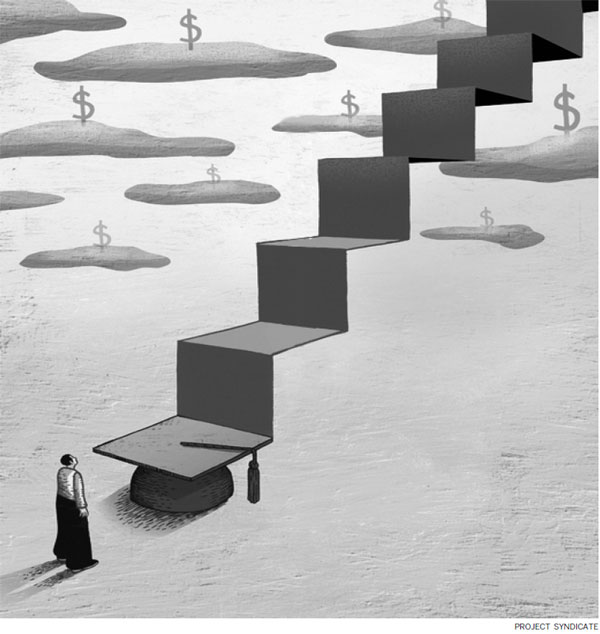
Strong human capital is critical to enable China to escape this fate. But China's labor force currently lacks the skills needed to support high-tech, high-value industries. Changing this will require comprehensive education reform that expands and improves opportunities for children, while strengthening skills training for adults.
To be sure, over the last four decades, the quality of China's labor force has improved substantially, which is reflected in impressive gains in educational attainment. Gross enrollment rates at the primary level have surpassed 100 percent since the 1990s, while secondary and tertiary enrollment rates reached 87 percent and 24 percent, respectively, in 2012. In 2010, more than 7 percent of Chinese citizens aged 15-64 had received secondary education, compared to about 20 percent in 1970.
Furthermore, Chinese students perform well in internationally comparable tests. Fifteen-year-olds in Shanghai outperformed students from 65 countries, including 34 OECD countries, in mathematics, science, and reading, according to the Program for International Student Assessment in 2009 and 2012.
China has also benefited from rapid employment growth, with more than seven million workers having entered the workforce each year since 1990. This, together with the massive reallocation of workers from rural to urban areas, has supported the labor-intensive manufacturing industries that have fueled China's economic rise.
But China's demographic advantage is diminishing quickly, owing to low fertility rates and population aging. According to the United Nations, by 2030, China's working-age population (15-59 years old) will have decreased by 67 million from its 2010 level.
Moreover, higher education in China leaves much to be desired, with employer surveys revealing that graduates of upper secondary schools and universities usually lack the required technical knowledge and soft skills. For example, in 2013, more than one-third of the Chinese firms surveyed said that they struggled to recruit skilled workers, with 61 percent attributing this to a shortage of general employable skills. How, then, can China expect to achieve the export diversification and technological upgrading that it needs to move up the global value chain?
Clearly, China needs to reform its higher-education institutions, including technical and vocational training programs. At the same time, it must expand opportunities for anyone with talent to acquire high-quality secondary and tertiary education, thereby reducing substantial disparities in the accessibility and quality of higher education across regions and social groups. And the children of migrant workers in urban areas must be granted full access to the education system. Such efforts to reduce educational disparities would help to address income inequality-a significant threat to China's future economic growth.
All of this will require increased public investment in education. As it stands, China's public investment in education, as a share of GDP, is below international standards across all levels, but especially in senior secondary and tertiary education.
China's education challenge also extends to quality. Inadequate education is a major driver of rising unemployment among China's senior secondary and tertiary graduates, not to mention their declining wage premium. This can be remedied through better financing, more effective recruitment and compensation policies, and more decentralized decision-making in school administrations.
Finally, though some evidence suggests that there is an over-supply of university graduates in China, ongoing demographic and sectoral shifts mean that China will encounter a supply deficit of 24 million highly skilled graduates of universities or higher-level vocational schools by 2020.
To fill this gap, China must upgrade its fragmented and ineffective technical-and vocational-training programs.
To ensure that its labor force can meet the demands of a rapidly changing economic and technological environment, China must build a more inclusive, higher quality education system. Without it, China may not be the world's number one economy for long.
The author is professor of economics and director of the Asiatic Research Institute at Korea University, and a senior adviser for international economic affairs to former president Lee Myung-bak of South Korea.
Project Syndicate
















