China's green drive 'can benefit Africa'
|
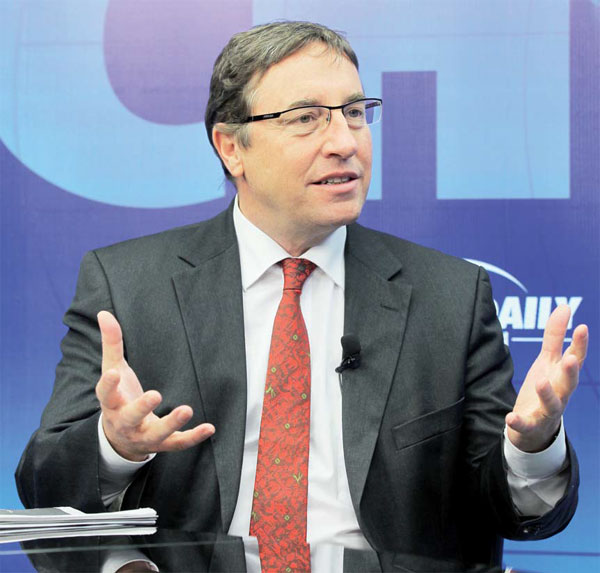
Achim Steiner, the UN's top environmental official, says transferring old technology is not sustainable. Wang Jing / China Daily |
UN's top environmental official praises nation's efforts at greener economy, but says it has a commitment to offer its know-how around the world
The UN's most senior environmental official says China's efforts at tackling its own industrial cleanup have passed "a turning point", and thinks the transfer of that know-how to Africa will now be vital to the continent's future sustainable growth.
Achim Steiner, executive director of the United Nations Environment Programme, calls the country's concept of ecological civilization - a new approach to thinking about the integration of economic and social environmental aspects - "the most significant political direction provided by Chinese leadership of the last few years".
In an exclusive interview, ahead of the first UN Environment Assembly, to be held in Nairobi June 23-27, Steiner told China Daily that successful ecological civilization planning touches both top policy-making and individual levels, given that its adoption in China stresses the commitment and efforts made by the country's leadership to building a long-term environmental strategy.
"Chinese citizens more than anyone know the costs that fast economic growth and development have had during the last 10 years," he says.
"But decisions made by the Chinese government have shown many signals that a turning point has passed with the establishment of the Ministry of Environmental Protection."
The keys to China's plan are to enhance energy efficiency and environmental quality, to facilitate industrial transformation and upgrading through innovation and environmental protection, and to eliminate outmoded industrial production capacities throughout different industries, while beefing up the environmental impact assessment of new projects.
The Nairobi assembly will gather more than 1,200 participants under the overarching idea of "Sustainable development goals and the post-2015 development agenda, including sustainable consumption and production".
The event is designed to encourage ongoing discussions on the formulation of a set of targets and indicators that would succeed the UN's Millennium Development Goals.
As head of the globe's most influential environmental body, Steiner says China's regulations on combating air pollution - approved last year - had displayed the country's dedication to accelerate a program to phase out its most polluting factories and power plants.
Also its investment in the renewable energy sector signals China is not only looking at its economic development in terms of ensuring energy supply, but moving toward a clean energy supply, he says.
"Significant investment has been earmarked, for example, in public transport, high speed railways, underground railway systems, and metro systems in big cities.
"All these indicate that throughout China, particularly at a national policy level, there is a recognition that the future can't be based on the development model of the last 30 years," he adds.
But Steiner says China's dilemma of how to tackle environmental issues while maintaining its economic development momentum is far from unique.
China and Africa both have ambitions to cooperate to accelerate industrialization in Africa, but to make the future industry transfer more sustainable and greener, leaders on both sides as well as Chinese CEOs should be motivated by a sense of environmental protection, he says.
China's domestic transition in adopting green energies and the technologies being used can be beneficial around the world, he adds, particularly in Africa.
"If China's investment in the domestic renewable energy market is successful, for instance, it would bring down the per capita unit of affordable wind power energy.
"That means China could enable many other countries to do this too, even in Europe, but it's particularly relevant in developing countries such as in Africa.
"When they start investing in this kind of infrastructure and begin to access clean energy and technology resources to develop themselves, then clearly China must play a significant role by taking that global, and helping to bring down the price of that technology."
However, Steiner took pains to emphasize that industry transfer is not just about what he calls packing and unpacking.
"If China dismantles its own old coal-fired power stations and packs them into containers and ships them to Africa, it might be good for the particular owner of the station.
"But all that does is to repeat the old pattern that was often seen from the 1960s to 1980s, when industrialized countries relocated their factories to developing countries, essentially locking these countries into another 20 years of very polluting industries," he says.
"This would prevent African countries from attaining their own technologies."
He concedes that green technology is often conceived as expensive and not applicable to some less developed countries, but he insists it's not about the economy of renewables, but how they are financed that matters.
He highlights the case of the UNEP headquarters in Nairobi, which uses green technology and natural renewable energy, a combination of which in the long-run will not only save energy costs, but also be kinder on the local environment.
"Credit lines can be found, and public financing and banking sectors can enable enterprises, shops or farming operations in Africa to have the capital they need to invest in solar power, so the economics of running and using that can be competitive," he says.
"We repaid the cost of our building's solar power in nine years, and we have earned money every year by selling our surplus electricity."
He says cleaner production is more expensive only in a sense that the cost of pollution is not charged to the producer, but society as whole.
"When you pollute a river by chemicals, oil or plastic, the producer could make its product cheaper, but it's society that pays for the cleanup. That's why the economics are so often badly out of step.
"Across the world, it has been demonstrated that greener energy costs may be higher per unit, but for society as a whole this type of consumption represents far better value.
"We are nearing the stage when the simply equation of 'green is expensive, brown is cheap', no longer applies," he adds.
Steiner says China, as the world's second-largest economy despite its developing-country status by per capita income, has a huge influence on other regions such as Africa.
"It's time for many Chinese companies to think about whether they can build a resilient African development model, or whether the relationship between China and Africa should remain in its old form, in which Africa only provides natural resources," he says.
He considers that a successful future economic relationship between the two largely relies on mutual value-added exchanges.
The UNEP executive director says the world is facing severe environmental challenges, and the development of a greener economy is very much a case of survival or death.
"The world's population has reached 7 billion, and so reinventing our economy to become greener and more sustainable is not just desirable, but essential.
"We are facing increasing shortages of resources, and we are living in a materially very inefficient world.
"It's not only about running out of metals or rare earths, it's about our inability to grow food in the future, about health and quality of life," he says.
"People increasingly don't just measure wealth as a healthy bank account or growth in GDP.
"If my child is suffering from environmental diseases, if our baby milk is contaminated, if I have to wear a mask to go to work, if I have to spend three hours in traffic to drive 10 km, or live next to public waste dumps, even with all the money in the world in my bank account, I am not experiencing the benefits of development.
"The global economy is moving quickly toward a major transition of its mainstream energy technologies, and facing some fundamental constrains on its future access to energy."
It's an issue facing not just every nation, but every household, he adds, "and China has already started experiencing those challenges."
lilianxing@chinadaily.com.cn