


Mental health needs are an emergency
China has a complex history in the treatment of the mentally ill. In 1849, the first institution to treat the mentally ill in China was established by Western missionaries, and some principles instituted by one of them, Dr John G. Kerr, are still valid today. His principles are: mentally ill patients should not be blamed for their actions, they are not to be thrown into prisons but put in hospitals, and they should be treated as human beings, not animals. Western models of treatment, however, were gradually introduced in China only after the launching of reform and opening-up in the late 1970s.
China has a large number of mentally ill patients, to treat whom it does not have adequate services and enough trained personnel. A new "mental health law" adopted recently does contain some important provisions for the benefit of patients. But it does not allow mentally ill patients the right to a legal hearing through a mental health tribunal or guarantee them legal representation, which has been criticized by health professionals and human rights organizations.
According to a study by The Lancet, about 173 million Chinese suffer from some form of mental health disorder. One hundred-fifty-eight million of them have never received professional help. Despite the high number of mentally ill patients, China averages only one psychiatrist for every 83,000 people - about one-twelfth the ratio in the United States and other industrialized countries. This led one psychiatrist to remark: "We are like pandas. There are only a few thousand of us."
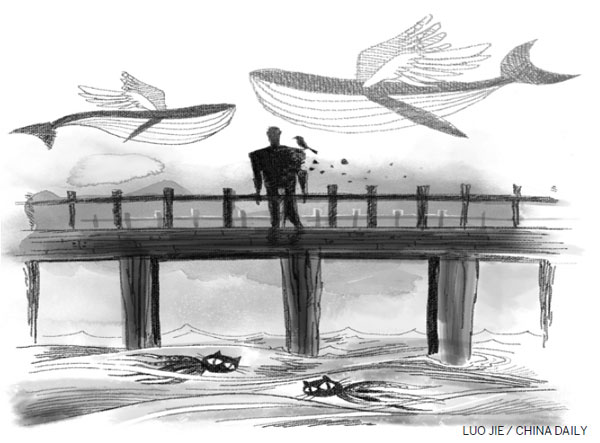
The need for psychiatrists is growing. The Lancet study shows the incidence of mental disorders increased more than 50 percent between 2003 and 2008. Although some of the cases can be attributed to improved diagnosis, most are likely to be the result of more stress in their everyday life.
The stress, in fact, could be one of the causes for the increasing number of violent crimes. In 2010, China suffered a series of copycat attacks on kindergartens in which tens of children were stabbed to death, prompting Yin Li, vice minister of health, to declare that China would build 550 hospitals for the treatment of the mentally ill.
In 2009, the World Health Organization said mental illness - which affected 7 percent of the population - had overtaken heart disease and cancer as the biggest burden on China's healthcare system. The spectrum of mental illness is broad ranging from minor conditions such as anxiety to serious illnesses like depression, obsessive-compulsive disorder and other problems that may lead to drug addiction and serious crimes.
Depression is China's second most commonly diagnosed disease and has a huge economic cost in terms of lost workdays and medical expenses. In recent years, depression has replaced schizophrenia as the most common mental disease at China's top mental health facility, Beijing's Anding Hospital. According to rough estimates, more than 260 million people were struggling with at least mild depression in 2011. Depression-related deaths such as suicides even exceed traffic fatalities.
In 2007, China's Medical Association estimated that two-thirds of the people suffering from depression had harbored suicidal thoughts at least once, and 15-25 percent actually committed suicide.
Huge needs in the treatment of the mentally ill have led to an increase of unregistered and inadequately trained psychologists who are unable to provide proper diagnosis and treatment to the patients. As a result, the condition of quite a few patients worsens.
The Ministry of Human Resources and Social Security is expanding the country's professional ranks by modifying criteria to certify mental health counselors, who can treat patients suffering from minor depression symptoms and thus alleviate the work of psychologists/psychiatrists who could attend to more serious cases. But additional steps have to be taken to ensure that enough professionals are trained in medicine and psychology to address all the problems.
Perhaps recruiting professionals and experts from abroad to help train local psychology students could help. But the government has no choice but to build more mental health facilities to help patients in greater need. Mental health needs are an emergency and they should be treated as such.
The author is a global health consultant and contributing editor for The Globalist.
















