Efficient ecosystem key for innovation-led development
As China shifts its development model from one that looks to catch up with the West to one that is more and more innovation-driven, it is critical that the nation builds an efficient innovation ecosystem, said experts at the Zhongguancun Forum 2014 on Thursday.
Top-notch experts from around the world said that a highly efficient ecosystem was badly needed for China to become a truly innovation-driven economy at the annual forum in Beijing.
Xu Guanhua, an academician at the Chinese Academy of Sciences and former minister of science and technology, hosted the event, and noted: "The forum is targeted at building the innovation ecosystem, assessing how it could influence and change the technological and commercial model and promoting synergic innovation and industrial development."
Chen Qingtai, former Party chief and vice-minister of the Development Research Center of the State Council, said in his keynote speech that China had been trying to catch up with leading economies for a long time.
"There were models in other countries to follow and the development path was highly predictable. Many matured technologies we need can be bought from overseas markets," he said.
"However, we have already passed that period and are moving into a time of innovation-driven development. There are huge differences between the old-fashioned catching-up model and the innovation-driven model," he said.
According to Chen, innovation is market driven. It takes entrepreneurial spirit and involves a lot of risks. "The new innovation will disrupt old innovation, which will lead to ups and downs for enterprises and the flow of the workforce. But, all in all, it will set a higher bar for the ecosystem," he said.
Wu Jinglian, a researcher at the Development Research Center of the State Council and professor of Baosteel Economics of China Europe International Business School, said China had made a lot of technological achievements since the creation of an innovative nation was put on the top of the government's agenda in 2005.
However, although China has progressed in terms of developing high-tech sectors, such as green energy and electrical cars, the development was based on high costs and high investments, said Wu.
"The problem is that our national innovation system is low in efficiency. We need to build a high-efficiency national innovation system, a network made of public and private organizations, in which entities can interact with each other in a good way," he said.
Del Christensen, chief of Global business Development of the Bay Area Council, explained the innovation ecosystem of Silicon Valley at the forum. He said Silicon Valley's success lay in a unique value chain of public and private research institutions, private companies, risk capital and specialized support services.
"The key is not the components, but the fluidity with which they interact. There are few barriers to participation," Christensen said. He added that one of his friends in Silicon Valley had just started a business with a simple idea and that there were more than 200 incubators and accelerators to support the dreams of entrepreneurs.
Christensen said that China offered several preferential policies to attract overseas talent to return to the country. He said Silicon Valley faced several challenges such as shrinking federal research funding and visa and immigration restrictions.
Human and financial capital may not be China's top challenges in terms of building an innovation ecosystem, experts said. Karin Finkelston, vice-president for Asia Pacific of the International Finance Corporation, said human and financial assets, networks and culture were just as important as hard infrastructure in terms of building an innovation ecosystem.
"However, the culture of business, collaboration and entrepreneurship is hardwired and can be slow to change," she said.
|
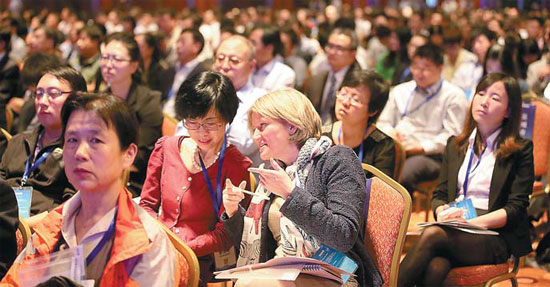
Two delegates have a discussion. |