'Snow land' doctor keeps on healing
A life dedicated to treating the people of rural Tibet stems from patient's gift 30 years ago
Most Chinese people regard Lunar New Year as a time of family reunion, but Li Suzhi spent his time treating patients in rural areas of the Tibet autonomous region.
"Doing one good thing is easy, but to keep doing good things throughout one's whole life is difficult," said Li, the president of the General Hospital of the Tibetan Military Area Command.
"Instead of spending my spare time with hobbies such as fishing or photography, as other people do, I find treating patients in rural areas a more meaningful pursuit," he said.
Li was born in 1954 in Shandong province and graduated from Shanghai's Second Military Medical University in 1976.
His classmates and family advised him against working in a remote area. A popular saying at the time he was studying at university was, "We can go anywhere but not Xin Xi Lan".
"Xin Xi Lan refers to the autonomous regions of Xinjiang and Tibet, and China's northwest city of Lanzhou," he said.
Li chose Tibet and, after working in the region for 38 years, now considers it as home. To people in the rural areas, he is regarded as a highly skilled doctor. His colleagues think he is a workaholic.
Li, on the other hand, considers himself just a simple doctor and good Party member.
On the first day of Lunar New Year, Li traveled to Shannan prefecture in a convoy of seven vehicles carrying equipment and 35 medical workers from his mobile hospital team.
He spent the next 12 days working in hospitals in the prefecture's two counties. It was the 124th such visit since the mobile hospital project started in 2006.
Li and his team treated more than 5,000 patients and carried out 33 operations at a cost of 200,000 yuan ($32,439).
"Lunar New Year is a good time for us to treat patients in rural areas because most villagers have returned home," he said.
Li is trying to change the attitude of Tibetan villagers that it is not good to see a doctor during festivals, even when they fall ill.
As a result of Li spending his holidays treating patients, he is held in high esteem by the villagers.
"Many Tibetans consider it a great honor to be treated by Li," said Zhang Lijun of the hospital's publicity department. "Li views helping people in rural areas as his mission in life."
When asked why he adopted such a dedicated approach to his work, Li responded with a story.
Three decades ago when he first came to Tibet to work as a doctor, he helped treat an elderly Tibetan woman called Dadron who had rheumatoid arthritis. Dadron had no family, and when he visited her the next year, Li discovered her condition greatly improved.
She presented Li with a khata, a piece of white silk that represents purity or gratitude, and an apple, which was an expensive gift in the 1980s. As Dadron made the presentation, tears rolled down her cheeks.
"Dadron's tears and the apple became the main driving force behind helping rural patients," he said. "Whenever I make trips to other provinces, I always miss Tibet, especially its people," he said.
Apart from saving thousands lives in Tibet with hands-on treatment, Li's medical research has resulted in overcoming two medical challenges - the prevention of acute plateau disease and treating youngsters born with heart disease.
The recovery time of acute plateau disease has been reduced from seven to 10 days to within 24 hours, and incidence of this disease has dropped from 60 percent in the 1980s to 2 percent. The rate of cure is 99 percent.
Li's free treatment has seen 3,400 Tibetan children recover from heart disease, according to the hospital.
In 2013 , he was awarded the title of "Good military doctor of the snow land" by the Central Military Commission.
Contact the writer at palden_nyima@chinadaily.com.cn.
|
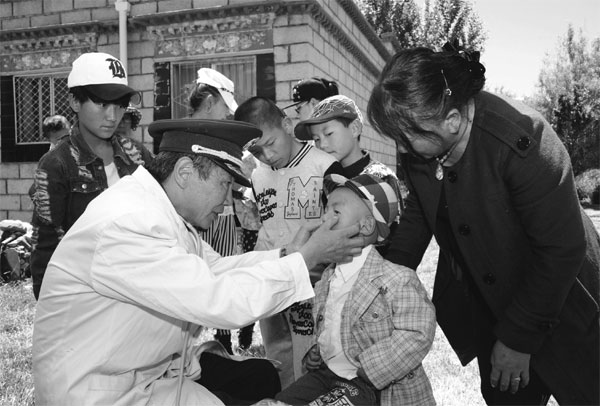
Doctor Li Suzhi leads a medical team visiting the SOS children's village in Lhasa on Children's Day in 2014. Provided to China Daily |