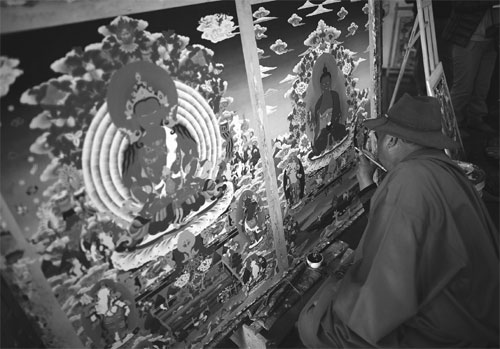
Thangka master guards ancient artform
Workshop offers free training to young people in traditional Tibetan Buddhist painting, reports Ren Qi in Garze, Sichuan province.
Great art often requires great sacrifice, and when it comes to thangka that can mean the artist risking the chance of a long, healthy life.
Thangka is a traditional Tibetan Buddhist craft that involves painting on a cotton or silk applique. Pieces serve as important aids in teaching about the life of Buddha, influential lamas and other deities.
"When you are practicing thangka, you need to put yourself into it, feel the soul of the thangka," artist Yungdrung Loyul said. "When coloring a thangka, the painter needs to put the brush into his or her mouth time to time, so the color is smooth and consistent.
"Lots of thangka painters have died in their 40s due to the way they painted and the toxic pigment (they ingested), but we never regret our choice to create thangka."
Yungdrung Loyul lives in Luhuo, a town in the Tibetan autonomous prefecture of Garze, southwestern Sichuan province, famous for thangka in the style of Langkajie, a master of the art born in 1610.
Despite the area's long history in the art, the number of people making thangka dwindled to fewer than 10 in the 1980s, leading to concern the art could one day disappear.
"A thangka is the elite technique of Tibetan traditional painting," said Yungdrung Loyul, director of the Association of Thangka Painting Artists. "But due to the lengthy learning process, many Tibetan youngsters choose instead to work in big cities, leaving this ancient art at risk of being lost."
To become a master in the craft can take an artist up to six years of arduous study, he said.
In 2007, he secured a bank loan of 50,000 yuan ($8,100 / GBP 5,300) to set up a workshop aimed at protecting the art for future generations, as well as a company to promote Luhuo's Langkajie-style thangka nationwide.
Yungdrung Loyul said there is now a growing demand for thangka at art markets in major cities, and added: "When my paintings were shown as part of an exhibition in Beijing, they received a warm welcome."
He has used the income from the company to recruit Luhuo youngsters to learn the craft, offering them free tuition, meals and accommodation.
"Today, families in Tibetan areas live better lives, and most wealthy parents want to send their children to large cities for further education," he said. "The young people who usually come to learn the art of thangka are from poor families, some with disabilities, so they are unable to have a normal job."
His workshop has more than 20 students, with the average age of 18. One of them is Dzekyid Lhamo, who has been studying the art for more than two years. "It's a process of willpower," the 17-year-old said. "But I don't think it's difficult. I like painting."
More than 50 young people have graduated from Yungdrung Loyul's workshop and are now working as professional thangka artists in cities such as Shanghai and Shenzhen.
After eight years, the company is also turning a profit. He said orders are flooding in every week, from all corners of China, helping to enrich the lives of his 200 painters, who produce at least one piece a month.
He said that one day he hopes to open a museum to display thangka masterpieces. "It's my dream that the museum will have more than 500 thangka, so more youngsters can enjoy and understand the art," he added.
|
A thangka artist at work in his studio. Many of the practitioners die in their 40s from exposure to the toxic pigment used in the ancient art form. Ren Qi / China Daily |