


Convenience stores to lead retail push
Improvement in business environment helps companies post robust growth rates, consider expansion
Convenience and online stores were the fastest-growing sectors in China's retail market last year, while hypermarkets and department stores lagged far behind, according to a report.
With smaller size and closer proximity to younger consumers, convenience stores clocked a 25 percent year-on-year growth in terms of sales. Online retail stores, on the other hand, grew by 48.7 percent, said the China Chain Store & Franchise Association.
|
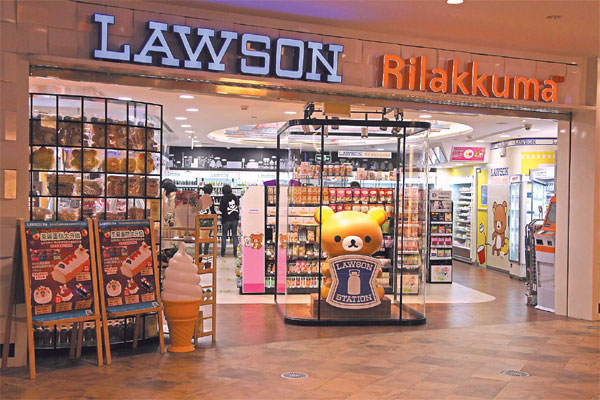
A Lawson convenience store in Shanghai. Lawson is the second largest convenience store chain in Japan, behind 7-Eleven. Provided to China Daily |
The number of convenience stores went up by 21.96 percent, while the number is 2.7 percent for department stores and 6.5 percent for hypermarkets.
Meiyijia convenience store, based in Dongguan, Guangdong province, topped the list of franchise chains with 6,390 outlets, followed by Shizu, Zhishang, based in Wenzhou, Zhejiang province, with 1,693. The Shanghai-based Family Mart, on the other hand, had 1,281 stores.
The growth comes mostly from the addition of the new stores, and a general improvement in the overall business environment which has made it conducive for convenience stores to expand, said Wang Hongtao, secretary-general of the convenience store division of the association.
Online retail has only had a minor impact on convenience stores compared to its significant influence on traditional outlets such as hypermarkets and department stores, he said, for reasons that consumers won't want to wait for merchandise that is often sold at convenience stores.
"If people want to drink Coke, they want to drink it now, not the next day delivered from the online retailer," said Wang.
The majority of consumers who come to convenience stores are young adults who are less sensitive to price, said Wang. The relatively smaller investment on an individual convenience store also encourages their expansion, he said.
Since entering China in 1996, Japanese convenience store operator Lawson China Holdings Co has formed a joint venture with Bailian Group, a local retailer in Shanghai, which has turned out to be a rather slow development. Lawson Inc is the second-largest convenience store chain in Japan behind 7-Eleven
Motonobu Miyake, senior vice-president of Lawson, said: "Sometimes we filed an application to open new stores, we found that our competitors already knew about the plan."
To save costs, the venture chose locations where rents are relatively lower and store space is small, which means many of their locations are not ideal. In 2005, when the number of stores had reached 300, Lawson decided to stop opening new stores. It also closed down some of the existing stores that were not profitable due to bad location and small operational space.
In 2011, Lawson China Holdings regained its controlling stake in the joint venture. After 2013, Lawson China Holdings has once again taken the expansion route due to the growing demand for convenience stores.
"However, the sense of insecurity always exists," said Miyake. "None of our convenience store operators in China would feel sure of their growth without constantly improvisation."
Despite the recent frenzy for hypermarkets and other retail formats to be diversified by joining the convenience store business, it is still a tough task for convenience stores to improve their store quality, which starts from key management and operations, said industry sources.
There is a huge gap in the daily sales of single convenience stores, with the highest being about 15,000 yuan ($2,420) and the lowest just 755 yuan. In the case of hypermarkets, the gap is much smaller, according to Pei Liang, secretary-general of the China Chain Store & Franchise Association.
The 2014 gross profit of convenience stores on average was 24.27 percent, much higher than hypermarkets and supermarkets, with the highest at 36.5 percent and lowest at 16.5 percent.
A person could visit a convenience store three times a day, sometime even without knowing very sure what he is looking for, said Miyake.
But the high frequency requires more updates on the merchandise portfolio. "If the customer does not find the things he wants during his visits, or sees the same products always, it is quite likely that he would not come again," said Miyake.
Lawson often removes unpopular items from the shelves and stops their production at the factory. On the other hand, it increases the output of its top-selling items, a strategy that helps manage costs, he said.
Miyake, who is also president of Lawson China Holdings, said the company plans to open 10,000 stores by 2025. About 50 percent of the new stores will be subsidiaries and the balance partially licensed ones.
Lawson is also moving into big cities like Beijing, Chongqing and Dalian with this model that focuses on collaborations with large-scale licensees. By doing so, if successful, it could expand businesses in the north, east and northeast markets.
According to the China Urban Convenience Store Index 2015 released by the association, the stores in the southern region of the country are better performers than the ones in the northern part, while coastal cities are better than the inland cities.
The index, based on data of convenience stores in 34 major and medium-sized cities in the country, found that Shenzhen and Guangzhou are the leaders while Fuzhou in Fujian province in the eastern region and Tianjin are the laggards in the ranking calculated on the basis of density, growth, conveniences and policy support.
Licensing has helped Lawson gain an edge in expansion and it seems the best option to increase its presence in China. "The profitability of convenience stores lies on their business scale and layout," Miyake said.
However, because of the large scale, it is really hard to roll out incentives to retain staff. Licensing would help solve this challenge, he said.
The experiences and know-how of the directly owned stores will be passed on to the licensed stores, providing them with updated products, logistics and management system, Miyake said.
Lawson's licensed stores take up half of their current 360 stores in Shanghai. In Japan, only 8 percent of their 12,000 stores are directly operated.
About 60 percent of operators have developed their own brand products. But this part of products takes much lower percentage of their total sales. The real task is how to improve the overall sales and gross profits, said Pei from the China Chain Store & Franchise Association.
Lawson is also working with large-scale licensees in local regions, especially those who know the area well, to identify good locations and to participate in the operations and management, as well as in building up self-owned brand food manufacturing.
Contact the writer at wangzhuoqiong@chinadaily.com.cn
















