


How to best narrow the income gap
Overall reform of taxation system needed to narrow excessive inequities in today's society
The recent joint report by UBS and PricewaterhouseCoopers says China has about 200 billionaires, almost one-third the number in the United States, while a report by China Merchants Bank and Bain shows the number of people with assets of more than 10 million yuan ($1.61 million) crossed 1 million at the end of 2014. And according to a National Health and Family Planning Commission survey, the income of China's top 20 percent high-income families is 19 times that of the lowest 20 percent low-income families.
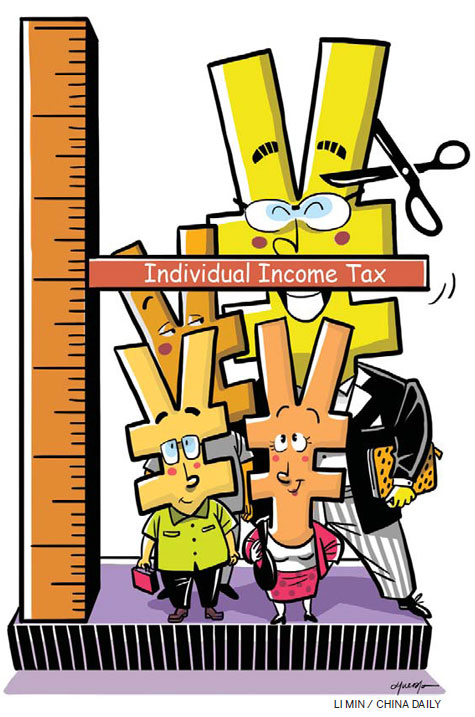
The question is: Can the income gap be narrowed through individual income tax?
Different views of fairness influence the choice of social policies. Today, most Chinese people do not accept the economically inefficient equalitarian view of fairness, because a society in which everybody earns the same amount of money lacks vitality and creativity, because contributions that increase social wealth fail to be recognized.
In a market economy, personal disposable capital, land and the labor factor differs, making a income gap a normal phenomenon. Even if individuals have equal opportunity in education and make the same efforts, their income could be different. But as long as society offers fair opportunities to all and everyone has a fair chance to increase his/her income through legal means, social arrangements have to be considered inclusive.
In the past, students from low-and middle-income families could become civil servants as long as they won admission to a college. Civil service offered a promising future with a decent salary and other welfare benefits. The problem is that even though it is easier for students to get higher education today, the number and ratio of students from rural areas and low-income families in key universities are declining, and graduates of non-key universities find it difficult to get a suitable job. And even if they get a job, their salary is usually low.
True, compulsory education is free in China, but, comparatively speaking, low-income families, especially in rural areas, pay a greater price to educate their children. The reason: Rural areas have few good schools, and some rural children have to go to towns or cities to receive education because many schools in villages have been closed down. This means extra expenditure on education, such as transport and other related costs. Moreover, in non-compulsory education periods, education expenditure is a heavy burden for low-income families. And if their children study in non-governmental colleges or art schools, the parents have to spend more.
But even after spending huge amounts of money on education, many graduates of non-key universities fail to land a job with a decent salary, which condemns low-income families to almost perpetual poverty.
Providing better public service for middle-and low-income people could reduce their expenditure on their children's education and create more opportunities for them to increase their incomes, which could help narrow the income gap.
The fact is, even a change in the individual income tax may not be able to help make the income distribution pattern fairer on a large scale. Last year, individual income tax accounted for only 6.19 percent of China's overall tax revenue, which means it plays a limited role in adjusting income distribution. And since the highest salary tax rate is already 45 percent - for incomes of 80,000 yuan a month and above, increasing it further for a fairer distribution of income will not be conducive to attracting competitive talent.
Also, the widespread practice of cash transactions prevents the individual income tax from helping make income distribution fairer. Some high-income individuals, especially private business owners, use cash to pay lower individual income taxes. Therefore taxation authorities should work with financial organizations to bring all high-income individuals under the umbrella of the individual income tax system. If that is done, individual income tax revenue could increase even if the individual tax burden for low- and middle-income families is reduced.
But there is no better way of narrowing the income gap than the overall reform of the taxation system.
The author is a researcher with the National Academy of Economics Strategy, affiliated to the Chinese Academy of Social Sciences. The views do not necessarily reflect those of China Daily.
















