


Breaking the infrastructure finance mold
AIIB has opportunity to invest in longer-term projects, work more closely with partners
Creation of the Asian Infrastructure Investment Bank is justified by the unique role it will play in global infrastructure funding, says Chen Huan, deputy head of the working group implementing creation of the bank.
Chen was speaking at a July 2 conference at the University of Oxford on infrastructure investment in emerging markets and developing economies, attended by about 100 industry practitioners and academics.
|
President Xi Jinping and representatives from founding countries of the AIIB at the signing ceremony to establish a legal framework for the lender. Wu Zhiyi / China Daily |
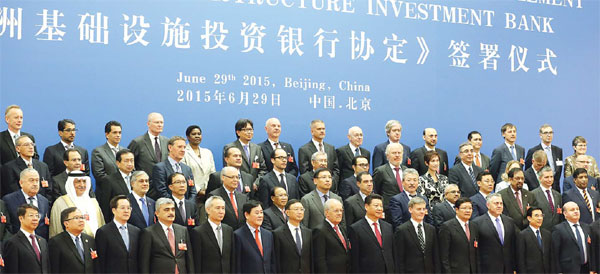
The AIIB, proposed by China in 2013, has a large membership consisting of almost all Asian countries. Most major countries outside Asia have joined, except the United States, Japan and Canada.
The official signing ceremony establishing the bank took place on June 29 in Beijing. On July 6, Jin Liqun, who worked at the World Bank and the Asian Development Bank on China's behalf, was nominated for head of the AIIB.
While there already are many multinational development banks, Chen says the focus of the AIIB will be unique, specializing in innovative methods to mobilize private sector capital to invest in multinational infrastructure projects.
"In this sector, we do have money, but the private sector is reluctant to invest because we lack a platform to mobilize resources. Often the private sector finds projects too risky because of a lack of systems, policy and framework in place for them to invest," he says.
This needs to be addressed by the AIIB so that private sector capital will follow projects the bank has chosen, he says.
The AIIB will complement existing multinational development banks because it focuses specifically on infrastructure, whereas other institutions may have wider goals such as poverty reduction, Chen says.
The mandate of the AIIB also is unique in its directive to invest in both greenfield and brownfield projects, whereas the World Bank and Asian Development Bank only invest in greenfield projects.
Greenfield projects lack constraints imposed by prior work such as land development. Brownfield projects take place where there has been some prior work or development - the term originally was used to describe reclamation of industrial land.
Chen says, as a new institution, the AIIB would not compete with existing institutions, because in its initial phase its funding costs might be higher as a result of the time necessary to establish a good credit rating.
The AIIB will welcome any country that wishes to join, he says. "We will be open to all countries. From day one, we make it to clear to the international community that we are open and transparent," he says.
The AIIB will set up a board to make decisions regarding specific projects, but in general it will focus on areas including energy, transport, urban development, rural development and logistics.
It will focus on both traditional and renewable energy, while in transport, it is anticipated it will cover a wide range of projects including roads, highways and light railways. In rural areas, it will address needs such as irrigation, and urban projects would cover such areas as sewage systems, water supplies, energy conservation and buildings, he says.
Chen says the key goal is to use investment and global best practices to support the development and operation of new and existing infrastructure in a cost-effective and timely manner.
Second, it hopes to encourage project innovation through its expertise and by working with international partners, making the best use of each organization's abilities.
Third, Chen says it is important to integrate the environmental and social sustainability of projects. Finally, he says it is essential to provide insight on emerging market issues to help drive infrastructure development and interconnectivity in Asia.
Establishment of the AIIB has been greeted by great support and high expectations from the international community, he says.
Gordon Clark, a professor and director of the Smith School of Enterprise and the Environment at the University of Oxford, says he thinks the AIIB can provide efficiency and long-term perspective to infrastructure financing.
"There is significant shortfall of funding, so adding another infrastructure bank can help address that issue, and it also makes the process of bringing solutions to market a lot easier," Clark says.
The key problem with much of today's infrastructure funding is its tendency to focus on short-term returns, because there is too much political pressure to produce results, he says.
But the AIIB, as a new institution, has the opportunity to set up its mandate with a long-term focus, so instead of measuring success over three to five years, for example, they could set performance targets for a 10-year period, he says.
"Because there is a lot of pressure for existing institutions to have successful projects, which are also cost-effective, transparent and accountable, they often invest in projects that can realize benefits easily. But for larger and more complicated projects that make a big difference to economic development, it is not so easy to produce these quick results," Clark says.
Alex Wong, head of global strategic infrastructure initiative at the World Economic Forum, says the emergence of an additional multinational institution such as the AIIB can introduce fresh ways of thinking and innovation.
"The AIIB is another major institution that can fill in some missing pieces of the puzzle, and leadership from China in the AIIB is very helpful, because infrastructure development is not a funding issue but is about political leadership," Wong says.
He says a new institution with strong political support is very welcome. "They have a chance to change the way things are done," he says..
It is important for the AIIB to embrace a multi-stakeholder approach from the beginning, he says, and the fact that the AIIB has been "open, inclusive and transparent" in how it has allowed all countries to participate in the organization is a good start.
Eswar Prasad, a senior fellow at the Brookings Institution and a former chief of the International Monetary Fund in China, says: "It is commendable that the AIIB aspires to set high standards of governance and transparency that will allow it to serve as a good example for the existing multilateral institutions."
Jean-Marc Aboussouan, chief of the infrastructure division and the structured and corporate finance department at the Inter-American Development Bank, says he hopes the AIIB will help to bring diversity to the global funding environment.
He says there would be many opportunities for AIIB to work with existing regional development banks that already have good knowledge and contacts with local government and project leaders.
Aboussouan says that while there are many good opportunities to invest in projects in Asia, the AIIB should take a leading role in working with local governments and projects to set up a framework for private sector players to feel confident about investing.
"The legal framework, and necessary reforms and policies, must be put in place, and the presence of multinationals such as the AIIB in such projects gives that comfort for private sector players. It would be a stamp of confidence," Aboussouan says.
Contact the writers at cecily.liu@chinadaily.com.cn and zhangchunyan@chinadaily.com.cn
















