


Li signals stronger economic reform
China's premier amends blueprint as he attempts to boost growth and strengthen domestic demand
When Premier Li Keqiang greeted New Zealand Governor-General Jerry Mateparae in a Uygur-style room in the Great Hall of the People in Beijing on July 22, he probably didn't expect the high-level bilateral talks to devolve into a question and answer session about China's economic reforms.
While it's customary for international leaders to inquire about the latest news on the Chinese economy - it's an issue that has ramifications for all nations, after all - Mateparae probed a little deeper below the surface of GDP growth and discussed the underlying health of the economy.
Li's message to his guest, and the world at large, was that implementing reforms is a tough, multifaceted job, but that the government is determined to push the changes through, including major reforms such as the reduction of the government's role in the economy and improvements to the financial sector.
Li began restructuring the world's second-largest economy when he assumed office in 2013. The reforms, their progress and the chances of success, are at the top of the list of concerns for the central leadership - and other world leaders, given the strength of the Chinese economy in an increasingly interlinked and globalized world.
Li is almost halfway through his first five-year term and the reforms are continuing. So far, the signs have been encouraging. In the first half of the year, the economy showed signs of growing robustness, with better-than-expected growth of 7 percent.
Momentum expected
Zhao Zhenhua, an economist at the Party School of the Central Committee of the Communist Party of China, says consumer prices are still too low. However, the economy is stabilizing after a tough start to the year, and stronger momentum can be expected in the second half because pledged investment is now feeding into the economy, and the freshly streamlined bureaucracy has started to have a positive impact on business, Zhao adds.
That success has been hard-won, especially given the disappointing economic data that confronted Li in the early part of the year, Zhao says. The credit- and investment-fueled economy seemed to have lost steam - the volume of rail freight, for example, fell by 9 percent in the first quarter. Some observers see the decline as a blow to the premier, because Li, who holds a doctorate in economics, used that figure to gauge economic performance when he was a provincial governor.
Furthermore, China's economic difficulties have been compounded by a hands-off approach in terms of local government administration, and by stronger environmental awareness among the public, which has resulted in a number of controversial projects being abandoned.
A sweeping anti-graft campaign has also produced contrasting results by dissuading corrupt officials from illegal practices, but also by making some officials reluctant to do their jobs for fear of being accused of abuse of power.
High-energy-consuming factories have been phased out to cut excessive industrial capacity, which resulted from a frenzy of investment during the 2008 global financial crisis. Last year, nearly 10,000 businesses in Hebei province were forced to shut down.
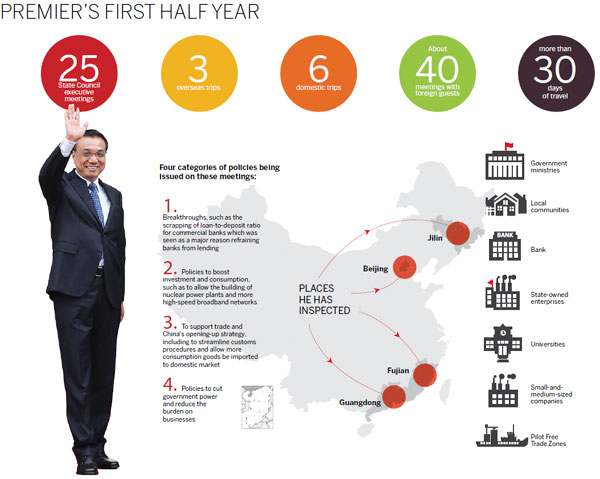
A closer look at this year's State Council executive meetings, a weekly working conference presided over by the premier to discuss essential issues with members of his Cabinet, provides an insight into Li's methods.
By the end of July, Li had held 17 executive meetings that mainly focused on four areas of reform.
First, seven new policies will be implemented to smash institutional barriers and free businesses from bureaucracy, including the cancellation of the outdated loan-to-deposit ratio for banks, which was seen as one of the factors that prevented banks from lending.
Second, policies have been formulated to encourage investment and consumption to boost economic growth. The moves will include the construction of faster Internet broadband networks to facilitate e-commerce, and will also entail massive infrastructure construction and the use of a huge amount of raw materials.
The third thread centered on the promotion of trade, and greater opening-up. A wider range of popular Western products will be imported to boost domestic demand and reverse the outflow of hard currency by Chinese tourists traveling overseas.
Raising efficiency
Niu Li, director of the Macro Projection Department at the State Information Center, says the first three sets of amendments will be useless unless progress can be made on the fourth - greater government efficiency and less intervention in the market.
"Easier administrative procedures, as well as streamlined customs procedures, will lay the basis for the other developments," he says. "That's why this theme was reflected in the majority of topics under discussion. That shows it has a high priority on Li's agenda."
Niu describes the restructuring program as a way of balancing long-term gain with short-term pain, as Li attempts to use a consumption-driven, services-oriented growth model to spur economic expansion to provide jobs and boost incomes.
"The once-turbocharged Chinese economy is on the verge of slipping further, after growing at its slowest pace for nearly a quarter of a century, and the situation in the backwaters, where the restructuring program was implemented later, is even worse," he says.
For example, coal-rich Shanxi province is being hit by both the restructuring of the local economy and the global commodity recession. "The provincial economy grew less than 5 percent last year and has fallen well below the potential growth rate," he says.
Zhao from the Party school echoed Niu's comments. "An accidental break in one link of the chain could lead to a butterfly effect," he says, adding that the problem has been in evidence in the recent stock market downturn, which he described as a "semi-financial crisis", which has revealed deficiencies in the financial system and underlined the "immature mentality" of retail investors in China.
"One lesson we can learn from the stock plunge is that institutional defects in our economic system and the risks that underline them should not be underestimated, no matter how far we have moved forward in other aspects," he says. "The leadership must be aware that the continuation of unfinished reforms, including reform of the capital market, is the proper approach to avoid future hazards."
In a recent article on the Financial Times website, Henry Paulson, former US treasury secretary and the author of Dealing with China, said maintaining the present "halfway house" will make it harder for China to avoid the middle-income trap that has prevented many emerging markets from developing into prosperous economies. Paulson concluded by saying that China's top policymakers will be aware that they will have to expend even more energy to achieve the reform agenda laid out 20 months ago.
zhaoyinan@chinadaily.com.cn
















