


Monkey see, humans do
Eight great places to watch playful primates go wild in the wild
"Emei's elves" are thieves. Indeed, it wasn't my wife who was rustling through the pack on my back.
It was a Tibetan macaque.
|
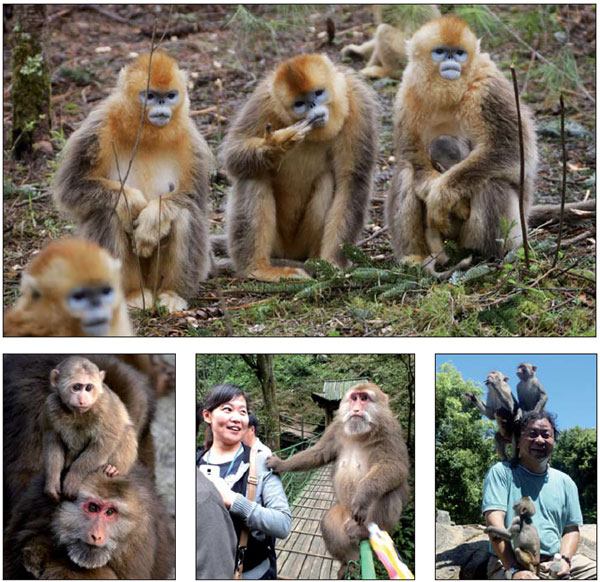
Wild primates that frolic at tourism destinations around China include (clockwise from top) golden monkeys in Hubei's Shennongjia, macaques on Hainan's Nanwan Monkey Island, Tibetan macaques in Sichuan's Emei Mountains and Huangshan stump-tailed macaques on Anhui's Huangshan Mountains. Photos by Wen Zhenxiao / Huang Yiming / Zhao Renbao / Liu Bingsheng / For China Daily |
(My spouse, for the record, is human.)
The animal was up to its furry armpit, swishing around for the peanuts in my bag.
I asked Carol what she wanted - then noticed her some distance away.
I turned around to find myself staring into its eyes.
Not hers.
A tug-of-war ensued.
I guess it makes sense you'd wield upper body strength disproportionate to your size if you performed treetop acrobatics all day.
(I still won. Barely.)
The monkeys on Sichuan province's Emei Mountains are colloquially known as "little beggars".
More like "little burglars".
That said, I chased another species out of our tree house in Yunnan province's Xishuangbanna before it could snatch anything.
Primates flash-flooded around - sometimes over - our feet at Qianling Mountain Park in Guizhou province's capital, Guiyang, where they're the main attraction. Some napped while limpidly draped over signs advertising their presence, without any sense of irony.
We homo sapiens perhaps love monkeys because they sway from a nearby branch of our evolutionary tree.
They're cousins that call for family reunions, typically via ecotourism.
China is home to about a dozen species - plus one ape group, the gibbon - that entice travelers every year.
They hold a special place in Chinese culture, making the cut of the 12 creatures esteemed as worthy of zodiac reverence.
In the spirit of the Year of the Monkey that begins on Feb 8, we explore China's best destinations to visit the primates that climb close to us up the web of life.
1 Monkey Island
Nanwan Monkey Island is a place where trained macaques reportedly greet guests with salutes and flags.
Yet they lack discipline and often break formation or even squabble at the site in Lingshui county, in southeastern Hainan province.
Most simian denizens of the country's only macaque reserve are truly wild.
And, apparently, love to dive and swim.
2 Lianyungang
Jiangsu province's Huaguo Mountains are peaks upon which some monkeys frolic. Others are frozen in stone.
The living primates scuttle up sculptures of the mischievous Monkey King, the protagonist of one, and arguably the zaniest, of China's four great novels, Journey to the West.
The heights are said to be the saucy superhero's home.
Visitors can pose with a trained monkey dressed as the Monkey King in front of the Water Curtain Cave through which the deity dashed to become supreme ruler of his kind. That is, before splashing through to the other side, cultivating magical powers and questing to India.
3 Shennongjia
Golden monkeys scamper through this forest reserve in Hubei province.
Legend whispers that another primate lumbers along this territory: the Yeren, or Wild Man, China's Big Foot.
That said, the place itself is named after a pseudomythical horned pharmacologist from whom all ethnic Han are believed to have descended.
Shennong is like a Chinese Abraham with an ox scalp, who gobbled unidentified herbs to discover if they wielded medicinal purposes - or poison. (It's said his intestines ruptured, fatally, after he digested a toxic yellow flower.)
The Unesco World Biosphere Reserve remains a botanist's playground.
Roughly 3,500 species of flora flourish. So do golden monkeys and, perhaps consequently, the lore of Yeren.
4 Foping
Snub-nosed monkeys play supporting roles to the stars of Shaanxi province's Foping National Nature Reserve, the world's densest wild panda population.
Exceedingly rare brown-and-white giant pandas, leopards and Asiatic black bears also amble over this wilderness.
Red-and-white giant flying squirrels sail through its canopies, while takin, which look like a cross between a goat and an ox, trot atop its soil.
5 Zhouzhi
The Qinling Mountains' golden snub-nosed monkeys are blue in the face - especially their lips.
The reason for their visage's complexion remains unknown.
Their flat features are likely an adaptation to prevent frostbitten proboscises.
The species' Latin name, Rhinopithecus roxellana, is said to hail from their resemblance to a 1500s concubine with a squashed schnoz.
About 4,000 of these primates roam the Zhouzhi nature reserve in Shaanxi province in bands of up to 400.
6 Gaoligong
Assorted gibbons, langurs and macaques scuttle through the Gaoligong Mountains.
The Unesco World Biosphere Reserve in Yunnan province bristles with one of the country's best-preserved woodlands.
Clouded leopards, red pandas and pangolins also prowl its topography.
A critically endangered snub-nosed monkey species, Rhinopithecus strykeri, was discovered there in 2011.
7 Chongzuo
Chongzuo Ecology Park is where you can stand shoulder-to-shoulder with scientists from the elite Peking University to observe black-headed langurs and white-headed leaf monkeys only found in the Guangxi Zhuang autonomous region.
The research base near the road is open to the public.
Simians snooze in caves at night and jet across hilltops during daytimes.
8 Zhangjiajie
Monkeys swirl among 8,000 stone shards of this terrain, which inspired the extraterrestrial world featured in the blockbuster Avatar.
Both the film and actual place - a Unesco World Heritage Site - are otherworldly landscapes occupied by primates who, well, aren't us but are pretty proximate.
That is, almost human, but not quite.
erik_nilsson@chinadaily.com.cn
















